Question 1Growth in living things is brought about by theA.deposition of new material from the surroundingsB.synthesis of new material from within the bodyC.absorption of water and mineralsD.elasticity of the cellObjective Show full explanation
Question 2In unicellular organisms, the structure responsible for reproduction isA.CytoplasmB.LysosomeC.MitochondrionD.NucleusObjective Show full explanation
Question 3The head-foot is a structure mostly found inA.MolluscaB.ReptileC.AnthropodaD.AmphibiaObjective Show full explanation
Question 4Which of the following flatworms is free-living?A.TapewormB.PlanariaC.LiverflukeD.AscarisObjective Show full explanation
Question 5In which of the following is a diploblastic level of specialization found?A.Phylum platyhelminthesB.Phylum NematodeC.Phylum AnnelidaD.Phylum CoelenterateObjective Show full explanation
Question 6Seed-producing vascular plants belong to theA.Phylum ThallophytaB.Phylum SpermatophyteC.Phylum PteridophytaD.Phylum BryophytaObjective Show full explanation
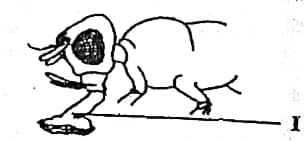
Question 7Use the diagram below to answer questions 7 and 8 The mouthparts represented are for theA.ButterflyB.MosquitoC.TermiteD.HouseflyObjective Show full explanation
Question 8 Use the diagram below to answer questions 7 and 8 The part labeled I is theA.MaxillaB.Maxillary palpC.ProboscisD.LabrumObjective Show full explanation
Question 9The streamlined body of birds is an adaptation forA.SwimmingB.FlightC.FeedingD.DefenceObjective Show full explanation
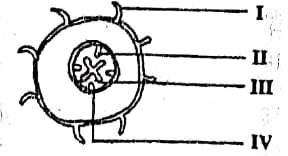
Question 10Use the diagram below to answer questions 10 and 11 The diagram represents the transverse section of aA.Dicot rootB.Monocot rootC.Dicot stemD.Monocot stemObjective Show full explanation
Question 11Use the diagram below to answer questions 10 and 11 The part that absorbs nutrients from the soil is labeledA.IB.IIC.IIID.IVObjective Show full explanation
Question 12The part of the mammalian alimentary system where protein is finally digested is theA.DuodenumB.JejunumC.IleumD.RectumObjective Show full explanation
Question 13When a cell is placed in a hypertonic solution, it willA.Retain its normal sizeB.Reduce in sizeC.Increase in sizeD.BurstObjective Show full explanation
Question 14An organism with an open transport system isA.GrasshopperB.EarthwormC.RatD.LizardObjective Show full explanation
Question 15Gaseous exchange in tadpoles take place in theA.LungsB.GillsC.MouthD.OperculumObjective Show full explanation
Question 16In plant, the end product of the breakdown of glucose in the absence of oxygen isA.EtheneB.Lactic acidC.EthanolD.Pyruvic acidObjective Show full explanation
Question 17The red color of petals in plants result from deposits ofA.ResinsB.TanninsC.AnthocyaninsD.OilsObjective Show full explanation
Question 18Which of the following vertebrae is found in the waist of a man?A.CaudalB.CervicalC.SacralD.LumbarObjective Show full explanation
Question 19The main feature of pentadactyl is the presence ofA.Five phalangesB.Three tarsalsC.Four carpalsD.Five metacarpalsObjective Show full explanation
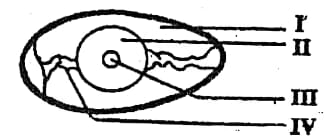
Question 20 Use the diagram below to answer questions 20 and 21 The part that will develop into a chick is labelledA.IB.IIC.IIID.IVObjective Show full explanation
Question 21 Use the diagram below to answer questions 20 and 21 The part labelled I is theA.YolkB.ShellC.ChalazaD.AlbumenObjective Show full explanation
Question 22Which of the following is the correct sequence of growth in multicellular organismsA.Cell enlargement → cell division → cell differentiationB.cell differentiation → cell division → cell enlargementC.Cell division → cell differentiation → cell enlargementD.Cell division → cell enlargement → cell differentiationObjective Show full explanation
Question 23Which of the following produces secretions that help in controlling the level of calcium in the bloodA.GonadB.ParathyroidC.PancreasD.Pituitary glandObjective Show full explanation
Question 24Edaphic ecological factors relate toA.WaterB.SoilC.The topographyD.The atmosphereObjective Show full explanation
Question 25The abiotic factor common to all habitats isA.turbidityB.salinityC.rainfallD.humidityObjective Show full explanation
Question 26The instrument used for measuring relative humidity is aA.pooterB.pH meterC.hygrometerD.hydrometerObjective Show full explanation
Question 27Which of the following is an ectoparasite of a cow?A.houseflyB.ascarisC.tickD.taeniaObjective Show full explanation
Question 28Excess carbon (IV) oxide in the atmosphere could lead toA.global warmingB.high rainfallC.algal bloomD.condensationObjective Show full explanation
Question 29Trees that are resistant to fire and drought are commonly found in theA.Tropical rainforestB.SavannaC.desertD.Montane forestObjective Show full explanation
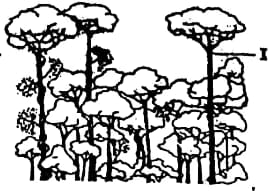
Question 30 The illustration shows the vegetation profile in aA.Guinea savannaB.Tropical rainforestC.Sudan savannaD.Mangrove swampObjective Show full explanation
Question 31The tree labelled I is part of theA.Upper canopyB.lower canopyC.emergentsD.shrubsObjective Show full explanation
Question 32A population is said to have reached equilibrium if itA.no longer faces competitionB.has attained its carrying capacityC.is declining with timeD.has exceeded its carrying capacityObjective Show full explanation
Question 33The organisms that help to increase soil fertility includeA.termite, butterfly larvae, earthworms and bacteriaB.bacteria, termites, domestic fowls and fungiC.earthworms, termites, bacteria and fungiD.earthworm, spiders, bacteria and fungiObjective Show full explanation
Question 34In an experiment to determine the percentage of water in a soil sample, the following data were obtained: \n Mass of crucible = X1g \n Mass of crucible and soil = X2g \n Mass of crucible and soil after heating = X3g \n What is the amount of soil water?A.(X3 - X2)gB.(X2 - X3)gC.(X3 - X1)gD.(X2 - X1)gObjective Show full explanation
Question 35The spread of tuberculosis is favoured byA.MalnutritionB.contaminated waterC.air pollutionD.overcrowdingObjective Show full explanation
Question 36Conservation of wildlife can be enhanced byA.intensified poultry farmingB.legislating against poachingC.house-to-house campaignD.planting various species of plantsObjective Show full explanation
Question 37A man with blood group B is married to a woman with blood group AB. Which of the following blood group combinations is possible in their children?A.B, O, ABB.B, A, ABC.B, A, OD.AB, A, OObjective Show full explanation
Question 38The differences observed in the height and weight of 30 pupils of the same age are a result ofA.mutationB.variationC.segregationD.evolutionObjective Show full explanation
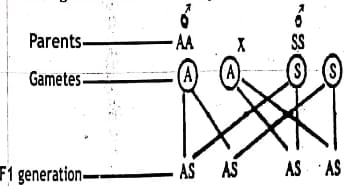
Question 39Use the diagram below to answer questions 39 and 40. In the F generation, all the offspring areA.affectedB.carriersC.normalD.carriers and affectedObjective Show full explanation
Question 40Use the diagram below to answer questions 39 and 40. The gametes produced areA.50% normal, 50% affectedB.100% affectedC.100% normalD.75% normal, 25% affectedObjective Show full explanation
Question 41A couple have six children which are all boys. The probability that their next child will be girl isA.1⁄4B.1⁄2C.3⁄4D.1⁄6Objective Show full explanation
Question 42The result of mating between a colour-blinded male (XY) and a normal female (XX) isA.3 carrier females:1 normal maleB.1 normal female:3 carrier malesC.2 normal females:2 carrier malesD.2 carrier females:2 normal malesObjective Show full explanation
Question 43Which of the following is responsible for contributing the chromosomes that determines the sex of an unborn offspring?A.the fatherB.the motherC.the grandfatherD.the grandmotherObjective Show full explanation
Question 44Competition may occur in a rice field ifA.the environemental temperature increasesB.the field become weedyC.nematodes are absentD.nematodes are presentObjective Show full explanation
Question 45Communities at early successional stages are often characterized byA.high competitive abilityB.high biological diversityC.low productivityD.high productivityObjective Show full explanation
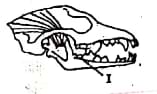
Question 46Use the diagram below to answer questions 46 and 47. The structure labelled I isA.a canineB.an incisorC.a premolarD.a molarObjective Show full explanation
Question 47Use the diagram below to answer questions 46 and 47. The dentition is that of a typicalA.herbivoreB.omnivoreC.carnivoreD.granivoreObjective Show full explanation
Question 48In which of the following is countershading likely to be exhibited?A.a fish that lives at the bottom of a pondB.a mammal tha lives in a holeC.a rodent that lives on the canopy of a treeD.a bird that lives at the bank of a riverObjective Show full explanation
Question 49The fertile castes of termites consists of theA.winged reproductives, king and queenB.workers, soldiers and kingC.workers, king and queenD.winged reproductive, soldiers and workersObjective Show full explanation
Question 50A theory of evolution based on the observation that individuals of the same species always show variations was proposed byA.MendelB.CrickC.LamarckD.DarwinObjective Show full explanation