Question 0In spirogyra, the pyrenoidA.excretes waste productsB.is suspended by cytoplasmic strandsC.is mainly used for respirationD.usually contains starchE.makes the plants slimy to touchObjective Show full explanation
Question 0In which of the following groups of animals are flagella and cilia found?A.FlatwormsB.AnnelidsC.CoelenteratesD.protozoaE.NematodesObjective Show full explanation
Question 0Which of the following is seed bearing?A.MossesB.Whistling pineC.Algal filamentD.liverwortE.Fern frondsObjective Show full explanation
Question 0Each of the following is an anthropod EXCEPT theA.crabB.spiderC.snailD.milipedeE.cockroachObjective Show full explanation
Question 0In fish the sense organs which detect movements in water are located within theA.gillsB.operculumC.nostrilsD.median finE.lateral lineObjective Show full explanation
Question 0Euglene is an autotrophic organism because itA.has flagellaB.has plant and animal featuresC.is found in waterD.can manufacture its foodE.move fastObjective Show full explanation
Question 0which of the following is NOT true of mucor? itA.contains chlorophllB.grows saprophyticallyC.bears spores in sporangiumD.consist of hypaeE.reproduces by conjugationObjective Show full explanation
Question 0Bryophtes are different from flower because theyA.live in moist habitaB.are small plantsC.reproduce sexually and asexuallyD.have small leavesE.have no vascular tissueObjective Show full explanation
Question 0At what stage in the life history of a toad is its mode of breathing similar to that of fish?A.Tadpole stageB.External gill stageC.Adult stageD.Internal gill stageE.Larval stageObjective Show full explanation
Question 0In lower plants like mosses, the structure which performs the functions of roots of higher plants is calledA.root hairsB.rootletsC.hypaeD.rhizoidsE.thalliObjective Show full explanation
Question 0In an angiosperm leaf, the xylem isA.beside the phloemB.surrounded by trhe phloemC.above the phloemD.around the phloemE.in separate bundles from the phloemObjective Show full explanation
Question 0A group of similar cells performing the same function isA.an organB.a systemC.a tissueD.an organelleE.an enzymesObjective Show full explanation
Question 0Which of the following is common to a dicotyledonous stem and monocotyledonous root?A.Medullary raysB.Central pithC.Wide cortexD.Narrow cortexE.Pericycle fibresObjective Show full explanation
Question 0Which of the following represents the sequence of protein hydrolysis? 1. polypeptides 2. Amino acides 3. Proteins 4. PeptonesA.3 → 1 → 2 → 4B.3 → 2 →4 → 1C.3 → 1 →2 → 4D.3 → 4 → 1 → 2E.3 → 1 → 4 → 2Objective Show full explanation
Question 0A food substance which produces red colouration with Sudan III containA.proteinB.sugarC.starchD.celluloseE.fatObjective Show full explanation
Question 0If calcium is deficient in food this may causeA.anaemiaB.retarded growthC.sterilityD.goitreE.beri-beriObjective Show full explanation
Question 0Partially digested food ready to leave the stomach is referred to asA.chymeB.curdC.glycogenD.pasteE.roughageObjective Show full explanation
Question 0The function of lymph nodes is toA.supply oxygenB.filter out bacteriaC.form red blood cellsD.supply amino acidsE.supply simple sugarsObjective Show full explanation
Question 0The vein which returns blood from the head and arms to the heart is calledA.aortaB.inferior vena cavaC.superior vena cavaD.pulmonary veinE.pulmonary arteryObjective Show full explanation
Question 0Blood platelets are important because they areA.amoeboid and nucleatedB.produce antitoxinsC.produce antibodiesD.digest harmful bacteriaE.release thrombin for blood clothingObjective Show full explanation
Question 0If a child can receive blood from all donors , he belongs to the blood groupA.OB.AC.BD.ABE.ASObjective Show full explanation
Question 0Which of the following events does NOT occur during anaerobic respiration of glucose?A.Muscle cells produce lactic acidB.Carbon dioxide is producedC.Milk bacteria produce lactic acidD.Energy is not producedE.Germinating seeds produced alcoholObjective Show full explanation
Question 0Identify which of the following are characteristics of the vertebrate respiratory surface 1. Moist 2. Vascularized 3. Semipermeable 4. Freely permeable 5. DryA.1, 2, 3B.1, 2, 5C.2, 3, 5D.2, 4, 5E.1, 3, 5Objective Show full explanation
Question 0In mammals, the function of the sebaceous gland is toA.produce sweatB.secrete sodium chorideC.secrete waterD.produce an oily substanceE.manufacture vitamin D for the skinObjective Show full explanation
Question 0Which of the following organs regulates the amount of amino acids and glucose in the body?A.KidneyB.LiverC.pancreasD.SpleenE.StomachObjective Show full explanation
Question 0Movements and positions of the head in man are detected by theA.cochleaB.malleusC.utriculusD.semicircular canalsE.outer earObjective Show full explanation
Question 0The appendicular skeleton is made up of theA.limbsB.skull and limbsC.phalangesD.ulna and radiusE.girdles and limbsObjective Show full explanation
Question 0The maize grain is a fruit and not a seed because itA.has a large endospermB.is formed from an ovaryC.is a monocotyledonD.has no plumule and radicleE.has a hypogeal germinationObjective Show full explanation
Question 0If a flower is protandrous then itA.must be unisexualB.has an undeveloped androeciumC.has no androeciumD.must be insect-pollinatedE.can prevent self pollinationObjective Show full explanation
Question 0For pollen to be released in Crotalaria the insect must depress theA.wingB.keelC.standardD.antepetalous stamenE.antesepalous stamenObjective Show full explanation
Question 0Irish potato is aA.bulbB.tap rootC.rhizomeD.root tuberE.stem tuberObjective Show full explanation
Question 0The characters by which an organism is recognized are termed itsA.phenotypeB.genotypeC.morphologyD.anatomyE.physiologyObjective Show full explanation
Question 0The hereditary material in a cell is known asA.ADPB.CNSC.RNAD.ATPE.DNAObjective Show full explanation
Question 0A young plant showing yellow leaves is likely to be deficient inA.calciumB.magnesiumC.potassiumD.boronE.molybdenumObjective Show full explanation
Question 0Germination which results in the cotyledons being brought above ground is calledA.hypocotylB.epicotylC.epigealD.hypogealE.plumuleObjective Show full explanation
Question 0The mammalian endocrine system is responsible forA.transmitting impulseB.regulating body temperatureC.regulating osmotic pressure of bloodD.chemical co-ordinationE.the manufacture of bloodObjective Show full explanation
Question 0An old man is likely to be long-sighted because age affects theA.optic nervesB.retinaC.ciliary musclesD.corneaE.aqueous humourObjective Show full explanation
Question 0In mammals, stimulus is transferred from the receptor muscles to the central nervous system through theA.motor neuronsB.effector musclesC.dendritesD.sensory neuronsE.synapsesObjective Show full explanation
Question 0A relationship between living organisms which is of mutual benefit isA.parasitismB.saprophtismC.ecosystemD.symbiosisE.commensalismObjective Show full explanation
Question 0Which of the following food chains is in the correct sequence?A.Weeds → Tadpole → Beetles → Fish → ManB.Weeds → Tadpole → Fish → Beetles → ManC.Tadpole → Beetles →Weeds → Man → FishD.Man → Fish → Beetles → Tadpole → WeedsE.Fish → Beetles → Weeds → Man → TadpolesObjective Show full explanation
Question 0The primary and secondary hosts respectively of bilharzia areA.fish and manB.man and dogC.snail and manD.man and snailE.fish and snailObjective Show full explanation
Question 0Which of the following is NOT caused by bacteria?A.CholeraB.GonorrhoeaC.TuberculosisD.OnchoceriasisE.TyphoidObjective Show full explanation
Question 0Tsetse fly is harmful to man because it is associated with the spread ofA.river blindnessB.malariaC.sleeping sicknessD.leprosyE.dysentryObjective Show full explanation
Question 0Soil erosion CANNOT be controlled byA.planting cover cropsB.contouring of sloping groundC.terracing of slopesD.laying of mulchE.burning of bushObjective Show full explanation
Question 0Water retention is highest in soils which are rich inA.sand, poor in humus and devoid of clayB.clay and sand, but poor in humusC.clay and humus, but poor in sandD.clay, poor in humus and devoid of sandE.sand and humus, but poor in clayObjective Show full explanation
Question 0The origin of mineral particles in the soil isA.humusB.waterC.micro-organismsD.weathered rockE.organic matterObjective Show full explanation
Question 0Atmospheric nitrogen is directly replenished in nature throughA.the activities of denitrifying bacteriaB.the breakdown of ammonium salts in the soilC.the activities of nitrifying bacteriaD.the activities of nitrogen-fixing bacteria in root nodulesE.egestion, death and decayObjective Show full explanation
Question 0The initial volume of water poured into 60g bag of dry soil was 50ml and the amount that drained through was 35ml. The percentage water content of the fully soaked soil is thereforeA.46.7B.25.0C.20.0D.30.0E.58.3Objective Show full explanation
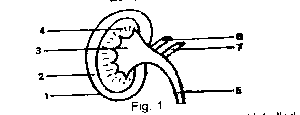
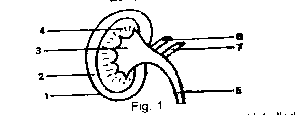
Question 0Bowman's capsule are located in the part labelledA.1B.2C.3D.4E.5Objective Show full explanation
Question 0Reabsorption of useful materials takes place in the part labelledA.1 and 3B.3 and 5C.5 and 6D.6 and 7E.2 and 4Objective Show full explanation