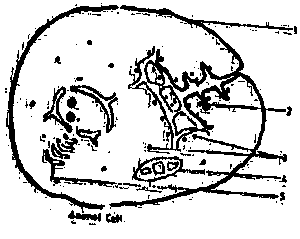
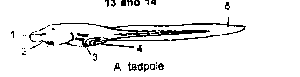
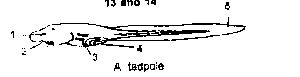
Question 0Which of the following structure is associated with aerobic respiration?A.1B.2C.3D.4E.Objective Show full explanation
Question 0The structure labelled 5 is used forA.protein synthesisB.energy productionC.secretionD.excretionE.Objective Show full explanation
Question 0Angiosperms and gymnosperms belong to the plants group known asA.schizophytaB.bryophytaC.pteridophytaD.spermatophytaE.Objective Show full explanation
Question 0Which of the following are non-green plants?A.EuglenaB.FungiC.SpirogyraD.AngiospermsE.Objective Show full explanation
Question 0Sting cells are normally found inA.FlatwormsB.HydraC.SnailsD.ParameciumE.Objective Show full explanation
Question 0Which of the following are differentiated into true roots, stems and leavesA.AlgaeB.SchizophytaC.PteridophytaD.BryophytaE.Objective Show full explanation
Question 0To facilitate gaseous exchange, breathing roots haveA.stomataB.mitochondriaC.cuticleD.lenticelsE.Objective Show full explanation
Question 0The annulus of fern sporangium helps inA.spore dispersalB.conduction of mineral saltC.trapping of light energyD.water retentionE.Objective Show full explanation
Question 0One of the features which adapts Paramecium to its environment is the possession ofA.a regular shapeB.two nucleiC.ciliaD.a pellicleE.Objective Show full explanation
Question 0In the earthworm, the cocoon is secreted by theA.chaetaB.prostomiumC.peristomiumD.citellumE.Objective Show full explanation
Question 0The function of maxillipeds in crayfish is to aidA.walkingB.swimmingC.feedingD.respirationE.Objective Show full explanation
Question 0The respiratory organ in the land snail is theA.radulaB.mantleC.tentacleD.footE.Objective Show full explanation
Question 0The gill rakers of fishes take part inA.feedingB.respirationC.swimmingD.diffusionE.Objective Show full explanation
Question 0A wide pith with a ring of conducting tissue is characteristic of the root ofA.sunflowerB.maizeC.beanD.okraE.Objective Show full explanation
Question 0Which of the following is formed immediately after the first product of photosynthesis?A.LipidB.StarchC.OxygenD.SugarE.Objective Show full explanation
Question 0One of the accessory organs of the digestive system is theA.KidneyB.SpleenC.liverD.lungE.Objective Show full explanation
Question 0The element common to protein carbohydrate and lipid isA.hydrogenB.sulphurC.nitrogenD.phosphorusE.Objective Show full explanation
Question 0The crown of the mammalian tooth is covered withA.cementB.dentineC.cariesD.enamelE.Objective Show full explanation
Question 0In the living cells, insufficient oxygen may cause a breakdown of glucose intoA.fatty acidsB.lactic acidsC.glycogenD.carbon dioxideE.Objective Show full explanation
Question 0Which of the following can bring about the greatest increase in the rate of transpiration?A.Increased humidityB.Reduced temperatureC.Reduced wind speedD.Reduced humidityE.Objective Show full explanation
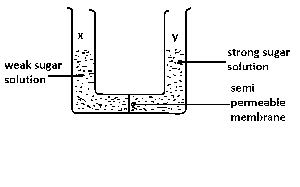
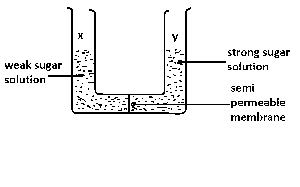
Question 0After 30 minutes, the level of sugar solution in the above figure willA.rise in x onlyB.rise in Y onlyC.be the same in X and YD.fall in YE.Objective Show full explanation
Question 0The process by which water moves from X to Y through the semi-permeable membrane is calledA.diffusionB.osmosisC.active diffusionD.osmoregulationE.Objective Show full explanation
Question 0Fibrinogen and prothrombin play important roles in theA.deamination of proteinsB.clotting of bloodC.detoxication of substanceD.storage of vitaminsE.Objective Show full explanation
Question 0Deoxygenation blood flows into the right and left lungs through theA.pulmonary veinB.vena cavaC.pulmonary arteryD.subclavian veinE.Objective Show full explanation
Question 0Which of the following is a plant excretory product?A.OilB.CytokininC.ResinD.Amino acidsE.Objective Show full explanation
Question 0The movement of the whole organism to an external stimulus is termedA.tropismB.a taxisC.a nastic movementD.a phototropic movementE.Objective Show full explanation
Question 0Which of the following vertebrae lacks a centrum?A.AtlasB.AxisC.ThoracicD.LumbarE.Objective Show full explanation
Question 0The function of the epididymis in mammals is theA.expulsion of urineB.storage of spermsC.circulation of bloodD.activation of spermsE.Objective Show full explanation
Question 0A collection of achenes formed from several carpels of a flower isA.a multiple fruitB.an aggregate fruitC.a shizocarpD.a simple fruitE.Objective Show full explanation
Question 0Vegetation propagation is described as asexual reproduction becauseA.reproductive organs are not involvedB.new individuals are not formedC.many new plants are producedD.there is no exchange of genetic materialsE.Objective Show full explanation
Question 0Epigeal germination can be found inA.sorghumB.maizeC.milletD.groundnutE.Objective Show full explanation
Question 0A dwarf plant can be stimulated to grow to normal height by the application ofA.thyroxinB.gibberellinC.insulinD.kininE.Objective Show full explanation
Question 0The greatest contribution to genetic studies was made byA.Thomas MorganB.Gregor MendelC.Charles DarwinD.Robert HookeE.Objective Show full explanation
Question 0The exchange of genes between homologous chromosomes is calledA.test crossB.back crossC.crossing-overD.mutationE.Objective Show full explanation
Question 0When two heterozygotes mate, the dominant trait will appear inA.the F1 generation onlyB.the F2 generation onlyC.both the F1 and F2 generationsD.neither the F1 nor F2 generationE.Objective Show full explanation
Question 0Which of the following characters is NOT sex-linked?A.River blindnessB.BaldnessC.HaemophiliaD.Colour blindnessE.Objective Show full explanation
Question 0The most important factors which influence an organism's way of life in its habitat areA.the physicals and biotic enviromentB.Food and water availabilityC.temperature, water, light and predator-prey relationshipD.competition for food and spacesE.Objective Show full explanation
Question 0Organisms in an ecosystem are usually grouped according to their trophic level asA.carnivores and epiphytesB.consumers and parasitesC.producers and consumersD.producers and saprophytesE.Objective Show full explanation
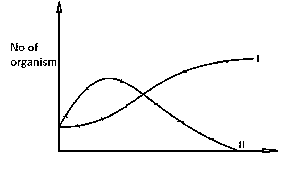
Question 0The above diagram represents a competitive interaction between organism in communities I and II. Which of the following statements is CORRECT?A.The population of I was higher than II at the beginning of the experimentsB.II was wiped out from the enviroment at the end of the experimentsC.The population of II was always lower than that ofD.The population of I was lower at the end of the experiment than at the beginningE.Objective Show full explanation
Question 0A food web is more stable than a food chain becauseA.it contains more organismsB.it has greater energy sourceC.it is not easy to destroyD.every organism has an alternative sourceE.Objective Show full explanation
Question 0Which of the following is likely to occur in a deciduous forest during the dry season?A.New leaves are formedB.The trees die offC.The undergrowth increasesD.The ground becomes bareE.Objective Show full explanation
Question 0Which of these is NOT an adaptive features for arboreal life?A.Possession of long tailB.Possession of clawsC.Possession of teethsD.counter shading in coat colourE.Objective Show full explanation
Question 0Which of the following diseases can be prevented by innoculation?A.SyphilisB.Malaria feverC.TuberculosisD.Acquired Immune Deficiency SyndromE.Objective Show full explanation
Question 0Sources of air pollutants areA.industrial chimneys, burning fossil oils and river damB.sulphur dioxide, acid rain and pesticidesC.sulphur mines, vehicle exhausts and aerosolsD.sewage, smoke and old vehicleE.Objective Show full explanation
Question 0Fertilizers are lost from the soil throughA.sheet erosion and evaporationB.leaching, underground seepages and run-offC.sheet erosion, gully erosion and wind erosionD.wind erosion and heavy rainfallE.Objective Show full explanation
Question 0Nitrogen- fixing micro-organisms in leguminous plants live symbiotically in theA.root nodulesB.tap rootC.branch rootsD.root hairsE.Objective Show full explanation
Question 0The structure labelled 4 is forA.feedingB.attachmentC.excretionD.respirationE.Objective Show full explanation
Question 0As the tadpole develops, the structure labelled 5A.grows longerB.becomes shorterC.becomes the hind legsD.remains unchangedE.Objective Show full explanation
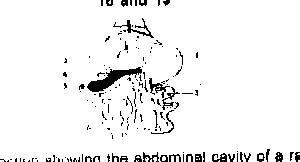
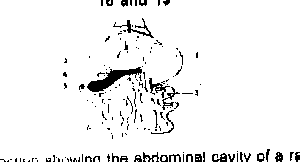
Question 0In the digestive system, absorption of nutrient into the blood takes place in the part labelledA.1B.2C.3D.4E.Objective Show full explanation
Question 0The gland which produces trypsin, amylase and lipase is labelledA.6B.4C.2D.1E.Objective Show full explanation