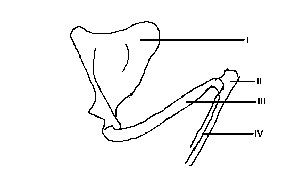
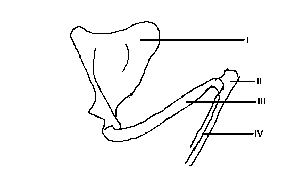
Question 0The organism that has a hydrostatic skeleton isA.TilapiaB.HydraC.mosquito larvaD.earthwormE.Objective Show full explanation
Question 0The possession of scales, laying of eggs with shells and bony structure of the head are characteristics shared byA.birds and reptilesB.fishes and birdsC.reptiles and fishesD.birds and molluscsE.Objective Show full explanation
Question 0The group of Arthropods that has no antennae is theA.CrustaceaB.ChilpodaC.ArachnidaD.DiplopodaE.Objective Show full explanation
Question 0The structure that is most commonly identified in all living cells under the light microscope is theA.mitochondrionB.chloroplastC.nucleusD.ribosomeE.Objective Show full explanation
Question 0Which of the following is an organ?A.Guard cellB.LiverC.Xylem bundleD.BloodE.Objective Show full explanation
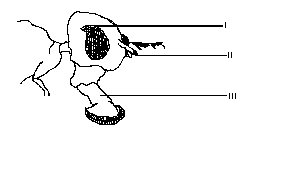
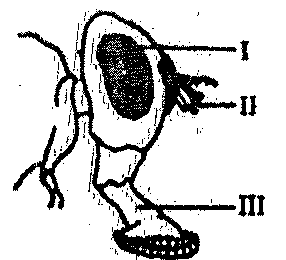
Question 0The structure labelled II is used forA.tastingB.feelingC.bitingD.suckingE.Objective Show full explanation
Question 0The structure labelled III represents theA.mandibleB.palpC.proboscisD.labiumE.Objective Show full explanation
Question 0The division of a body into two equal halves along a longitudinal plane is calledA.bilateral symmetaryB.transverse sectionC.radial symmetryD.longitudinal sectionE.Objective Show full explanation
Question 0In which of the following organisms does each cell combine the function of nutrition, reproduction and growth?A.RhizophusB.DryopterisC.BrachymeniumD.SpirogyraE.Objective Show full explanation
Question 0They key event in the transition of the amphibians from water to land is theA.replacement of the gills with lungsB.possession of webbed limbsC.development of long hing limbsD.possession of tympanic membraneE.Objective Show full explanation
Question 0In plant cells, the chloroplast are locatedA.inside the cell wallB.outside the protoplasmC.within the vacuoleD.within the cytoplasmE.Objective Show full explanation
Question 0In the woody stems, gaseous exchange takes place through theA.micropylesB.stomataC.lenticelsD.vesselsE.Objective Show full explanation
Question 0Substance manufactured by the leaves are transported to other parts of the plant through theA.xylemB.companion cellsC.sieve tubesD.cambiumE.Objective Show full explanation
Question 0After a meal of yam has been digested, the highest concentration of glucose is to be found in theA.hepatic arteryB.pulmonary veinC.hepatic portal veinD.posterior vena cavaE.Objective Show full explanation
Question 0The dark reaction of photosynthesis involvesA.fixation of carbon (IV) oxide to give six-carbon sugarB.fixation of carbon (IV) oxide with the help of oxygenC.use of carbon (IV) oxide to produce glucose using ATPD.fixation of carbon (IV) oxide on chlorophyll using hydrogenE.Objective Show full explanation
Question 0Mammals acclimatize to reduced oxygen content at high altitudes byA.the stimulation of marrow to reduce the amount of erythrocytes producedB.increasing the rate at which erythrocytes are destroyedC.the stimulation of marrow to produce more erythrocytesD.increasing the break down of the protein portion of the erythrocytesE.Objective Show full explanation
Question 0The modes of nutrition in Nitrobacter, Ascaris and Homo sapiens respectively areA.photosynthetic , parasitic and holozoicB.chemosynthetic, parasitic and holozoicC.photosynthetic, parasitic and heterophyticD.chemosynthetic, holophytic and holozoicE.Objective Show full explanation
Question 0The richest source of vitamin A areA.palm oil and groundnut oilB.palm oil and carrotC.rice and groundnut oilD.oranges and carrotE.Objective Show full explanation
Question 0The force that holds water together in the form of a stream within the xylem tube is theA.cohesion of water molecules to one another by hydrogen bondsB.force of gravity attacking the water molecules through the hydrogen bondsC.attraction between the water and xylem osmotic forceD.normal flow of water from the ground with help of gravitational forceE.Objective Show full explanation
Question 0Yellowing of leaves is a symptom associated with deficiency ofA.iron, calcium and magnesiumB.nitrogen, sulphur and potassiumC.sulphur, phosphorus and ironD.magnesium, nitrogen and ironE.Objective Show full explanation
Question 0The lymphatic system of mammals rejoins the blood circulatory system at theA.hepatic veinB.subclavian veinC.renal veinD.common iliac veinE.Objective Show full explanation
Question 0In dissection, the rib cage of mammal has to be opened in order to expose theA.diaphragmB.liverC.heartD.sternumE.Objective Show full explanation
Question 0Fertilization in humans usually takes place in theA.lower part of the uterusB.upper part of the uterusC.lower part of the oviductD.upper part of the oviductE.Objective Show full explanation
Question 0Insects visit flowers in order toA.feed on the nectarB.deposit pollen on the stigmaC.pollinate the flowersD.transfer pollen from anthersE.Objective Show full explanation
Question 0In epigeal germination, the cotyledons areA.carried above the ground by the elongation hypocotylB.pulled underground by the elongating epicotylC.pulled underground by the elongating epicotylD.carried above the ground by the elongating epicotylE.Objective Show full explanation
Question 0Bacteria multiply rapidly by means ofA.buddingB.fragmentationC.binary fissionD.spore formationE.Objective Show full explanation
Question 0The correct sequence for the perception of smell in mammals isA.chemicals → olfactory nerve endings → brainB.dissolved chemicals → nasal sensory cell → brainC.chemicals → mucus membrane → sensory cells→ brainD.dissolved chemicals → sensory cells → olfactory nerve → brainE.Objective Show full explanation
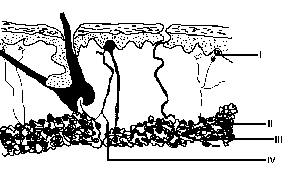
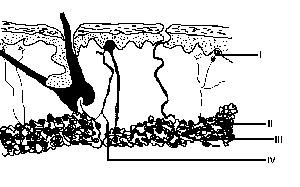
Question 0The part labelled III is forA.protectionB.insulationC.lubricationD.growthE.Objective Show full explanation
Question 0The structure labelled II is known asA.sweat glandB.lymph vesselC.blood vesselD.nerve endingE.Objective Show full explanation
Question 0In mammals, the organ which performs digestive and endocrine functions is theA.liverB.pancreasC.gastric glandD.salivary glandE.Objective Show full explanation
Question 0Th chitin in the exoskeleton of many arthropods is strengthened byA.calcium compoundsB.organic saltsC.lipidsD.proteinsE.Objective Show full explanation
Question 0The structure labelled II articulates with III to formA.sliding jointB.hinge jointC.pivot jointD.ball-and-socket jointE.Objective Show full explanation
Question 0The construction of dams may lead to an increase in the prevalence ofA.typhoid fever, measles and yellow feverB.tuberculosis, leprosy and trypanosomiasisC.guinea worm, malaria and tuberculosisD.malaria, bilharziasis and onchocerciasisE.Objective Show full explanation
Question 0Floating microscopic heterotrophs are mostly grouped asA.phytoplanktonB.zooplanktonC.microbesD.nektonE.Objective Show full explanation
Question 0Vaccination is carried out in order toA.check the production of poisonB.increase the activity of white blood cellsC.increase the number of red blood cellsD.stimulate the production of antibodiesE.Objective Show full explanation
Question 0A soil consisting of alumina and iron (II)oxide is known asA.loamy soilB.clayey soilC.lateriteD.podzolE.Objective Show full explanation
Question 0The sign + is used to indicate an association where an organism gains, while 0 is used where an organism is unaffected. An association indicated as +0 is known asA.predationB.commensalismC.parasitismD.competitionE.Objective Show full explanation
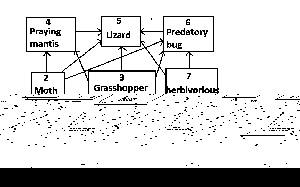
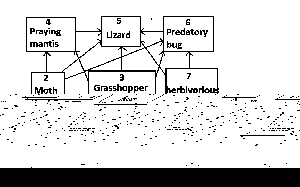
Question 0Primary consumers are found inA.1, 2 and 3B.1, 3 and 7C.2, 3 and 7D.2, 4 and 5E.Objective Show full explanation
Question 0The biomass is likely to increase in the sequenceA.1 → 2 → 4 → 5B.1 → 3 → 4 → 5C.3 → 5 → 6 →7D.5 → 4 → 3 → 1E.Objective Show full explanation
Question 0Which of the following characterizes the white mangrove?A.Prop rootsB.Buttress rootsC.Breathing rootsD.Stilt rootsE.Objective Show full explanation
Question 0If the offspring of a cross between a brown mouse (bb) and a black mouse (BB) are allowed to interbreed, how many different genotypes would result?A.2B.3C.4D.5E.Objective Show full explanation
Question 0The biological factor that is unique to each individual is theA.DNAB.eye colourC.blood groupD.RNAE.Objective Show full explanation
Question 0From evolutionary standpoint , the older a fossil-bearing rocks is, the more likely it is to containA.aves as opposed to amphibiansB.invertebrates as opposed to vertebratesC.angiosperms as opposed to algaeD.vertebrates as opposed to invertebratesE.Objective Show full explanation
Question 0The very bright colours in some types of mushroomA.are warning that they may be poisonousB.indicate they are very tasteC.attract potential transporters of the sporesD.perform the same function as bright colours in flowersE.Objective Show full explanation
Question 0The least adaptive feature of aboreal life is theA.possession of fouur limbsB.possession of clawsC.development of long tailD.shading of coat colourE.Objective Show full explanation
Question 0Which of the following is one of Lamarck's theories?A.Some variations are more favourable to existence in a given environment than othersB.All living organisms are constantly involved in a struggle to existenceC.The size of a given population remains fairly constantD.New species originates through the inheritance of acquired traitsE.Objective Show full explanation
Question 0The loud cry made by a brooding hen when a predator is around is meant toA.alert the poultry attendantsB.attract cocks to come and fight the predatorC.advertise the boundaries of its territory to intrudersD.warn its chicks and other chickens of impending dangerE.Objective Show full explanation
Question 0The most important environment factor which epiphytes in the rain forest compete for isA.waterB.nutrientsC.lightD.cabinet ministerE.spaceObjective Show full explanation
Question 0The habitat of the cysticercus of taenia solium isA.Alimentary canal of cattleB.Muscles of pigC.Alimentary canal of pigD.Muscles of cattleE.Objective Show full explanation