Question 0In terms of the number of individuals, which of the following taxa is most inclusive?A.orderB.familyC.classD.speciesE.Objective Show full explanation
Question 0A characteristic that can possibly be shared by both living and non living organisms isA.locomotionB.irritabilityC.increase in biomassD.increase in sizeE.Objective Show full explanation
Question 0The cell of an onion bulb can be differentiated from a cheek cell by the presence ofA.plasmalemmaB.chloroplastC.cell wallD.nucleusE.Objective Show full explanation
Question 0In plants, the structure that performs a similar function with the testis in mammals is theA.stigmaB.filamentC.antherD.receptanceE.Objective Show full explanation
Question 0The bacteria type that are arranged in chains are theA.staphylococciB.clostidiaC.streptococciD.basilliE.Objective Show full explanation
Question 0The most abundant group of organisms in the animal kingdom isA.mammaliaB.avesC.annelidaD.insectaE.Objective Show full explanation
Question 0Radial symmetry is a future common toA.platyhelminthesB.nematodesC.coelenteratesD.arthropodsE.Objective Show full explanation
Question 0Which of the following is used mainly for balancing in fish?A.the caudal finB.the pectoral finC.the anal finD.the dorsal finE.Objective Show full explanation
Question 0The beak of a duck is structurally adapted forA.scooping and sieving foodB.catching and grasping foodC.picking and cracking foodD.boring and sucking foodE.Objective Show full explanation
Question 0The most important characteristic that makes reptiles to conquer terrestrial habitats is the possession ofA.long tailB.scaly skinC.sharp clawD.amniotic eggE.Objective Show full explanation
Question 0In a dicotyledonous stem, the zone between the epidermis and the pericycle is theA.cortexB.steleC.xylemD.ploemE.Objective Show full explanation
Question 0The order of passage of food in the digestive system is?A.ileum → caecum → large intestine → rectumB.ileum → colon → caecum →rectumC.large intestine →ileum → caecum →rectumD.colon → caecum → ileum →rectumE.Objective Show full explanation
Question 0insectivorous plants traps and kill their prey to deriveA.phosphorousB.calciumC.nitrogenD.zincE.Objective Show full explanation
Question 0In the alimentary system of a bird, the function of teeth is carried out by theA.cropB.beakC.gizzardD.tongueE.Objective Show full explanation
Question 0What will happen wen two equal sized pieces of unripe pawpaw labelled X and Y are dropped into equal volumes of concentrated salt solution and distilled water respectively?A.pawpaw X will become turgidB.both will increase in sizeC.pawpaw Y will become turgidD.both will decrease in sizeE.Objective Show full explanation
Question 0Exhaled air differs from inhaled air in that itA.less amount of carbon(IV) oxideB.is usually lower in temperatureC.often has more oxygenD.usually has more water vapourE.Objective Show full explanation
Question 0In the mammalian kidney, the Bowman''s capsules is located in theA.ureterB.pelvisC.cortexD.medullaE.Objective Show full explanation
Question 0A plant parenchyma cell also acts as a supporting tissue when itA.becomes flaccidB.contains crystalsC.becomes turgidD.is pigmentedE.Objective Show full explanation
Question 0During ovulation, an egg is released from theA.corpus luteumB.ovarian funnelC.graafian follicleD.fallopian tubeE.Objective Show full explanation
Question 0The transmission of impulses along a nerve fibre is characterized byA.hormonal and temperature changesB.electrical and ionic changesC.hormonal and changesD.electrostatic changesE.Objective Show full explanation
Question 0The major consequences of bush burning in an ecosystem isA.the loss of waterB.the loss of biological diversityC.a decrease in animal populationD.an increase in soil fertilityE.Objective Show full explanation
Question 0Which of the following associations is an example of mutualismA.hydra viridis and zoochlorellaeB.human and liceC.shark and remora fishD.bread and rhizopus stoloniferE.Objective Show full explanation
Question 0In a typical freshwater habitat, the edge of the stream or pond constitutes theA.tidal zoneB.intertidal zoneC.littoral zoneD.euphotic zoneE.Objective Show full explanation
Question 0The main ecological problem facing intertidal organisms isA.desiccationB.floatationC.salinityD.humidityE.Objective Show full explanation
Question 0Stomata of some plants are sunken and protected by hairs. These are features ofA.mesophytesB.epiphytesC.hydrophytesD.xerophytesE.Objective Show full explanation
Question 0An ecological factor that will have the most limiting effects on the abundance of phytoplankton in a turbid pond isA.pHB.oxygenC.lightD.temperatureE.Objective Show full explanation
Question 0In an experiment to determine the percentage of air in a soil sample, the following readings were recorded: volume of water in measuring cylinder = 500 cm3 volume of soil added to water = 350 cm3 volume of water and soil after stirring = 800 cm3 the percentage of air in the soil sample isA.6.25%B.10.36%C.14.28%D.43.28%E.Objective Show full explanation
Question 0A boy who is fond of swimming in a pond finds himself passing urine with traces of blood. He is likely to have contactedA.schistosomiasisB.onchocerciasisC.poliomyelitisD.salmonellosisE.Objective Show full explanation
Question 0The easiest way to establish the level of pollution in a local stream is to measure the level ofA.oxygenB.carbon (IV) oxideC.ammoniaD.alkalinityE.Objective Show full explanation
Question 0The Rhesus factor of blood was first identified in a category ofA.monkeysB.human femalesC.human malesD.chimpanzeesE.Objective Show full explanation
Question 0Genetically modified food products have not become universally accepted becauseA.they are not tasty as others produced by conventional meansB.they are usually costlier than others produced by conventional meansC.their effects on human consumers is not yet fully understandD.the technology can be applied only in developed countriesE.Objective Show full explanation
Question 0A major adaptive feature of endoparasites is theA.loss of the organ of movementB.presence of clawsC.loss of the central nervous systemD.presence of piercing mouthpartsE.Objective Show full explanation
Question 0The abilty of a chameleon to change its colour is an adaptive future forA.attractionB.defenceC.displayD.attackE.Objective Show full explanation
Question 0Which of the following is the most advanced evolutionary development in plants?A.possession of unicellular structuresB.development of flowersC.dispersal of sporesD.development of secondary thickeningE.Objective Show full explanation
Question 0Which of the following is a major cause of variation among organisms?A.InbreedingB.BackcrossingC.Sexual reproductionD.Gene dominanceE.Objective Show full explanation
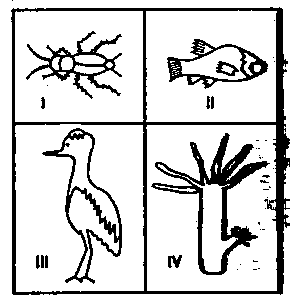
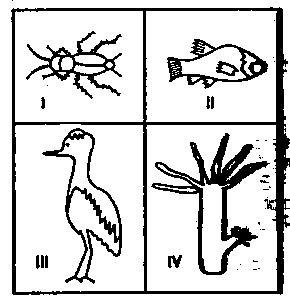
Question 0Use the diagram above to answer this question. Which of the organisms is characterised by the possession of a chitinous exoskeleton?A.lB.llC.lllD.lVE.Objective Show full explanation
Question 0Use the diagram above to answer this question.The type of reproduction illustrated in IV isA.sexualB.conjugationC.binary fissionD.buddingE.Objective Show full explanation
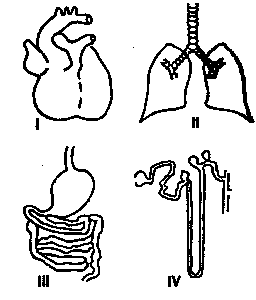
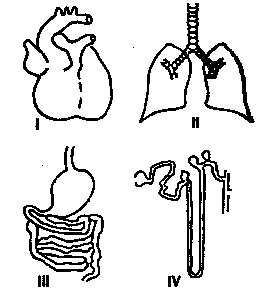
Question 0Use the diagram above to answer this question.The vessel that carries blood from l to ll is theA.pulmonary arteryB.pulmonary veinC.carotid arteryD.jugular veinE.Objective Show full explanation
Question 0Use the diagram above to answer this question.Water reabsorption takes place inA.ll and lllB.lll and lVC.l and IVD.l and lllE.Objective Show full explanation
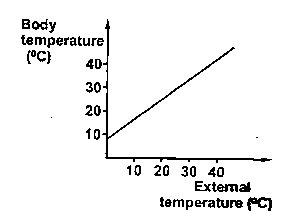
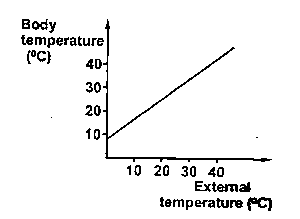
Question 0Use the diagram above to answer this question.Form the graph above, it can be appropriately deduced thatA.the body temperature in ll varies with that in lB.the body of temperature in l is independent of external temperatureC.l and ll maintain constant body temperatureD.external temperatures affect the body temperature of l and llE.Objective Show full explanation
Question 0Use the diagram above to answer this question. The animal represented by l is aA.poikilothermB.homoiothermC.carnivoreD.herbivoreE.Objective Show full explanation
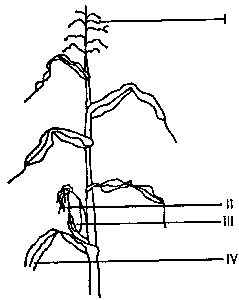
Question 0In the diagram, the illustration is a typical example of a plant pollinated byA.windB.manC.insectsD.birdsE.Objective Show full explanation
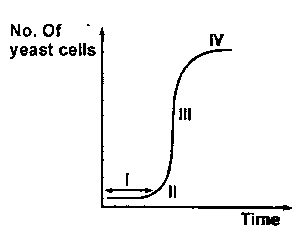
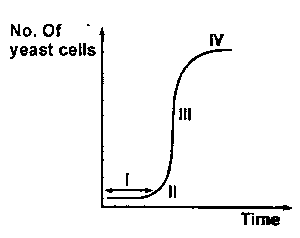
Question 0In the diagram, the part labelled I represents theA.stationary phaseB.lag phaseC.log phaseD.steady phaseE.Objective Show full explanation
Question 0In the diagram, the part labelled IV indicated that the yeast population hasA.reached its maximum sizeB.reached senescenceC.stopped metabolizing foodD.started dyingE.Objective Show full explanation
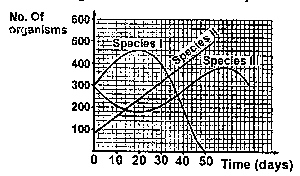
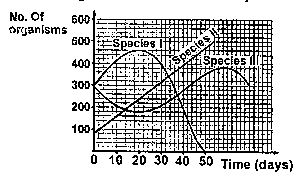
Question 0In the diagram, if species i, ii and iii interact in a community, which of the following statement is true?A.the population of species ii is growing at a slow rateB.the population of species iii has reached its carrying capscity?C.the population of species I has become extinctD.the population of species I is alwaysE.Objective Show full explanation
Question 0In the diagram, the population size of species II on the 20th day isA.100B.200C.300D.400E.Objective Show full explanation
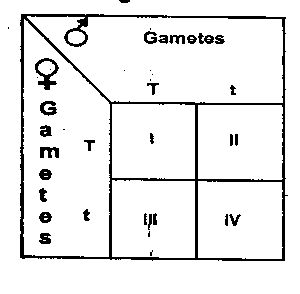
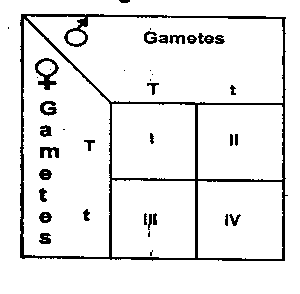
Question 0In the diagram, which of the four offspring of the cross will be sort if T the gene for tallness isA.iB.iiC.iiiD.ivE.Objective Show full explanation
Question 0In the diagram, the genotypic ratio of the offspring of the cross isA.1:2B.1:2:1C.1:1:1:1D.3:1E.Objective Show full explanation
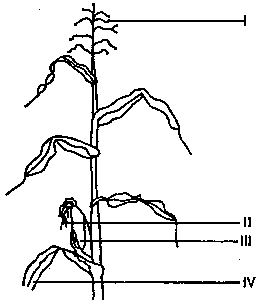
Question 0Use the diagram above to answer this question. The male inflorescence is labelledA.iB.iiC.iiiD.ivE.Objective Show full explanation
Question 0The natural process that produces adaptive evolutionary changes isA.MutationB.Gene flowC.Genetic driftD.Natural selectionE.Objective Show full explanation