Question 0The lowest level of organization in living organisms isA.organB.cellC.systemD.tissueE.Objective Show full explanation
Question 0Which of the following is the most complex according to their cellular level of organization?A.HeartB.HairC.EuglenaD.HydraE.Objective Show full explanation
Question 0Which of the following organisms is multicellular?A.ChlamydomonasB.SpirogyraC.AmoebaD.EuglenaE.Objective Show full explanation
Question 0In bryophytes, sex organs are produced in theA.protonemaB.sporophyteC.gametophyteD.rhizoidE.Objective Show full explanation
Question 0Seed plants are the most dominant vegetation on land because ofA.their motile gamatesB.their ability to photosynthesizeC.efficient seed dispersalD.availability of waterE.Objective Show full explanation
Question 0Which of the following is an aboreal organism?A.ElephantB.FishC.AntelopeD.BirdE.Objective Show full explanation
Question 0i2/1, c0/0, pm3/2, m3/3. The general formula above represent that ofA.an omnivoreB.a detritus feederC.a carnivoreD.a herbivoreE.Objective Show full explanation
Question 0A circulatory system is very essential in mammals but not in smaller organisms like Amoeba becauseA.Amoeba lives in freshwaterB.Diffusion is sufficient to transport materials in AmoebaC.Amoeba lacks blood containing haemoglobinD.Amoeba exibits anaerobic respirationE.Objective Show full explanation
Question 0In vascular plants, the sieve tubes and companion cells are present in theA.cambiumB.cortexC.xylemD.phloemE.Objective Show full explanation
Question 0The stomata of leaves are similar in function to theA.pharynx of humansB.scales of fishC.spiracle of insectsD.trachea of toadsE.Objective Show full explanation
Question 0The use of moist skin for respiration in amphibians is known asA.cellular respirationB.cutaneous respirationC.buccal respirationD.pulmonary respirationE.Objective Show full explanation
Question 0Water in plants is removed as water vapour through the process ofA.diffusionB.osmosisC.evaporationD.transpirationE.Objective Show full explanation
Question 0An example of an organ of perennation in plants isA.rhizomeB.seedC.petal of a flowerD.calyx of flowerE.Objective Show full explanation
Question 0Alternation of generation is a feature shown inA.mossesB.fungiC.grassesD.conifersE.Objective Show full explanation
Question 0Coordination and regulation of body activities in mammals are achieved by theA.nerves and muscleB.nerves and hormonesC.nerves onlyD.hormones onlyE.Objective Show full explanation
Question 0The Cerebellum of the Brain controlsA.Reflex ActionB.Muscular ActivityC.Emotional ExpressionsD.the Endocrine SystemE.Objective Show full explanation
Question 0The part of the brain responsible for peristalsis is theA.Olfactory LobeB.Medulla OblongataC.HypothallamusD.ThalamusE.Objective Show full explanation
Question 0Which of the following instruments is used for measuring atmospheric pressure?A.HydrometerB.HygrometerC.ThermometerD.BarometerE.Objective Show full explanation
Question 0The influence of soil on organisms in a habitat is referred to asA.EdaphicB.PhysiographicC.BioticD.TopographicE.Objective Show full explanation
Question 0The genetic make-up of an organism is described asA.AlleleB.ChromosomeC.PhenotypeD.GenotypeE.Objective Show full explanation
Question 0The major limiting factor of productivity in the aquatic habitat isA.FoodB.TemperatureC.WaterD.SunlightE.Objective Show full explanation
Question 0Which of the following group of organisms feeds directly on green plants?A.Primary ConsumersB.Secondary ConsumersC.ProducersD.DecomposersE.Objective Show full explanation
Question 0A characteristic feature of tropical rainforest is that itA.Contains trees with narrow leavesB.Contains large number of plant speciesC.Contains fewer number of plant speciesD.Has total annual rainfall of less than 50cmE.Objective Show full explanation
Question 0The study of how and why population size change over time isA.Population estimationB.Population dynamicsC.Population ecologyD.Population CycleE.Objective Show full explanation
Question 0A severe and long dry season is a characteristic feature ofA.Sahel SavannaB.Mangrove SwampsC.Sudan SavannaD.Guinea SavannaE.Objective Show full explanation
Question 0Which of the following is a nitrogen-fixing blue-green algae of soil?A.RhizobiumB.NitrosomonasC.ClostridiumD.AnabaenaE.Objective Show full explanation
Question 0The soil with highest water-retaining capacity isA.Clayey SoilB.Stoney soilC.Sandy soilD.Loamy SoilE.Objective Show full explanation
Question 0The causative agent of Poliomyelitis isA.VirusB.FungusC.ProtozoanD.BacteriumE.Objective Show full explanation
Question 0One of the ways of controlling noise pollution in urban areas isA.by siting industries away from residential areasB.that fuel should be completely combusted by enginesC.by planting trees on both sides of the roadD.by wearing ear devicesE.Objective Show full explanation
Question 0A constituent of the exhaust fumes from electricity generating sets which causes serious pollution isA.Carbon (II) OxideB.Water VapourC.OzoneD.Carbon (IV) OxideE.Objective Show full explanation
Question 0Which of the following is true of small pox?A.It is transmitted by bacteriaB.It can effectively be controlled with antibioticsC.It can effectively be controlled by vaccinationD.It is a water-borne infectionE.Objective Show full explanation
Question 0A pollutant that is mostly associated with acid rain isA.Nitrogen (IV) OxideB.OzoneC.FluorineD.Carbon (IV) OxideE.Objective Show full explanation
Question 0When the adults have reach a certain degree of weakness, the process of binary fission is replaced by conjugation inA.ParameciumB.EuglenaC.AmoebaD.PlasmodiumE.Objective Show full explanation
Question 0Whorls, arches, loops and compounds are types of variation inA.ColourB.Finger printsC.Hair ColourD.Blood groupE.Objective Show full explanation
Question 0A couple has 10 children, all female. Which of the following best explains the situationA.The sex determination was by the man's X chromosomeB.The man's sperm count is lowC.The woman is not capable of producing male childrenD.The sex determination was by the man's Y chromosomeE.Objective Show full explanation
Question 0A biological agent with antiviral property isA.InterferonB.enzymeC.antibioticD.disinfectantE.Objective Show full explanation
Question 0One of the advantages of outbreeding isA.pests toleranceB.disease resistanceC.fast growthD.tall heightE.Objective Show full explanation
Question 0An individual with blood group AB can receive blood from those in blood group(s)A.A, B, AB, OB.A, AB and O onlyC.AB onlyD.A and B onlyE.Objective Show full explanation
Question 0The stream-lined shape of fishes is an adaptation forA.Securing matesB.easy movementC.obtaining foodD.defence and attackE.Objective Show full explanation
Question 0An example of a poikilothermic organism is aA.LizardB.CockroachC.rabbitD.birdE.Objective Show full explanation
Question 0All living organisms are constantly involved in a struggle for existence. This was proposed byA.MorganB.DarwinC.LamarckD.WallaceE.Objective Show full explanation
Question 0Adaptive radiation is illustrated inA.modified insect mouthpartsB.dentition in mammalsC.wings in birds and batsD.appendages in insectsE.Objective Show full explanation
Question 0i. Growth is mainly apical ii. Growth is specific with definite shape iii. Growth is throughout life. Which of the above correctly describes the growth pattern in plants?A.i, ii and iii onlyB.ii and iii onlyC.i and ii onlyD.i and iii onlyE.Objective Show full explanation
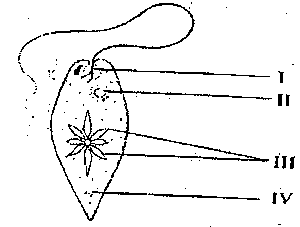
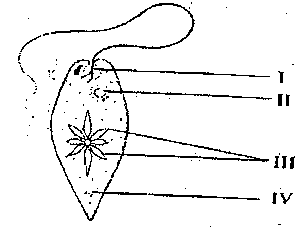
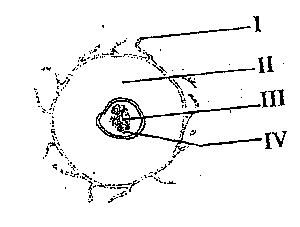
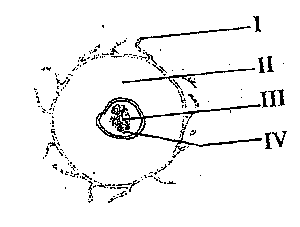
Question 0Use the diagram to answer this question. The part labelled II is theA.nucleusB.eyespotC.basal granuleD.contractile vacuoleE.Objective Show full explanation
Question 0Use the diagram above to answer this question. The part responsible for photosynthesis is labelledA.IIIB.IVC.ID.IIE.Objective Show full explanation
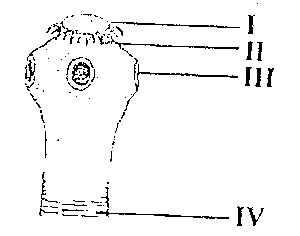
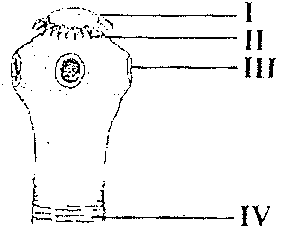
Question 0Use the diagram above to answer this question. The young proglottid is represented byA.IIIB.IVC.ID.IIE.Objective Show full explanation
Question 0In the diagram, the organs for attachments to the lining of the host's intestine are labelledA.ii and iiiB.iii and ivC.i and iiD.i and iiiE.Objective Show full explanation
Question 0In the diagram, the part labelled I is theA.xylemB.phleomC.root hairsD.cortexE.Objective Show full explanation
Question 0The diagram is the transverse section of aA.monocotyledonous stemB.dicotyledonous stemC.monocotyledonous rootD.dicotyledonous rootE.Objective Show full explanation