JAMB Chemistry 1980 Past Questions

Practice each question, then open it to see the full details.

Question 0Question image
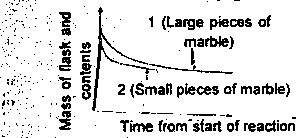
The following graph demonstrates the rate of reaction between calcium carbonate (marble)and dilute hydrochloric acid. The graph shows that the rate of reaction is initially greatest when
  • A.the initial slope of the curve is steepest and this occur when small pieces of marble are used and is due to a small surface area of reactant
  • B.the occur when large pieces of marble are used and is due to a small surface area of reactant
  • C.the initial slope of the curve is steepest and this occurs when small pieces of marble are used and is due to a large surface area of reactant
  • D.the initial slope of the curve is steepest and this occur when large surface area of reactant
  • E.the initial slope of the curve is least steep and this occur when small pieces of marble are used and is due to the increased surface area of the reactant
Objective
Question 0Question image
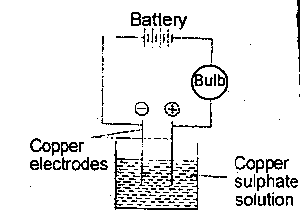
Copper sulphate solution was electrolysed using the apparatus show above. Which of the following changes are observed?
  • A.The bulb lights and copper is deposited at both electrodes
  • B.the bulb lights and copper is deposited at the anode and disappears from the cathode
  • C.the bulb lights and copper is deposited at the cathode and oxygen liberated at the anode
  • D.the bulb lights and copper is deposited at the cathode and disappears from the anode
  • E.the bulb lights but no additional changes are observed
Objective
Question 0
Which of the following tests would confirm-unequivocally that a solution X contain the sulphate ion if it gives with
  • A.silver nitrates solution, a white precipates insoluble in dilute HNO3
  • B.barium chloride solution, a white precipitate insoluble in dilute H2SO4
  • C.barium chloride solution, a white precipitate insoluble in dilute HCl
  • D.barium chloride solution a white precipitate soluble in dilute ammonia
  • E.barium chloride solution a white precipitate insoluble in dilute HCl
Objective