Question 0The addition of water to calcium oxide leads to?A.a physical changeB.a chemical changeC.the formation of a mixtureD.an endothermic changeE.Objective Show full explanation
Question 0A mixture of iron and sulphur can be separated by dissolving the mixture in?A.steamB.dilute hydrochloric acidC.dilute sodium hydroxideD.benzeneE.Objective Show full explanation
Question 0A given amount of gas occupies 10.0 dm3 at atm, and 273°C. The number of moles of the gas present is? (Molar volume of a gas at s.t.p. = 22.4 dm3)A.0.89 molB.1.90 molC.3.80 molD.5.70 molE.Objective Show full explanation
Question 08.0 g of an element X react with an excess of copper (ll) tetraoxosulphate (lV) solution to deposit 21.3 g of copper. The correct equation for the reaction is? (Cu = 64).A.X(s) + CuSO4(aq) → Cu(s) + XSO4(aq)B.X(s) + 2CuSO4(aq) → 2Cu(s) + X(SO4)2(aq)C.2X(s) + CuSO4(aq) → Cu(s) + X2SO4(aq)D.2X(s) + 3CuSO4(aq) → 3Cu(s) + X2(SO4)3(aq)E.Objective Show full explanation
Question 0C3H8(g) + 502(g) → 4H2O + 3CO2(g). Form the equation above the volume of oxygen at s.t.p. required to burn 50cm3 of propane is?A.250 cm3B.150 cm3C.100 cm 3D.50 cm3E.Objective Show full explanation
Question 030cm3 of hydrogen was collected over water at 27°C and 780 mm Hg. If the vapour pressure of water at the temperature of the experiment was 10 mm Hg, calculate the volume of the gas at 760 mm Hg and 7°C?A.40.0 cm3B.35.7 cm3C.28.4 cm3D.25.2 cm3E.Objective Show full explanation
Question 0If sulphur (IV) oxide and methane are released simultaneously at the opposite ends of a narrow tube, the rates of diffusion Rso2 and Rch4 will be in the ratio? (S = 32, O = 16, C = 12, H = 1)A.4:1B.2:1C.1:2D.1:4E.Objective Show full explanation
Question 0A solid begins to melt when?A.constituent particles acquires a greater kinetic energyB.energy of vibration of particles of the solid is less than the intermolecular forcesC.constituent particles acquires energy above the average kinetic energyD.energy of vibration of particles of the solid equals the intermolecular forcesE.Objective Show full explanation
Question 0Which of the following electron configurations indicates an atom with the highest ionization energy?A.2,8,7B.2,8,8,1C.2,8,8,2D.2,8,8,7E.Objective Show full explanation
Question 0The line observed in the sample hydrogen spectrum are due to emission of?A.electrons from the atomsB.energy by proton transitionC.energy by electron transitionD.neutron from the atomE.Objective Show full explanation
Question 0The property used in obtaining oxygen and nitrogen industrially from air is the?A.boiling pointB.densityC.rate of diffusionD.solubilityE.Objective Show full explanation
Question 0Potassium tetraoxomanganate (VII) is often added to impure water to?A.reduce organic impuritiesB.reduce inorganic impuritiesC.destroy bacteria and algaeD.remove permanent hardnessE.Objective Show full explanation
Question 0The soil around a battery manufacturing factory is likely to contain a high concentration of?A.Ca2+ saltsB.Pb2+ saltsC.Mg2+ saltsD.Al3+ saltsE.Objective Show full explanation
Question 0Excess phosphorus was burnt in a gas jar and the residual gas passed successively over concentrated KOH solution and concentration H2SO4 before being collected in a flask. The gases collected are?A.carbon (IV) oxide, nitrogen and the rare gasesB.nitrogen and the rare gasesC.carbon (IV) oxide, nitrogen (IV) oxide and the rare gasesD.carbon (IV) oxideE.Objective Show full explanation
Question 0If an element X of an atomic number Z and mass number Y is irradiated by an intense concentration of neutrons, the relevant nuclear equation is?A.yzX + 10n → y - 1z + 1XB.yzX + 10n → y + 1zXC.yzX + 10n → yz + 1XD.yzX + 10n → y + 1z - 1XE.Objective Show full explanation
Question 090.0g of MgCI2 was placed in 50.0cm3 of water to give a saturated solubility of the salt is 8.0 mol dm3 at the same temperature, what is the mass of the salt left undissolved at the given temperature? (Mg = 24, Cl = 35.5)A.52.0gB.58.5gC.85.5gD.88.5gE.Objective Show full explanation
Question 0Soap lather is an example of a colloid in which a?A.liquid is dispersed in gasB.solid is dispersed in liquidC.gas is dispersed in liquidD.liquid is despersed in liquidE.Objective Show full explanation
Question 0The pH of a solution obtained by mixing 100cm3 of a 0.2M solution of NaOH is?A.1.3B.7.0C.9.7D.12.7E.Objective Show full explanation
Question 0Mg2+(aq) + 2e->(aq) → Mg(s)E°(volts) = 2.370 Zn2+(aq) + 2e->(aq) → Zn(s)E°(volts) = -0.763 Cds2+(aq) + 2e->(aq) → Cd(s)E°(volts) = 0.403 Cu2+(aq) + 2e->(aq) → Cu(s)E°(volts) = 0.340 In the electrochemical series above, the strongest reducing agents is?A.Cu (s)B.Cd(s)C.Znsub>(s)D.Mg(s)E.Objective Show full explanation
Question 02Cl2(g) + 2H2O(g) 4HCl(g) + O2(g) ∆H° = +115KJ mol-1. In the above equilibrium reaction, a decrease in temperature will?A.favour the reverse reactionB.favour the forward reactionC.have no effect on the equilibrium stateD.double the rate of the reverse raectionE.Objective Show full explanation
Question 02X(g) + Y(g) → Z(g): In the equation above, The rate of formation of Z is found to be independent of the concentration of Y and to quadruple when the concentration of X is doubled. The correct equation for the reaction is?A.R = k (X)(Y)B.R = K (X) ° (Y)C.R = K (X) ° (Y) 2D.R = K (X) 2(Y)°E.Objective Show full explanation
Question 0A gas that turns a filter paper previously soaked in lead ethanoate solution black is?A.hyrogen chlorideB.hydrogen sulphideC.sulphur (IV) oxideD.sulphur (VI) oxideE.Objective Show full explanation
Question 03CuO(s) + 2NH3(g) → 3Cu(s) + 3H2O(I) N2(g) (i). 2NH3(g) + 3Cl2(g) → 6HCl(g) + N2(g) (ii). 4NH3(g) + 3O2(g) → 6H2O(I) + 2N2(g) (iii). The reactions represented by the equations above demonstrate the?A.basic properties of ammoniaB.acidic properties of ammoniaC.reducing properties of ammoniaD.oxidizing properties of ammoniaE.Objective Show full explanation
Question 0A solution containing chloride ions gives white precipitate with silver trioxonitrate(V) Solution. The precipitate will be insoluble in dilute?A.HNO 3 but soluble in ammonia solutionB.HNO3 and ammonia solutionC.HCl but soluble in ammonia solutionD.HCl and in ammonia solutionE.Objective Show full explanation
Question 0The oxide that remains unchanged when heated in hydrogen is?A.CuOB.Fe2O3C.PbO2D.ZnOE.Objective Show full explanation
Question 0Which of the following is observed when a solution of iron (III) chloride is mixed with a solution of sodium hydroxide?A.A gas is evolvedB.A deep blue precipitate is formedC.The resultant solution turns green turnsD.A brown precipitate is formedE.Objective Show full explanation
Question 0The metal that will react with water only in the form of steam to librate hydrogen gas is?A.calciumB.aluminiumC.ironD.zincE.Objective Show full explanation
Question 0A common characteristic shared by iron and aluminium is that both?A.are extracted by reduction methodsB.form only basic oxidesC.show oxidation states of +2 and +3D.form soluble hydroxidesE.Objective Show full explanation
Question 0Alloys are often used in preference to pure metals because?A.metals are too hardB.merals are ductileC.metallic properties are improve in alloysD.alloys are a mixture of metalsE.Objective Show full explanation
Question 0One mole of hydrocarbon contains 6g of hydrogen. If the molecular weight is 54, the hydrocarbon is an?A.alkanoneB.alkaneC.alkeneD.alkyneE.Objective Show full explanation
Question 0On cracking medicinal paraffin, a gas is evolved which gives a pop sound with a lighted splinter and an oily liquid which decolourizes bromine solution is also obtained. The products of the cracking are ?A.carbon (IV) oxide and alkyneB.carbon (ll) oxide and alkeneC.hydrogen gas and alkeneD.hydrogen gas and alkaneE.Objective Show full explanation
Question 0How many structural isomers can be drawn for the non-cyclic alkanol with molecular formula C 4H10O?A.1B.2C.3D.4E.Objective Show full explanation
Question 0An example of aromatic compound is?A.C6H13OHB.C6H13CIC.C6H5OHD.C6H14E.Objective Show full explanation
Question 0Terylene is synthesized from ethane- 1, 2-diol and benzene - 1, 4-dicarboxylic acid by?A.addition reactionB.condensation reactionC.elimination reactionD.substitution reactionE.Objective Show full explanation
Question 0Which of the following is true concerning the properties of benzene and hexane?A.Both undergo substitution reactionB.Both undergo addition reactionC.Both are solidsD.Both can decolourized bromine waterE.Objective Show full explanation
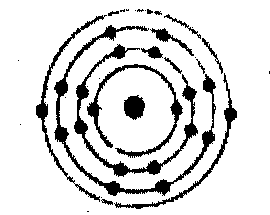
Question 0The diagram above represents an atom that can combine with chlorine to formA.a covalent bondB.an electrovalent bondC.a hydrogen bondD.a co-ordinate bondE.Objective Show full explanation
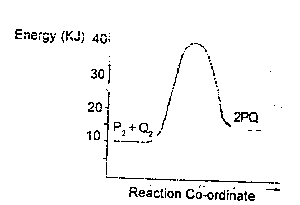
Question 0In the diagram above , the activation energy for the backward reaction isA.+5kJB.+15KJC.+25KJD.+30KJE.Objective Show full explanation
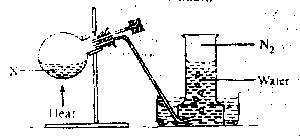
Question 0In the experiment above, X could be a solution ofA.sodium trioxonitrate (V) and ammonium chlorideB.sodium trioxonitrate (lll) and ammonium chlorideC.lead (ll) trioxonitrate (V) and copper turningsD.potassium trioxonitrate (V) and copper turningsE.Objective Show full explanation