Question 0When a solid substance disappears completely as a gas on heating, the substance is said to have undergoneA.evaporationB.distillationC.crystallizationD.sublimationE.Objective Show full explanation
Question 0A chemical reaction is always associated withA.an increase in the composition of one of the substanceB.a change in the volume of the reactantsC.a change in the nature of the reactantsD.the formation of new substanceE.Objective Show full explanation
Question 0If a solution contains 4.9g of tetraoxosulphate (VI) acid, calculate the amount of copper (II) oxide that will react with it [Cu = 64, O = 16, S = 32, H = 1]A.0.8gB.4.0gC.40.0gD.80.0gE.Objective Show full explanation
Question 0What volume of gas is evolved at S.t.p if 2g of calcium trioxocarbonate (IV) is added to a solution of hydrochloric acid? [Ca = 40, C = 12, O = 16, Cl = 35.5, H = 1 Molar volume of agas at s.t.p = 22.4 dm3A.112 cm2B.224 cm2C.448 cm2D.2240 cm2E.Objective Show full explanation
Question 0According to charles' law, the volume of a gas becomes zero atA.0 oCB.-100 oCC.-273 oCD.-373 oCE.Objective Show full explanation
Question 0It is difficult to achieve an orderly arrangement of the molecules of a gas because theyA.have no definite shapeB.have little force of attraction between themC.can collide with one another in the containerD.are too small in sizeE.Objective Show full explanation
Question 0A given volume of methane diffuses in 20s. How long will it take the same volume of sulphur (IV) oxide to diffuse under the same conditions? [C = 12, H = 1, S = 32, O = 16A.5sB.20sC.40sD.60sE.Objective Show full explanation
Question 0An electron can be added to a halogen atom to form a halide ion withA.2 valence electronsB.3 valence electronsC.7 valence electronsD.8 valence electronsE.Objective Show full explanation
Question 0The shape of s-orbitals isA.sphericalB.ellipticalC.spiralD.circularE.Objective Show full explanation
Question 022688Ra → x86Rn + α - particle What is the value of x in the nuclear reaction above?A.220B.222C.226D.227E.Objective Show full explanation
Question 0The property of chlorine which causes hydrogen chloride to be more ionic than the chlorine molecules is itsA.electrovalencyB.electron affinityC.electropositivityD.electronegativityE.Objective Show full explanation
Question 0Chlorine consisting of two isotopes of mass number 35 and 37 in the ratio 3:1 has an atomic mass of 35.5. Calculate the relative abundance of the isotopes of mass number 37A.20B.25C.60D.75E.Objective Show full explanation
Question 0Which of the following mixture of gases is likely to burn in flameA.neon and hydrogenB.nitrogen and heliumC.helium and neonD.neon and nitrogenE.Objective Show full explanation
Question 0Hardness of water is caused by the presence of ions ofA.magnesium and silverB.cacium and magnesiumC.sodium and potassiumD.calcium and sodiumE.Objective Show full explanation
Question 0Pollution of underground water by metal ions is very likely in the soil that has highA.acidityB.alkalinityC.chloride contentD.nitrate contentE.Objective Show full explanation
Question 0A carcinogenic substance isA.asbestos dustB.sawdustC.nitrogen (II) oxideD.carbon (II) oxideE.Objective Show full explanation
Question 0The solubility in mol dm/-3 of 20g of CuSO4 dissolved in 100g of water at 180o is [Cu = 64, S = 32, O =16]A.0.13B.0.25C.1.25D.2.00E.Objective Show full explanation
Question 0Calcium tetraoxosulphate (VI) dissolves in water only sparingly to form aA.solutionB.suspensionC.precipitateD.colloidE.Objective Show full explanation
Question 0Which of the following compound is a normal salt?A.NaHSB.NaHSO4C.NaHCO3D.Na2CO3E.Objective Show full explanation
Question 0What volume of 0.5 mol dm-3 H2SO4 will exactly neutralize 20cm3 of 0.1 mol dm-3 NaOH solution?A.2.0 cm3B.5.0 cm3C.6.8 cm3D.8.3 cm3E.Objective Show full explanation
Question 0The oxidation state of chlorine in HClO4 isA.-5B.-1C.+1D.+7E.Objective Show full explanation
Question 0ZnO(s) + CO(g) → Zn(s) + CO2(g) In the reaction above, Zinc has beenA.decomposedB.displacedC.oxidizedD.reducedE.Objective Show full explanation
Question 0Which of the following acts as both reducing and oxidized agent?A.H2B.SO2C.H2SD.CO2E.Objective Show full explanation
Question 0In the electrolysis of brine, the anode isA.platinumB.copperC.zincD.carbonE.Objective Show full explanation
Question 0The mass of silver deposited when a current of 10a is passed through a solution of silver salt for 4830s is [Ag = 108, F = 96500 c mol-1]A.108.0gB.54.0gC.27.0gD.13.5gqE.Objective Show full explanation
Question 02CO(g) + O2(g) → 2CO2(g) Given that ΔH[CO]is -110.4 kJmol-1 and ΔH[CO2] is -393.0 kJmol-1, the energy change for the reaction above isA.-503.7 kJB.-282.6 kJC.+282.6 kJD.+503.7 kJE.Objective Show full explanation
Question 0Which of the following hydrogen halides the highest entropy value?A.HFB.HClC.HBrD.HIE.Objective Show full explanation
Question 0N2O4(g) ↔ 2NO2(g) In the endothermic reaction above, more product formation will be favoured byA.a constant volumeB.an increase in pressureC.a decrease in pressureD.a decrease in volumeE.Objective Show full explanation
Question 0Which of the following shows little or no net reaction when the volume of the system is decreased?A.H2(g) + I2(g) ↔ 2HI(g)B.2NO2(g) ↔ N2O4(g)C.PCl5(g) ↔ PCl3(g) + Cl2(g)D.2O3(g) ↔ 3O2(g)E.Objective Show full explanation
Question 0The allotropy of carbon used in the decolourization of sugar isA.GraphiteB.SootC.CharcoalD.LampblackE.Objective Show full explanation
Question 0Which of the following gases can be collected by the method of downward delivery?A.ChlorineB.OxygenC.AmmoniaD.HydrogenE.Objective Show full explanation
Question 0When steam is passed over red-hot carbon, the substances produced areA.Hydrogen and trioxocarbonate (IV) acidB.Hydrogen, oxygen and carbon (IV) oxideC.Hydrogen and carbon (II) oxideD.Hydrogen and carbon (IV) oxideE.Objective Show full explanation
Question 0Sulphur (IV) oxide bleaches byA.ReductionB.OxidationC.HydrationD.AdsorptionE.Objective Show full explanation
Question 0Carbon is tetravalent becauseA.The electrons in both the 2s and 2p orbitals are equivalentB.The electrons in all the orbitals of carbon are equivalentC.The 2s and 2p atomic orbitals hybridizeD.All the atomic orbitals of carbon hybridizeE.Objective Show full explanation
Question 0Aluminium hydroxide is used in the dyeing industry as aA.SaltB.DyeC.MordantD.DispersantE.Objective Show full explanation
Question 0Alloys are best prepared byA.ElectroplatingB.Arc-weldingC.Reducing and mixture of their metallic oxideD.Cooling a molten mixture of the metalsE.Objective Show full explanation
Question 0Transition metals possess variable oxidation states because they haveA.Electrons in the d orbitalsB.Electron in the s orbitalsC.A variable number of electrons in the p orbitalsD.Partially filled p orbitalsE.Objective Show full explanation
Question 0Sodium metal is always kept under oil because itA.Readily reacts with waterB.Is reduced by atmospheric nitrogenC.Reacts vigorously on exposure to airD.Reacts with oxygen and carbon (IV) oxideE.Objective Show full explanation
Question 0Oxyacetylene flame is used for iron-welding because itA.Makes the iron metals solidify very quicklyB.Combines with oxygen to give a pop soundC.Evolves a lot of heat when burntD.Dissociates to produce carbon (IV) oxide and oxygenE.Objective Show full explanation
Question 0The alkyl group can be represented by the general formulaA.CnH2n+1B.CnH2nC.CnH2n+2D.CnH2n-2E.Objective Show full explanation
Question 0An isomer of C5H12 isA.ButaneB.2 – methylbutaneC.2 – methylpropaneD.2 – ethylbutaneE.Objective Show full explanation
Question 0A characteristic of the alkane family isA.Addition reactionB.Elimination reactionC.Substitution reactionD.Neutralization reactionE.Objective Show full explanation
Question 0Which of these reagents can confirm the presence of a triple bond?A.Bromine waterB.Acidified KMnO4C.Copper (I) chlorideD.Bromine gasE.Objective Show full explanation
Question 0Vulcanization involves the removal ofA.A monomerB.The single bondC.The double bondD.A polymerE.Objective Show full explanation
Question 0CH3COOH(g) → H4(g) + CO2(g) The reaction above isA.CarboxylationB.DecarboxylationC.AcidificationD.EsterificationE.Objective Show full explanation
Question 0C2H5OH(aq) → Y If the above reaction takes place in conc. H2SO4 at 180o, Y representsA.CH4B.C2H5COOHC.C2H4D.CH3OCH3E.Objective Show full explanation
Question 0Alkanol + Alkanoic ↔ Ester + Water The reverse reaction above is known asA.HydrolysisB.SaponificationC.HydrationD.FermentationE.Objective Show full explanation
Question 0In the production of soap, concentrated sodium chloride solution is added toA.Increase the solubility of soapB.Decrease the solubility of the soapC.Saponify the soapD.Emulsify the soapE.Objective Show full explanation
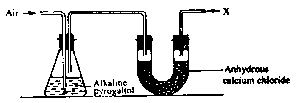
Question 0In the experiment above, X is a mixture of nitrogen, carbon (IV) oxide andA.waterB.impuritiesC.inert gasD.oxygenE.Objective Show full explanation
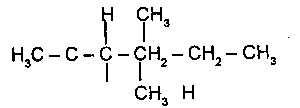
Question 0The IUPAC nomenclature of the compound above isA.2-ethylpentaneB.3,4-dimethylhexaneC.2,3-dimethylhexaneD.2-ethylhexaneE.Objective Show full explanation