Question 0The raw materials used for the smelting of iron ore in a furnace isA.CaSO4B.CaCO3C.CuSO4D.Zn(NO3)2E.Objective Show full explanation
Question 0On heating, which of the following compounds will decompose to the free metal, nitrogen (IV) oxide and oxygen?A.Ca(NO3)2B.Cu(NO3)2C.AgNO3D.NaNO3E.Objective Show full explanation
Question 0The group IA metals are not found free in nature because theyA.are very reactive and unstableB.are malleable and ductileC.have high melting and boiling pointD.conduct heat and electricityE.Objective Show full explanation
Question 0Carbon exist naturally in the combined state asA.graphiteB.coalC.diamondD.woodE.Objective Show full explanation
Question 0The efficiency of a solid catalyst to increase reaction rates depends on itsA.surface areaB.solubilityC.concentrationD.quantityE.Objective Show full explanation
Question 0Dynamic equilibrium describes a situation whereA.a reaction gives back the reactantB.te concentration of the reactant and products is equalC.both forward and and reverse reactions proceed at the same rateD.reactants are converted to productsE.Objective Show full explanation
Question 0The ion that will give a white precipitate with aqueous NaOH and soluble in excess of the base isA.Ca2+B.Mg2+C.Zn2+D.Cu2+E.Objective Show full explanation
Question 0Which of the following pairs of substance will react further with oxygen to form a higher oxide?A.CO2 and H2OB.NO and H2OC.CO and CO2D.SO2 and NOE.Objective Show full explanation
Question 0The characteristic colour of the flame shown when a copper sail moistened with concentrated hydrochloric acid on a platinum wire is put on bunsen burner isA.lilacB.greenC.yellowD.brick-redE.Objective Show full explanation
Question 0In the industrial production of H2 from natural gas the CO2 produced along with the H2 is removed byA.washing under pressureB.drying over phosphorus (V) oxideC.passing the mixture into lime waterD.using ammonical copper (I) chlorideE.Objective Show full explanation
Question 0The sulphide which is insoluble in dilute hydrochloric acid isA.FeSB.CuSC.ZnSD.Na2SE.Objective Show full explanation
Question 0Which of the following typically represents a photochemical reaction?A.Formation of water from hydrogen and oxygen moleculesB.Conversion of dinitrogen (IV) oxide to nitrogen (IV) oxideC.Decomposition of calcium hydroxide to its oxideD.Conversion of silver halides to grey metallic silverE.Objective Show full explanation
Question 0The gas obtained as a product of anaerobic action on organic matter buried in the earth isA.etheneB.methaneC.carbon (IV) oxideD.nitrogen (IV) oxideE.Objective Show full explanation
Question 0Nigerian crude oil is described as light crude because of itsA.low sulphur contentB.high natural gas contentC.high octane numberD.low aliphatic-hydrocarbon contentE.Objective Show full explanation
Question 0An example of aliphatic unsaturated hydrocarbon isA.pentaneB.butanolC.propeneD.benzeneE.Objective Show full explanation
Question 0Which of the following has an isomer?A.C6H6B.C2H6C.C4H10D.C2H4E.Objective Show full explanation
Question 0CH3 - CH2 - C CH The hybridization in the compound above isA.Sp2B.spC.sp3 and sp2D.sp3 and spE.Objective Show full explanation
Question 0One mole of a hydrocarbon contains 36g of carbon and its vapour density is 20. The structure of the hydrocarbon isA.CH3C ≡ CHB.CH3CH = CH2C.CH3CH2C ≡ CHD.CH3CH2 CH3E.Objective Show full explanation
Question 0An emulsion may be produced by shaking a detergent solution withA.palm wineB.ethanoic acidC.palm oilD.waterE.Objective Show full explanation
Question 0The products of the combustion of candle wax areA.hydrogen and waterB.oxygen and waterC.carbon (IV) oxide and waterD.carbon (II) oxide and waterE.Objective Show full explanation
Question 0When 50cm2 of a saturated solution of sugar of molar mass 342 g at 40oC was evaporated to dryness, 34.2g of dry solid was obtained. The solubility of sugar at 40oC isA.2.0 mol dm-3B.3.5 mol dm-3C.7.0 mol dm-3D.10.0 mol dm-3E.Objective Show full explanation
Question 0Which of the following results in the fall of acid rain?A.Oxides of leadB.Particulate matterC.Oxides of sulphurD.Gaseous hydrocarbonE.Objective Show full explanation
Question 0Water has the ability to dissolve almost all substance because its molecules has a structure withA.one positive end and one neutral endB.one positive end and one negative endC.two negative endsD.two positive endsE.Objective Show full explanation
Question 0When a crystal was added to the clear solution of its salt, the crystal did not dissolve and the solution remained unchange. This showed that the solution wasA.supersaturatedB.concentratedC.unsaturatedD.saturatedE.Objective Show full explanation
Question 0A particle that contains 11 protons, 12 neutrons and 10 electrons is probably aA.neutral non-metalB.metallic ionC.non-metallic ionD.neutral metalE.Objective Show full explanation
Question 0A difference between chemical and physical change is that in a chemical changeA.oxygen is consumedB.heat is suppliedC.a reversible process oocursD.a new substance is formedE.Objective Show full explanation
Question 0The volume of 2.5 moles of oxygen at s.t.p is [Molar volume of a gas at s.t.p = 22.4 dm3]A.50.0 dm3B.84.0 dm3C.28.0 dm3D.56.0 dm3E.Objective Show full explanation
Question 0Nuclear fission involves the splitting of a heavy element into two nuclei ofA.nearly equal masses with a relaese of energy and radiatonB.equal masses with a relaese of energyC.equal masses with a release of energy and radiationD.unequal masses without any relaese of energyE.Objective Show full explanation
Question 0What is the molar mass of a substance, if 0.4 mole of the substance has a mass of 25.0g?A.62.5 gB.40.0 gC.6.3 gD.2.5 gE.Objective Show full explanation
Question 0The element with the electron configuration 1s22s22p3 isA.calciumB.chlorineC.oxygenD.nitrogenE.Objective Show full explanation
Question 0A decrease in atomic size and an increase in nuclear charge across a period lead toA.an increase in the tendency to lose electronB.an increase in chemical reactivityC.a decrease in electropositivityD.a decrease in covalency in bond formationE.Objective Show full explanation
Question 0The order in which a mixture of sand, ammonium chloride and sodium chloride can be separated isA.dissolution → dryness → filtration → evaporationB.filtration → sublimation → evaporation → drynessC.sublimation → dissolution → filtration → evaporationD.dissolution → filtration → sublimation → evaporationE.Objective Show full explanation
Question 0The idea of planetary electron was that ofA.RutherfordB.ThompsonC.BohrD.DaltonE.Objective Show full explanation
Question 0If 30cm3 of gas at 50oC is warmed to 80o at a fixed pressure, the fractional increase in volume isA.0.009B.0.093C.0.910D.1.090E.Objective Show full explanation
Question 02C2H2(g) + 5O2(g) → 4CO2(g) + 2H2O(g) In the reaction above, the mass of carbon(IV)oxide produced on burning 78 g of ethyne is [C =12, O = 16, H = 1]A.264 gB.39 gC.352 gD.156 gE.Objective Show full explanation
Question 0The ion that can be used as an oxidizing agent isA.Au3+B.Fe3+C.F-D.Ca2+E.Objective Show full explanation
Question 0H2(g) + Br2(g) → 2HBr(g) The above reaction is carried out at 25oC. ΔH is -72 kJ mol-1 and ΔS is - 106 J mol-1K-1, the reaction willA.not proceed spontaneously at the givenB.proceed spontaneously at the given temperatureC.proceed in the reverse direction at the given temperatureD.proceed spontenously at lower temperatureE.Objective Show full explanation
Question 0Zinc and carbon rods are used as anode and cathode respectively in aA.Leclanche cellB.lead accumulatorC.Daniel cellD.voltaic cellE.Objective Show full explanation
Question 0The solution that will conduct the highest amount of electricity isA.0.5 mol dm-3 of hydrochloric acidB.2.0 mol dm-3 of hydrochloric acidC.0.5 mol dm-3 ethanoic acidD.2.0 mol dm-3 ethanoic acidE.Objective Show full explanation
Question 0In which of the following is the oxidation number of sulphur equal to -2?A.SO3B.S8C.H2SD.SO2E.Objective Show full explanation
Question 0In the electrolysis of CuSO4(g) using platinum electrodes, the reaction at the anode isA.4H+ + 4e- → 2H2B.4OH- - 4e- → 2H2O + O2C.2OH - 2e- → 2OHD.2OH- + 2OH- → 2H2O + O2E.Objective Show full explanation
Question 0Na2CO3(g) + 2HCl(aq) → 2NaCl(aq) + H2O(l) + CO2(g) How many moles of sodium trioxocarbonate (IV) are there in a 25 cm3 solution which required 10cm3 of 0.05 mol dm-3 hydrochloric acid solution to neutralize it?A.1.000 moleB.0.100 moleC.0.010 mole`D.0.111 moleE.Objective Show full explanation
Question 0If the heat of combustion of hydrogen is -285.8kJ, What is the heat of formation of water?A.+571.6 kJB.-571.6 kJC.-285.8 kJD.+285.8 kJE.Objective Show full explanation
Question 05SO2(g) + 2KMnO4(aq) + 2H2O(l) → K2SO4 + 2MnSO4(aq) + 2H2SO4(aq) In the reaction above, the products give aA.purple solutionB.purple precipitateC.colourless precipitateD.colourless solutionE.Objective Show full explanation
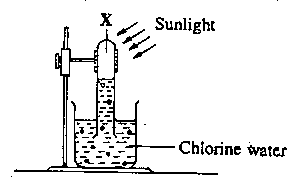
Question 0In the diagram above, gas X isA.hydrogenB.chlorineC.oxygenD.hydrogen chlorideE.Objective Show full explanation
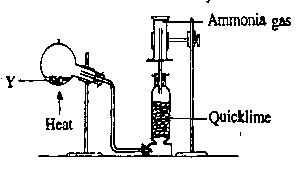
Question 0In the diagram above, mixture Y isA.NH4NO3(s) + CaSO4(s),/sub>B.NH4CL(s) + NaNO2(s)C.NH4NO2(s) + Na2SO4(s)D.NH4CL(s) + Ca(OH)2(s)E.Objective Show full explanation
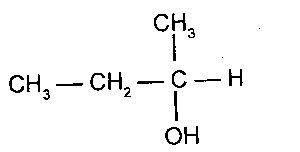
Question 0The oxidation of the compound above producesA.2-butanoneB.2-butanalC.3-butanalD.3-butanoneE.Objective Show full explanation
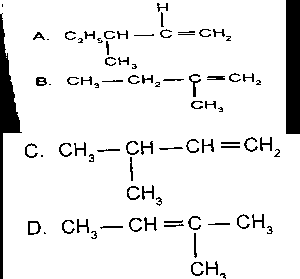
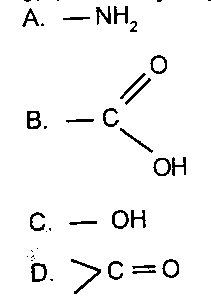
Question 0Which of the following functional groups will give gas bubbles when treated with a saturated solution of sodium hydrogen trioxocarbonate (IV)?A.AB.BC.CD.DE.Objective Show full explanation