Question 0Chlorophyll obtained from given leaves of plant can be shown to be composed of more than one coloured component by the technique ofA.crystallizationB.hydrolysisC.chromatographyD.sublimationE.Objective Show full explanation
Question 0In countries where the temperature falls below 273K, salt is always sprinkled on the icy road in order toA.lower the melting point of the iceB.increase the density of the iceC.make the ice impureD.raise the melting point of the iceE.Objective Show full explanation
Question 02Na(s) + 2H2O(l) → 2NaOH(aq) + H2(g) From the equation above, calculate the mass of sodium hydroxide produced by 2.3g of sodium. [H = 1, O = 16, Na = 23]A.0.40gB.0.80gC.4.00gD.8.00gE.Objective Show full explanation
Question 016.8 g of sodium hydrogen trioxocarbonate (IV) is completely decomposed by heat. Calculate the volume of carbon(IV) oxide given off s.t.p [Na 23, C = 12, O = 16, H = 1, Molar volume of a gas at s.t.p = 22.4 dm3]A.22.40 dm3B.11.20 dm3C.2.24 dm3D.1.12 dm3E.Objective Show full explanation
Question 0300 cm3 of gas has a pressure of 800 mmHg. If the pressure is reduced to 650 mmHg, find its volumeA.243.75 cm3B.369.23 cm3C.738.46 cm3D.1733.36 cm3E.Objective Show full explanation
Question 0Diffusion is slowest in solid particles than in particles of liquid and gases becauseA.solid particles have more kinetic energy than the particles of liquid and gasesB.solid particles have less kinetic energy than the particles of liqiud and gasesC.solid particles have less restriction in their movement than liquid and gas particlesD.the particles in solids are far apart and the cohesive forces between them are negligibleE.Objective Show full explanation
Question 0The experiment that showed that atoms have tiny positively charged nucleus was first carried out byA.MoseleyB.RutherfordC.MillikanD.DaltonE.Objective Show full explanation
Question 0The atom of an element X is represented as zyX. The basic chemical properties of X depends on the value ofA.YB.ZC.Y - ZD.Z - YE.Objective Show full explanation
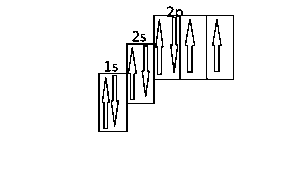
Question 0The diagram above represent the electron sub-level forA.carbonB.nitrogenC.oxygenD.flourineE.Objective Show full explanation
Question 0In the periodic table, the electrical and thermal conductivities are properties of elements thatA.decrease across the period and increase down the groupB.increase across the period and decrease down the groupC.decrease across the period and down the group`D.increase acrosss the period and down the groupE.Objective Show full explanation
Question 0\( _{11} ^{11}Na + _0^1n → _{11}^{24}Na \) The reaction above is an example ofA.nuclear fissionB.nuclear fusionC.artificial transmutationD.beta decayE.Objective Show full explanation
Question 0Air boiled out of water as steam is richer inA.nitrogen and oxygenB.carbon (IV) oxide and oxygenC.noble gases and carbon (IV) oxideD.oxygen and noble gasesE.Objective Show full explanation
Question 0In the course of purifying water for town supply the water is passed through large settlings tanks, containing sodium aluminate (III) to removeA.large particlesB.germsC.fine particlesD.odourE.Objective Show full explanation
Question 0When a few drops of water is added to a blue anhydrous cobalt (II) chloride, the colour changes toA.whiteB.pinkC.redD.blueE.Objective Show full explanation
Question 0The vulcanizer's solution is prepared by dissolving rubber inA.ethanolB.kerosineC.benzeneD.petrolE.Objective Show full explanation
Question 0117.0g of sodium chloride was dissolved in the solubility in 1.0dm3 of distilled water at 25oC. Determine the solubility in mol dm-3 of sodium chloride at that temperature [Na = 23, Cl = 35.5]A.1.0B.2.0C.3.0D.4.0E.Objective Show full explanation
Question 0The uncovered raw food that is sold along major roads is likely to contain some amounts ofA.PbB.CuC.AgD.NaE.Objective Show full explanation
Question 0What is the pH of 0.001 mol dm-3 solution of sodium hydroxideA.14B.13C.12D.11E.Objective Show full explanation
Question 00.05 mol dm-3 HCl is neutralized by 25 cm3 NaOH. If the volume of acid used is 32.00cm3, what is the concentration of the baseA.0.016 mol dm-3B.0.032 mol dm-3C.0.039 mol dm-3D.0.064 mol dm-3E.Objective Show full explanation
Question 0Insoluble salts can be prepared byA.titrating an alkali against an appropriate acidB.reacting an acid with trioxocarbonatr (IV) saltC.directing combination of the elements which make up the saltD.mixing two soluble compounds containing the metallic radical and the acidic radicalE.Objective Show full explanation
Question 0The oxidation state of carbon in HCOOH isA.-1B.+2C.+3D.zeroE.Objective Show full explanation
Question 0What is the IUPAC nomenclature of the compound NaCIO?A.sodium oxochlorate (I)B.sodium chloro (I) oxideC.sodium monooxochlorate (II)D.sodium chloro (I) monoxideE.Objective Show full explanation
Question 0In recharging a lead-acid accumulator, the reaction at the cathode can be represented asA.Pb2+(aq) + SO2-4(aq) →PbSO4(s)B.Pb2+(aq) + 2e- →Pb(s)C.Pb2+(aq) + 2H2O(l) → PbO2(s) + 4H+(aq) + 4e-D.Pb(s) → Pb2+(aq) + 2e-E.Objective Show full explanation
Question 0If a given quantity of electricity liberates 0.65g of Zn2+, what amount of Hg2+ would be liberated by the same quantity of current? [Zn = 65, Hg = 201]A.1.00gB.2.10gC.4.02gD.8.04gE.Objective Show full explanation
Question 0NH3(g) + HCl(s) → NH4Cl(s) The entropy change in the system above isA.positiveB.zeroC.negativeD.indeterminateE.Objective Show full explanation
Question 0Which of the following reaction is endothermic?A.C(s) + O2(g) → CO2(g)B.CaO(s) + H2O(l) → Ca(OH)2(s)C.C(s) + H2O(g) → CO(g) + H2(g)D.HCl(aq) + NaOH(aq) → NaCl(aq) + H2O(l)E.Objective Show full explanation
Question 0A catalyst speeds up the rate of chemical reaction byA.taking part in the reactionB.increasing the activation energy of the reactionC.lowering the activation energy of the reactionD.increasing the heat contentE.Objective Show full explanation
Question 0The rate of a reaction usually decrease in the concentration of reactants becauseA.kinetic energy decreaseB.temperature increaseC.speed increasesD.reactants collision decreaseE.Objective Show full explanation
Question 0The substance that is used in the steel industry for the removal of carbon, sulphur and phosphorus impurities from pig iron isA.oxygenB.chlorineC.nitrogenD.hydrogenE.Objective Show full explanation
Question 0Which of the following compounds of trioxonitrate (V) will decomposes to give dinitrogen (i) oxide and water when heated?A.NaNO3B.Zn(NO3)2C.Cu(NO3)2D.NH4NO3E.Objective Show full explanation
Question 0When a solution of ammonium trioxocarbonate (IV) is added to a solution of an unknown salt, a white precipitate which is soluble in dilute hydrochloric acid but insoluble in ethanoic acid is formed. This indicates the presence ofA.Ca2+B.Na+C.Zn2+D.K+E.Objective Show full explanation
Question 0Leads is used for making bullets and lead shots because of itsA.resistance to corrosionB.low melting pointC.high densityD.flexibilityE.Objective Show full explanation
Question 0which of the following gives a precipitate when treated with NaOH solution?A.AlCl3B.NH4ClC.Na2CO3D.CH3COONaE.Objective Show full explanation
Question 0The most common ores of iron includeA.haematite, malachite and limoniteB.chalcolite, calamine and borniteC.magnetite, haematite and borniteD.magnetite, chalcolite and borniteE.Objective Show full explanation
Question 0The type of isomerism shown by cis- and trans- isomers isA.optical isomerismB.positional isomerismC.functional isomerismD.geometrical isomerismE.Objective Show full explanation
Question 0If the silver mirror test is positive, it indicates the presence of anA.alkyneB.alkanolC.alkanoneD.alkanalE.Objective Show full explanation
Question 0If glucose is heated with concentration tetraoxosulphate (VI) acid, it will be dehydrated toA.carbonB.carbon (IV) oxideC.etheneD.ethanolE.Objective Show full explanation
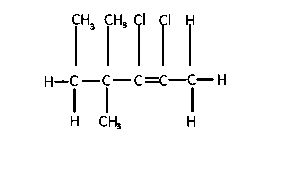
Question 0The IUPAC nomenclature for the structure above isA.2, 3 - dichloro - 4, 4, 5 - trimethyl pent - 2 - eneB.4, 5 - dichloro - 2, 3 - dimethyl hex - 2 - eneC.2, 3 - dichloro - 4, 4 - dimethyl hex - 2- eneD.2, 3 dichloro - 2, 2 - dimethyl hex - 2 - eneE.Objective Show full explanation
Question 0A hydrocarbon X with a molar mass of 26 consists of 92.3% carbon. What is its molecular formularA.C2H2B.C3H3C.C4H4D.C5H5E.Objective Show full explanation
Question 0A red precipitate of copper (I) carbide is formed when ammonium solution of copper (I) chloride is introduced intoA.CH2 = CH - CH2 - CH3B.CH3 CH2 - C ≡ CHC.CH3 CH2 CH2 CH3D.CH3 - C C - CH3E.Objective Show full explanation
Question 0Reduction of nitroalkanes, nitrites and amides is a route for the preparation ofA.aminesB.alkenesC.polymersD.detergentsE.Objective Show full explanation
Question 0Reduction of alkanonoes with LialH4 producesA.primary alkanolsB.secondary alkanolsC.tertiary alkanolsD.polyhydric alkanolsE.Objective Show full explanation
Question 0The product obtained when a mixture of benzene vapour and hydrogen are passed over nickel catalyst at 180oC isA.cyclohexaneB.cyclopentaneC.n- hexaneD.n - pentaneE.Objective Show full explanation
Question 0Polyvinyl chloride is used in the production ofA.glassB.alloyC.pipesD.ceramicsE.Objective Show full explanation
Question 0Detergents are manufactured with straight hydrocarbon chains so as to make themA.solubleB.biodegradableC.cheaperD.foamyE.Objective Show full explanation
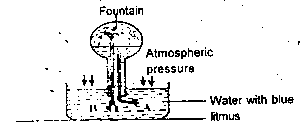
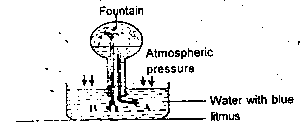
Question 0Use the diagram to answer this question. The gas that can be used to demonstrate the experiment isA.hydrogen chlorideB.hydrogen sulphideC.nitrogen(ll) oxideD.dinitrogen (l) oxideE.Objective Show full explanation
Question 0Use the diagram to answer this question.The colour of the fountain water isA.blueB.orangeC.redD.yellowE.Objective Show full explanation
Question 0Choose the correct option from the structure aboveA.AB.BC.CD.DE.Objective Show full explanation