Question 0A mixture is different from a compound becauseA.the properties of a compound are those of its individual constituents while those of a mixture differ from its constituentsB.a mixture is always homogeneous while a compound is notC.the constituent of a compound are chemically bound together while those of a mixture are notD.a mixture can be represented by a chemical formula while a compound cannotE.Objective Show full explanation
Question 0What is the percentage of sulphur in sulphur (IV) oxide?A.66%B.25%C.40%D.50%E.Objective Show full explanation
Question 0A gas X diffuses twice as fast as gas Y. if the relative molecular mass of X is 32, calculate the relative molecular mass of Y.A.128B.8C.16D.64E.Objective Show full explanation
Question 0200 cm3 of a gas at 25oC exerts a pressure of 700 mmHg. Calculate its pressure if its volume increase 350 cm3 at 75oC.A.342.53 mmHgB.1430.54 mmHgC.467.11 mmHgD.400.00 mmHgE.Objective Show full explanation
Question 0An element X has electron configuration 1s2 2s2 2p6 3s2 3p5. Which of the following statements is correct about the element?A.lt has a completely filled p-orbitalB.lt has 5 electrons in its outermost shell.C.lt belongs to group ll on the periodic tableD.lt is a halogenE.Objective Show full explanation
Question 0Beryllium and aluminium have similar properties because theyA.are both metalsB.belong to the same groupC.belong to the same periodD.are positioned diagonally to each otherE.Objective Show full explanation
Question 0If the difference in electronegativity of elements P and Q is 3.0. The bond that will be formed between them isA.metallicB.covalentC.co-ordinateD.ionicE.Objective Show full explanation
Question 0How many protons, neutrons and electrons respectively are present in the element 60/27 Co?A.27, 33 and 33B.33, 27 and 27C.27, 33, and 27D.60, 33 and 60E.Objective Show full explanation
Question 0The radio active radiation used in studying the arrangement of particles in giant organic molecules isA.\(\gamma\)- raysB.\(\alpha\)- particlesC.X-raysD.\(\beta\) - particlesE.Objective Show full explanation
Question 0A silicon -containing ore has 92% 28Si, 5% 29Si and 3% 30Si. Calculate the relative atomic mass of the silicon.A.14.00B.29.00C.28.11D.28.00E.Objective Show full explanation
Question 0The nitrogen obtained from air has a density higher than the one from nitrogen-containing compounds because the one from air is contaminated withA.water vapourB.oxgyenC.rare gasesD.carbon (IV) oxideE.Objective Show full explanation
Question 0Water is said to be temporarily hard when it containsA.Ca (HCO3)2 and Mg (HCO3)2 saltsB.Ca (HCO3)2 and CaCO3 SALTSC.Mg(HCO3)2 and CaSO4 saltsD.CaSO4 and Ca(HCO3)2 saltsE.Objective Show full explanation
Question 0On exposure to the atmosphere, a hydrated salt loses its water of crystallization to become anhydrous. This phenomenon is referred to asA.efflorescenceB.diliquescenceC.hygroscopyD.hydrolysisE.Objective Show full explanation
Question 016.55g of lead (ll) trioxonitrate (V) was dissolved in 100g of distilled water at 20oC, calculate the solubility of the solute in moldm-3 [Pb = 207, N = 14, O = 16]A.0.05 gB.2.00 gC.1.00 gD.none of the aboveE.Objective Show full explanation
Question 0The dispersion of a liquid in a liquid medium will giveA.an emulsionB.a fogC.a gelD.an aerosolE.Objective Show full explanation
Question 0The major and most effective way of controlling pollution is toA.improve machinery so that the substances released from combustion are less harmfulB.pass strict laws against it by individuals and companiesC.educate people on the causes and effects of pollutionD.convert chemical wastes to harmless substances before releasing them into the environmentE.Objective Show full explanation
Question 0The colour of litmus in a neutral medium isA.purpleB.pinkC.yellowD.orangeE.Objective Show full explanation
Question 0The mathematical expression of PH isA.log 10[OH-]B.log 101/[H 3 O+]C.log 10[H 3 O+]D.log 101/[OH -]E.Objective Show full explanation
Question 0Which of the following salts will turn blue litmus red?A.Sodium tetrahydroxozincate (ll)B.Potassium hydrogentetraoxosulphate (lV)C.Sodium trioxocarbonate (lV)D.Zinc chloride hydroxideE.Objective Show full explanation
Question 0Zn (s) + CuSO 4(aq) → ZnSO 4(aq) + Cu (s) In the reaction above, the oxidation number of the reducing agent changes fromA.0 to + 4B.0 to + 2C.+ 1 to + 2D.+ 1 to + 3E.Objective Show full explanation
Question 0H 2O (g) + C (s) → H2(g) + CO(g) The oxidizing agent in the reaction above isA.CO(g)B.C(s)C.H2O(g)D.H(2)(g)E.Objective Show full explanation
Question 0Calculate the quantity of electricity in coulombs required to liberate 10g of copper from a copper compound [Cu=64, F = 96500 Cmol-1]A.32395.5B.30156.3C.60784.5D.15196.5E.Objective Show full explanation
Question 0How many faraday of electricity is required to produce 0.25 mole of copper?A.1.00FB.0.01FC.0.05FD.0.50FE.Objective Show full explanation
Question 0If the change in free energy of a system is -899 Jmol-1 and the entropy change is 10Jmol-1k-1 at 250C, calculate the enthalpy change.A.+2081 Jmol-1B.-2081 Jmol-1C.-649 Jmol-1D.+649 Jmol-1E.Objective Show full explanation
Question 0In an equilibrium reaction, which of the following conditions indicates that maximum yield of the product will be obtained?A.Equilibrium constant is very largeB.∆H - T∆S = OC.∆ H > T ∆ SD.Equilibrium constant is less than zeroE.Objective Show full explanation
Question 0In a chemical reaction, the change in concentration of a reactant with time isA.entropy of reactionB.enthalpy of reactionC.rate of reactionD.order of reactionE.Objective Show full explanation
Question 0Cr 2O\(\frac{2 -}{7}\) (aq) + H 2O(1)⇌ 2CrO \(\frac{2 -}{4}\) (aq) + 2H + (aq) What happens to the reaction above when the hydrogen ion concentration is increased?A.more of the products will be formedB.the reaction will not proceedC.the equilibrium position will shift to the rightD.the equilibrium position will shift to the left.E.Objective Show full explanation
Question 0Which of the following will shift to the left from dilute tetraoxosulphate (VI) acid?A.LeadB.MagnesiumC.CpperD.GoldE.Objective Show full explanation
Question 0The gas that is removed by the water in the flask isA.O 2B.SO 2C.HCID.H 2E.Objective Show full explanation
Question 0Fluorine does not occur in the free state in nature becauseA.it is a poisonous gasB.it belongs to the halogen familyC.it is inertD.of its high reactivityE.Objective Show full explanation
Question 0In the extraction of sodium from fused sodium chloride, the anode is made of platinum becauseA.sodium is formed at the anodeB.chlorine is formed at the anodeC.sodium does not react with platinumD.chlorine does not react with platinumE.Objective Show full explanation
Question 0In the electrolytic extraction of cacium from calcium chloride, the cathode isA.zincB.graphiteC.platinumD.ironE.Objective Show full explanation
Question 0A compound that gives a brick-red colour to a non-luminous flame is likely to containA.copper ionsB.sodium ionsC.calcium ionsD.aluminium ionsE.Objective Show full explanation
Question 0A few drops of NaOH solution was added to an unknown salt forming a white precipitate which is insoluble in excess solution. The cation likely present isA.Zn2+B.Pb2+C.Ca2+D.Al3+E.Objective Show full explanation
Question 0The general formula of haloalkanes where X represents the halide isA.Cn H 2n-1X.B.C nH 2nX.C.C nH 2n+2 XD.C nH 2n+1XE.Objective Show full explanation
Question 0The alkanol obtained from the production of soap isA.propanolB.ethanolC.glycerolD.methanolE.Objective Show full explanation
Question 0Ethyne is passed through a hot tube containing organo-nickel catalyst to produceA.isopreneB.polytheneC.ethanolD.benzeneE.Objective Show full explanation
Question 0Due to the unstable nature of ethyne, it is stored by dissolving inA.ethane-1,2-diolB.propanolC.ethanoic acidD.propanoneE.Objective Show full explanation
Question 0The process of converting starch to ethanol isA.crackingB.distillationC.fermentationD.oxidationE.Objective Show full explanation
Question 0The polymer used in making car rear lights isA.perspexB.bakeeliteC.polystyreneD.polyacrylonitrileE.Objective Show full explanation
Question 0CH3COOC2H5(1) + H2O(1) ⇌ CH 3COOH (aq) + C 2H 5OH (aq) The purpose of H+ in the reaction above is toA.increase the yield of productsB.maintain the solution at a constant PHC.increase the rate of the hydrolysisD.decrease the rate of the reverse reactionE.Objective Show full explanation
Question 0A hydrocarbon has an empirical formula CH and a vapour density of 39. Determine its molecular formula. [C = 12, H = 1]A.C2H6B.C3H8C.C3H4D.C6H6E.Objective Show full explanation
Question 0Polystyrene is widely used as packaging materials for fragile objects during transportation because of itsA.ligjtnessB.low densityC.high densityD.high compressibilityE.Objective Show full explanation
Question 0The process of converting linear alkanes to branched chain and cyclic hydrocarbons by heating in the presence of a catalyst to improve the quality of petrol is referred to asA.refiningB.crachingC.reformingD.blendingE.Objective Show full explanation
Question 0The petroleum fraction that is used in heating furnaces in industries isA.diesel oilB.gasolineC.keroseneD.lubricating oilE.Objective Show full explanation
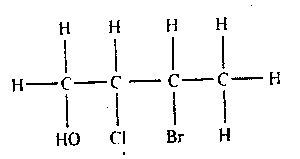
Question 0The IUPAC nomenclature of the compound above isA.2-bromo-3-chlorobutanolB.3-bromo-2-chlorobutanolC.3-chloro-2-bromobutanolD.2-chloro-3-bromobutanolE.Objective Show full explanation
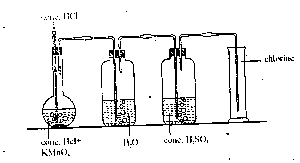
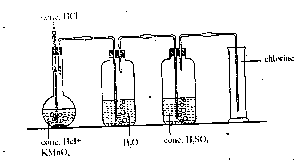
Question 0In the diagram, the function of the concentrated H2SO4 is toA.purify the gasB.dry the gasC.liquefty the gasD.remove odourE.Objective Show full explanation
Question 0The gas that is removed by the water in the flask isA.O2B.SO2C.HCI.D.H2E.Objective Show full explanation
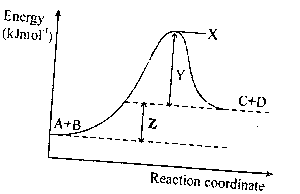
Question 0Z in diagram above representsA.heat of reactionB.activation energyC.free energyD.entropy of reactionE.Objective Show full explanation