Question 0In an electrochemical cell, polarization is caused byA.OxygenB.HydrogenC.Tetraoxosulphate(IV) acidD.ChlorineE.Objective Show full explanation
Question 0The condition required for corrosion to take place is the presence ofA.Oxygen and Carbon (IV) oxideB.Water and OxygenC.Water and Carbon (IV) oxide and OxygenD.Water and Carbon (IV) oxideE.Objective Show full explanation
Question 0The enzyme used in the hydrolysis of starch to dextrin and maltose isA.ZymaseB.SucraseC.AmylaseD.LactaseE.Objective Show full explanation
Question 0In the laboratory preparation of chlorine from concentrated hydrochloric acid in the presence of potassuim tetraoxomanganate(VII) the produced is dried by passing it throughA.Concentrated tetraoxosulphate (VI) acidB.Anhydrous calcium chlorideC.Calcium oxideD.Sodium hydroxideE.Objective Show full explanation
Question 0The monomer of nylon isA.HydroxybenzeneB.Hexanedioic acidC.Benzene -1,-4-dicarboxylic acidD.Ethane-1,2-diolE.Objective Show full explanation
Question 0The principle of column chromatography is based on th ability of the constituents toA.React with the solvent in the columnB.React with each other in the solvent in the columnC.Dissolve in each other in the columnD.Move at different speeds in the columnE.Objective Show full explanation
Question 0Ammonium chloride can be separated from its mixture with common salt byA.DistillationB.EvaporationC.DecantationD.SublimationE.Objective Show full explanation
Question 0The ability of carbon to form long chains is referred to asA.AlkylationB.AcylationC.CarbonationD.CatenationE.Objective Show full explanation
Question 0The industrial preparation of hydrogen gas from water gas is referred to asA.Bosch processB.Contact processC.Haber processD.Bayer ProcessE.Objective Show full explanation
Question 0The relative atomic mass of a naturally occurring lithium consisting of 90%\(\frac{7}{3}\)Li and 10%\(\frac{6}{3}\)Li isA.6.2B.6.8C.7.1D.6.9E.Objective Show full explanation
Question 0The colour of litmus in an alkaline medium isA.RedB.YellowC.PinkD.BlueE.Objective Show full explanation
Question 0The compounds CH3CH2CHO and CH3COCH3 can be distinguished from each other usingA.Dilute ammoniaB.Benedict's solutionC.Tollen's reagentD.Sodium hydroxide solutionE.Objective Show full explanation
Question 0Which of the following statements is true about 2-methylpropane and butaneA.They have different number of carbon atomsB.They are members of same homologous seriesC.They have the same boiling pointsD.They have the same chemical propertiesE.Objective Show full explanation
Question 0The process that requires the use of hardwater in its operation isA.TanningB.BottlingC.LaundryD.DyeingE.Objective Show full explanation
Question 0What is the concentration of a solution containing 2g of NaOH in 100cm3 of solution? [Na=23, O=16, H=1]A.0.05 moldm-3B.0.30 moldm-3C.0.50 moldm-3D.0.40 moldm-3E.Objective Show full explanation
Question 0The radioisotope used in industrial radiography for the rapid checking of faults in welds and casting isA.Phosphorus-32B.Cobalt-60C.Carbon-14D.Iodine-131E.Objective Show full explanation
Question 0The compound produced when sodium peroxide is heated with excess sodium isA.Na2CO3B.Na2OC.NaNO2D.NaOHE.Objective Show full explanation
Question 0The pollutant that contributes to the depletion of the ozone layer isA.CFCsB.NO2C.SO2D.COE.Objective Show full explanation
Question 0Which of the following properties is not peculiar to matter?A.Kinetic energy of particles increases from solid to gasB.Random motion of particles increases from gas to solidC.Orderliness of particles increases from gas to liquidD.Random motion of particles increases from liquid to gasE.Objective Show full explanation
Question 0Cast iron is used in makingA.Chains and agricultural implementsB.Iron sheets and retort standC.Nails and iron rodsD.Stoves and cookersE.Objective Show full explanation
Question 0Which of the following compounds is used as a gaseous fuel?A.CH3 -CH2 -CHO2 -COOHB.CH3 -C = CHC.CH3 -CH2 -CH2 -CH3D.CH2 -CH2 -CH3E.Objective Show full explanation
Question 0The product formed when propanol is heated over a copper catalyst in the absence of oxygen areA.CH3CH2CHO and H2B.CH3CHO and CO2C.CH3CH2COOH and H2D.CH3COOH and CO2E.Objective Show full explanation
Question 0Alkanols have the general molecular formulaA.C1H2n-2B.C1H2n-1CHOC.C1H2n-2OHD.C2H2n+1OHE.Objective Show full explanation
Question 0Which of the following is not an alkali?A.Ca(OH)2B.NH3C.NaOHD.Al(OH)3E.Objective Show full explanation
Question 0Which of the following statements is correct about the periodic table?A.Elements in the same group have the same number of electron shellsB.The non-metallic properties of the elements tend to decrease across each periodC.Elements in the same period have the same number of valence electronsD.The valence electrons of the elements increase progressively across the periodE.Objective Show full explanation
Question 0The metal whose ore can be concentrated by passing it through a magnetic separator isA.ZnB.SnC.CnD.CaE.Objective Show full explanation
Question 0What volume of 0.5 MH2SO4 will exactly neutralize 20cm3 of 0.1 MNaOH Solution?A.2.0cm 3B.5.0cm 3C.6.8cm 3D.8.3cm 3E.Objective Show full explanation
Question 0Diamond cannot be usedA.In making bicycle chainsB.As abrasivesC.In cutting glass and metalsD.As dies for drawing wiresE.Objective Show full explanation
Question 0Ethanol is soluble in water due to the presence of aA.Carbonyl groupB.Hydroxyl groupdC.Phenyl groupD.Methyl groupE.Objective Show full explanation
Question 0The number of electronic shells contained in an atom with electron configuration 1s22s22p63s23p64s2 isA.3B.2C.4D.5E.Objective Show full explanation
Question 0The drying agent suitable for drying ammonia isA.Calcium ChlorideB.Calcium OxideC.Phosphorus(V) OxideD.Concentrated H2SO4E.Objective Show full explanation
Question 0The arrangement of particles in crystal lattices can be studied usingA.X-raysB.\(\beta\)-raysC.\(\alpha\)-raysD.\(\gamma\)-raysE.Objective Show full explanation
Question 0In the extraction of iron, the waste gas from the furnace is a mixture ofA.PH3 CO and CO2B.CO and CC.N2 , CO and CO2D.PH3 and COE.Objective Show full explanation
Question 0In a neutralization reaction involving HCI and NaOH using litmus as indicator, the colour at the end point isA.BlueB.RedC.OrangeD.PurpleE.Objective Show full explanation
Question 0An example of a solid emulsion isA.ButterB.Hair creamC.MilkD.Cod-liver oilE.Objective Show full explanation
Question 0An isotope has an atomic number of 15 and a mass number of 31. The number of proton it contains isA.16B.15C.31D.46E.Objective Show full explanation
Question 0Calculate the volume in cm3 of oxygen evolved at s.t.p when a current of 5A is passed through acidified water for 193s? [F = 96500 C mol1. Molar volume of a gas at s.t.p = 22.4dm3]A.0.056dm3B.0.224dm3C.224.000dm3D.56.000dm3E.Objective Show full explanation
Question 0The gas that is used for the treatment of cancer isA.NeonB.RadonC.XenonD.ArgonE.Objective Show full explanation
Question 0A chemical reaction in which the hydration energy is greater than the lattice energy is referred to asA.A reversible reactionB.A spontenous reactionC.An endothermic reactionD.An exothermic reactionE.Objective Show full explanation
Question 0MnO4(aq) + Y 5Fe2+ (aq) \(\mapsto\) Mn2+ (aq) + 5Fe 2+ (aq) + 4H2O(1) In the equation above, Y isA.10H+ (aq)B.5H+ (aq)C.8H+ (aq)D.4H+ (aq)E.Objective Show full explanation
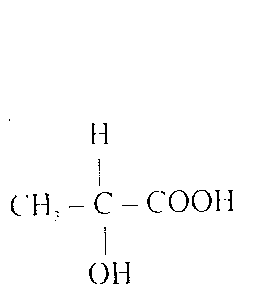
Question 0The compound above exhibitsA.Geometric isomerismB.Positional isomerismC.Structural isomerismD.Optical isomerismE.Objective Show full explanation
Question 0n monosaccharide \( \underset{Q}{\stackrel{P}{\rightleftharpoons}} \) polysaccharide -n water. In the process above, P and Q respectively representA.Condensation and hydrolysisB.Fermentation and condensationC.Polymerization and hydrolysisD.Polymerization and condensationE.Objective Show full explanation
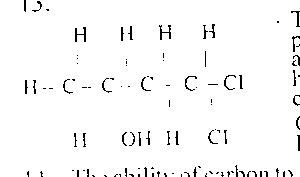
Question 0The functional groups present in the compound above areA.Alkene and halo-groupB.Hydroxyl and chloro-groupC.Alkene and chloro-groupD.Hydroxyl and halo-groupE.Objective Show full explanation
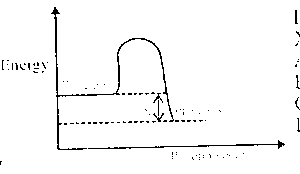
Question 0In the diagram above, X is theA.EnthalphyB.Activated complexC.Activation energyD.Enthalphy changeE.Objective Show full explanation
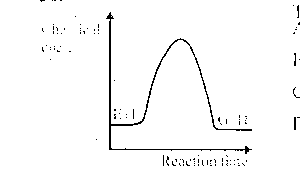
Question 0The diagram representsA.A spontaneous reactionB.An exothermic reactionC.A non-spontaneousD.An endothermic reactionE.Objective Show full explanation
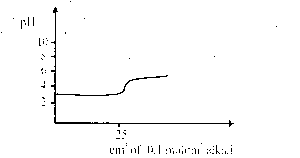
Question 0The curve depicts titration betweenA.Strong acid and strong baseB.Strong acid and weak baseC.Weak acid and weak baseD.Weak acid and strong baseE.Objective Show full explanation
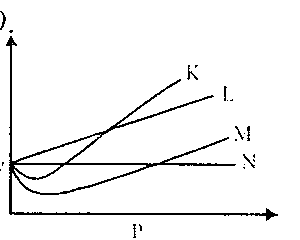
Question 0From the diagram above, an ideal gas can be represented byA.KB.MC.LD.NE.Objective Show full explanation
Question 0CH4(g) + CI2(g) \(\to\) CH2CI(s) + HCIg The major factor that influences the rate of the reaction above isA.ConcentrationB.CatalystC.TemperatureD.LightE.Objective Show full explanation
Question 0N2O4(aq) \(\rightleftharpoons\) 2NO2(g) \(\bigtriangleup\)H = +ve In the reaction above, an increase in temperature willA.Increase the reactant productionB.Increase the value of the equilibrium constantC.Shift the equilibrium to the leftD.Decrease the value of the equilibrium constantE.Objective Show full explanation