Question 0The law of variable proportions is also known asA.law of demandB.law of diminishing returnsC.law of diminishing marginal utilityD.law of returns to scaleE.Objective Show full explanation
Question 0All the following are problems identified with agriculture in West Africa exceptA.land tenure systemB.ignorance of the farmersC.use of crude implementD.provision of food for the teeming populationE.Objective Show full explanation
Question 0Revenue can be expressed asA.total Profit made after salesB.amount of goods producedC.total money realized from salesD.amount spent on purchasesE.Objective Show full explanation
Question 0All the following are factors that would bring about a change in supply exceptA.level of technologyB.government policyC.Entry of new firmsD.Price of the commodityE.Objective Show full explanation
Question 0The combination of two commodities each yielding the same level of satisfaction to the consumer isA.consumer surplusB.indifference curveC.budget constantD.goods of necessityE.Objective Show full explanation
Question 0In which situation is it likely that the demand for labour would be inelastic?A.Labour and capital are close substitutesB.Labour costs are only a small proportion of total costsC.Demand for the final product that the labour produces is elasticD.A large quantity of unemployed labour is available in the economyE.Objective Show full explanation
Question 0The headquarter of the Organization Of Petroleum Exporting Countries (OPEC) is inA.Paris, FranceB.Geneva, SwitzerlandC.Lagos, NigeriaD.Vienna, AustriaE.Objective Show full explanation
Question 0What will increase the likelihood that the firms in an industry will conclude to maximize their joint profit?A.The industry has many differentiated productsB.The industry is characterized by rapid technological changeC.The industry consist of large number of producersD.There are significant barriers to prevent firms entering the marketE.Objective Show full explanation
Question 0A commercial bank can create money byA.issuing currencyB.increasing cash ratioC.issuing chequeD.lending to borrowersE.Objective Show full explanation
Question 0The source of all economic problems arises fromA.wantsB.ScarcityC.Opportunity CostD.Scale of PreferenceE.Objective Show full explanation
Question 0The quantity theory of money states that a reduction in the quantity of money in circulation would bring aboutA.A constant change in priceB.A rise in pricesC.An unequal fall in pricesD.A proportionate fall in priceE.Objective Show full explanation
Question 0The tax levied on locally produced goods isA.import dutyB.excise dutyC.company taxD.value added taxE.Objective Show full explanation
Question 0\(\begin{array}{c|c} \text{Capital consumption allowance} & \text{N20,000} \\ \hline \text{Gross domestic production} & \text{N60,000} \\ \hline \text{Factor payment to foreigners} & \text{N10,000} \\ \hline \text{Factor income from abroad} & \text{N15,000} \\ \end{array}\) From the above table, calculate the Gross National Product.A.N70,000B.N75,000C.N50,000D.N60,000E.Objective Show full explanation
Question 0Petroleum has the following positive contributions to the Nigerian economy exceptA.Generate employmentB.Source of government revenueC.development of mono economyD.Infrastructure developmentE.Objective Show full explanation
Question 0The market in which the operators are many and none of them can influence the price isA.stock exchange marketB.imperfect marketC.perfect foreign marketD.exchange marketE.Objective Show full explanation
Question 0The concentration of industries in a particular geographical area isA.localization of industriesB.roles of industrializationC.location of industryD.strategies of industrializationE.Objective Show full explanation
Question 0\(\begin{array}{c|c} \text{Units of quantity} & \text{Total utility} & \text{Marginal utility} \\ \hline 0 & - & - \\ \hline 1 & 10 & 10 \\ \hline 2 & 15 & 5 \\ \hline 3 & 17 & 2 \\ \hline 4 & 18 & 1 \\ \hline 5 & 18 & 0 \\ \end{array}\) The table illustrate the law ofA.admonishing returnsB.increasing returnsC.diminishing marginal utilityD.increasing marginal utilityE.Objective Show full explanation
Question 0All the following are the canons of taxation given by Adam Smith exceptA.objectiveB.economyC.convenienceD.certaintyE.Objective Show full explanation
Question 0Census can be classified asA.defacto and dejureB.increasing and decreasingC.over and underD.optimumE.Objective Show full explanation
Question 0A firm that charges the maximum price without attracting competition from new entrants isA.Oil firmsB.Monopolistic competitive firmC.Monopolistic firmD.Perfectly competitive firmE.Objective Show full explanation
Question 0A monopolist has the power to influence the prices of goods and services. Therefore, he is aA.price makerB.price takerC.price systemD.price competitionE.Objective Show full explanation
Question 0Which of the following business units can issue shares?A.PartnershipB.Public limited liability companyC.Sole proprietorshipD.Central bankE.Objective Show full explanation
Question 0Which of the following are examples of transfer paymentA.gift and donationsB.rents and ratesC.profit and dividendsD.internal and external debtsE.Objective Show full explanation
Question 0The technical relationship between the physical inputs and the physical outputs of a firm isA.UtilityB.CostC.DemandD.Production functionE.Objective Show full explanation
Question 0The income elasticity of demand of normal goods isA.negativeB.positiveC.zeroD.fixedE.Objective Show full explanation
Question 0The following equations relate to an open economy with a government sector. E = aggregate expenditure on domestically produced goods, C = Consumption, I = Investment, G = Government expenditure, T = taxes, M = imports, X = Exports. Which equation is correctA.E = C + I + GB.E = C + I + G + M – XC.E = C + I + G + X – MD.E = C + I + G – T + M – XE.Objective Show full explanation
Question 0\(\begin{array}{c|c} \text{Units of labour} & \text{Fixed capital} & \text{Total product} & \text{Average product} & \text{Marginal product} \\ \hline 0 & 10 & - & - & - \\ \hline 1 & 10 & 10 & 10 & 10 \\ \hline 2 & 10 & 25 & ? & 15 \\ \hline 3 & 10 & 50 & 16.7 & 25 \\ \hline 4 & 10 & 80 & 20.0 & 30 \\ \hline 5 & 10 & 106 & 21.2 & 26 \\ \end{array}\) Calculate the average product when the 2nd labour was employed 12.5A.12.5B.12C.15D.10E.Objective Show full explanation
Question 0The relationship between the cost of living and standard of living isA.A rise in cost of living gives a corresponding rise in standard of livingB.A lower cost of living give a higher standard of livingC.A lower cost of living give a lower standard of livingD.None of the aboveE.Objective Show full explanation
Question 0The ordinalist approach of utility postulated that utility can beA.RankB.MeasurableC.RiseD.FallE.Objective Show full explanation
Question 0The frequent value that occurs most in a data isA.medianB.meanC.modeD.rangeE.Objective Show full explanation
Question 0Mr. Patrick’s income is N900 while that of Mr. Shodawe is N1,300. if Mr. Patrick and Shodawe pay N90 and N130 as taxes, the tax system isA.DirectB.ProgressiveC.RegressiveD.ProportionalE.Objective Show full explanation
Question 0Which of the following is not a type of unemploymentA.factory unemploymentB.structural unemploymentC.mass unemploymentD.frictional unemploymentE.Objective Show full explanation
Question 0\(\begin{array}{c|c} \text{Units of variable factor} & \text{Total Product} \\ \hline 1 & 25 \\ \hline 2 & 31 \\ \hline 3 & 40 \\ \hline 4 & 48 \\ \hline 5 & 55 \\ \end{array}\) The marginal product at the fifth variable factor isA.7B.6C.5D.9E.Objective Show full explanation
Question 0The financial institution known as a building society isA.commercial bankB.central bankC.mortgage bankD.development bankE.Objective Show full explanation
Question 0A line in commodity space which shows the constraints imposed by his budget, his money income and the price of goods purchased isA.supply curveB.liquidity preferenceC.Budget lineD.demand curveE.Objective Show full explanation
Question 0The information that rank a consumer preferences is given byA.Scale of preferenceB.Indifference mapC.Demand scheduleD.Supply scheduleE.Objective Show full explanation
Question 0The ownership of a public limited liability company is made up ofA.two to twenty personsB.minimum of two and maximum of fiftyC.minimum of seven and no maximum numberD.owner owned by the governmentE.Objective Show full explanation
Question 0All the following are types of specialization exceptA.Manager SpecializationB.Product specializationC.Specialization by sexD.Geographical specializationE.Objective Show full explanation
Question 0A market will be at equilibrium whenA.demand and supply are equalB.demand is greater than supplyC.price is higherD.supply is greater than demandE.Objective Show full explanation
Question 0Which of the following will shift the demand curve for Bournvita to the rightA.a rise in price of BournvitaB.an increase in incomeC.a tax on cocoa producerD.a fall in price of BournvitaE.Objective Show full explanation
Question 0Find the range in the following data 9, 15, 6, 20, 24, 18, 12, 8, 20, 10, 5.A.24B.5C.19D.12E.Objective Show full explanation
Question 0All the following are properties of an indifference curves exceptA.it can intersectB.it slopes downward from left to right like that of a normal demand curveC.as it shift rightward it indicate higher and higher level of satisfactionD.it does not intersectE.Objective Show full explanation
Question 0Isocost and isoquant can be attributed toA.Theory of consumer behaviourB.Theory of costC.Theory of productionD.Theory of valueE.Objective Show full explanation
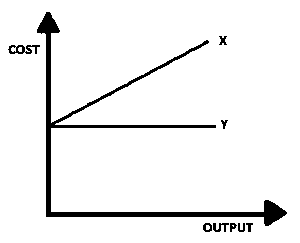
Question 0The line Y in the diagram representsA.total costB.variable costC.fixed costD.marginal costE.Objective Show full explanation
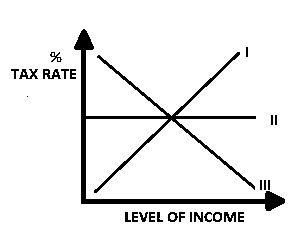
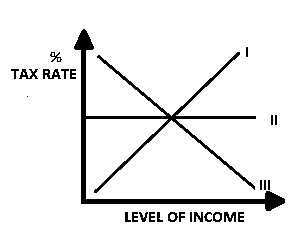
Question 0The curve labeled II illustrates a system of taxationA.proportional taxB.regressive taxC.value addedD.progressive taxE.Objective Show full explanation
Question 0The curve labeled III illustrate a system of taxationA.regressive taxB.progressive taxC.value added taxD.proportional taxE.Objective Show full explanation
Question 0What would be likely to increase inflation in any economy?A.Increase in demandB.Reduce public spendingC.Control excessive importD.Increase in direct taxE.Objective Show full explanation
Question 0The term of trade can be expressed asA.(Price index of export ÷ Price index of export)× 100B.(price index of import ÷ price index of export) × 100C.(Price index of export ÷ Price index of import)× 100D.(Price index of export ÷ Price index of import)× 100E.Objective Show full explanation
Question 0The income of an individual increases from N150 to N250 and his consumption rate increases from N100 to N150. Calculate the Marginal Propensity to ConsumeA.2B.0.4C.1D.0.5E.Objective Show full explanation
Question 0The study of broad economic aggregates isA.Macro economicsB.deductive method of economic analysisC.micro economicsD.Inductive method of economics analysisE.Objective Show full explanation