Question 1Nigeria's location lies between?A.7° — 10°N, 3° — 17°EB.4° — 14°N, 3° — 15°EC.8° — 14°N, 5°— 10°ED.5° — 14°N, 3°— 11°EObjective Show full explanation
Question 2Nigeria shares borders with the following countries?A.Benin Republic, Ghana, Ivory Coast, ChadB.Togo, Benin Republic, Niger, ChadC.Gulf of Guinea, Cameroon, E. Guinea, ChadD.Niger Republic, Cameroon, Chad, Benin RepublicObjective Show full explanation
Question 4Chaparral is a type of vegetation in the New World. Its counterpart in the old world is?A.Cork oakB.AcaciaC.MarquisD.FlaxObjective Show full explanation
Question 5Which of the following is the best description of climate?A.The average condition of rainfall, wind, sunshine, temperature, humidity and cloudiness over a period of 35 years.B.General atmospheric conditionsC.The average condition of temperature and rainfallD.The pattern of rainfall for a number of years.Objective Show full explanation
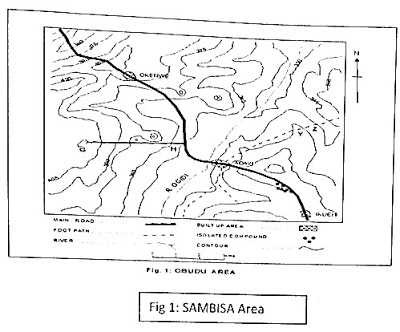
Question 6 Use the map above to answer questions 6-10 What is the approximate height of the location marked XA.360 metres B.375 metresC.380 metresD.395 metresObjective Show full explanation
Question 7 Use the map above to answer questions 6-10 Name the feature crossed by the footpath between points Y and ZA.WindgapB.GorgeC.RidgeD.SpurObjective Show full explanation
Question 8 Use the map above to answer questions 6-10 A map measures 10cm by 6cm. If the map is enlarged such that its area is 240 sq.cm, the map could be said to have been enlargedA.twiceB.thriceC.four timesD.six timesObjective Show full explanation
Question 9 Use the map above to answer questions 6-10 What is the average gradient of the slope marked G-HA.1.36B.1.38C.1.32D.1.40Objective Show full explanation
Question 10 Use the map above to answer questions 6-10 What is the length of the main road to the nearest kilometres A.14 kilometresB.10 kilometresC.11 kilometresD.19 kilometresObjective Show full explanation
Question 11A map with a scale of 1:40,000 is reduced to one-quarter of its size, what is the scale of the reduced map?A.1:10,000B.1:50,000C.1:160,000D.1:200,000Objective Show full explanation
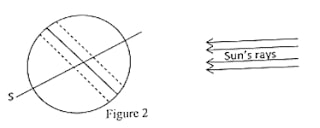
Question 12When is the earth relative to the sun in the position shown in Figure 2? A.DecemberB.MarchC.JuneD.SeptemberObjective Show full explanation
Question 13Which of the following phenomena is not directly related to the revolution of the earth?A.seasonal changesB.varying duration of sunshine hoursC.unequal solar radiation on the earth's surfaceD.night and dayObjective Show full explanation
Question 14Inter-regional trade among countries in West-Africa is promoted mainly by?A.Relationship with former colonial rulersB.Production of similar goodsC.Deliberate Governmental policies in recent timesD.Competition among the nations in Africa.Objective Show full explanation
Question 15Which of the following zones is the least industrialized in Nigeria?A.Lagos-IkejaB.Kaduna-ZariaC.Lokoja-AjaokutaD.Port-Harcourt - AbaObjective Show full explanation
Question 16The processes of weathering include all but one of the followingA.alternate heating and cooling of rocksB.rock-breaking due to frost actionC.rock rotting because of chemical changesD.movement of rock particles downslopeObjective Show full explanation
Question 17The Qattara Depression in Egypt is the product of?A.wind deflationB.glacial gongingC.volcanic activityD.down-warpingObjective Show full explanation
Question 18Which of the following is NOT a waterway in Africa?A.the orangeB.the MackenzieC.the votlaD.the ZambeziObjective Show full explanation
Question 19Which minerals are found in the Abeokuta area of Southern Nigeria?A.tin and columbiteB.iron and ZincC.lead and ZincD.salt and phosphateObjective Show full explanation
Question 20All the following can be found in the upper course of a river except?A.potholesB.cataractsC.LeveesD.gorgesObjective Show full explanation
Question 21Seasons are recognized within the tropics primarily on the basis ofA.air massesB.temperatureC.rainfallD.evaporationObjective Show full explanation
Question 22The major areas of mixed farming in the world are also areas of?A.sparse population with low arable crop productions.B.dense population with a high percentage of farmersC.dense population and a large number of urban centresD.sparse population and dispersed rural settlements.Objective Show full explanation
Question 23The highest landforms in Nigeria are developed on?A.sandstoneB.granitesC.basaltsD.shalesObjective Show full explanation
Question 24The main hydrological centre in Nigeria is theA.Jos PlateauB.Western uplandsC.Biu plateauD.Eastern highlandObjective Show full explanation
Question 25Which of the following best explains Lagos?A.Its infrastructural facilitiesB.Its early contact with the outside worldC.Being the former seat of the governmentD.Its extensive land for developmentObjective Show full explanation
Question 26The most common tree in the desert is theA.palmB.acaciaC.pineD.larchObjective Show full explanation
Question 27The most obvious physical feature that distinguishes undisturbed mature soil from an immature soil is theA.humus contentB.layered profileC.nutrient statusD.topsoil textureObjective Show full explanation
Question 28The direction of the flow of ocean currents is determined mainly by theA.rotation of the earth and land and sea breezesB.shape of the continents and the temperature of the continental interiorC.prevailing winds and the rotation of the earthD.depth of the ocean and the amount of freshwater inflowObjective Show full explanation
Question 29The medium class of a layered cloud which brings continuous rain, snow or sleet is?A.altocumulusB.altostratusC.stratocumulusD.nimbostratusObjective Show full explanation
Question 30The biodiversity of an ecosystem may be reduced through?A.extinction of plant speciesB.removal of a single animalC.introduction of a new plantD.trapping of a single fish.Objective Show full explanation
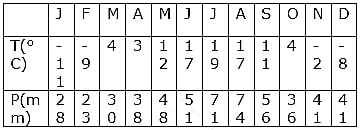
Question 31Study the table below which shows the mean climatic conditions of station Q, and answer questions 31, 32, 33 and 34. T= Temperature P = Precipitation The annual temperature range at the station isA.10°CB.20°CC.30°CD.40°CObjective Show full explanation
Question 32Study the table below which shows the mean climatic conditions of station Q, and answer questions 31, 32, 33 and 34. T= Temperature P = Precipitation This station belongs to which type of climate?A.MediterraneanB.cold temperateC.cool temperateD.warm temperateObjective Show full explanation
Question 33Study the table below which shows the mean climatic conditions of station Q, and answer questions 31, 32, 33 and 34. T= Temperature P = Precipitation The tropical rainforest differs in structure from the savannah in thatA.both never occur in the same continentB.the savannah is a natural vegetation while the rainforest is a derived oneC.the savannah grows in layers while the rainforest does notD.the savannah has less species diversity than the rainforestObjective Show full explanation
Question 34Study the table below which shows the mean climatic conditions of station Q, and answer questions 31, 32, 33 and 34. T= Temperature P = Precipitation The main source of tropical hardwood for timber is theA.montane forestB.mangrove forestC.rainforestD.coniferous forest.Objective Show full explanation
Question 35One of the problems of soil management in a humid area is?A.leaching of mineralsB.waterloggingC.lack of oxygen in the soilD.alkalinityObjective Show full explanation
Question 36Magma, while thrusting its way up to the surface, may cool and solidify within the crust asA.Plutonic rocksB.Sedimentary rockC.Clay soilD.None of the aboveObjective Show full explanation
Question 37The Nigerian towns which owed much of their growth in the 20th century to the development of the railway includeA.Oshogbo, Minna, Owerri and JosB.Lagos, Minna, Nnewi and GusauC.Enugu, Jos, Kaduna and MinnaD.Lagos, Lokoja, Gusau and UmuahiaObjective Show full explanation
Question 38Which of the following industries is likely to be located at or near the source of its major raw materials?A.BreweriesB.Aluminium SmeltingC.TextileD.Cement manufacturingObjective Show full explanation
Question 39A manufacturing industry would tend to be market-oriented if theA.finished products lose weight in the process of productionB.industry requires a large pool of labourC.industry requires regular power supplyD.finished products are highly perishableObjective Show full explanation
Question 40Which of the following represents the cheapest mode of transportation?A.waterB.airC.railD.roadObjective Show full explanation