Question 1During the electrolysis of dilute tetraoxsulphate(VI) acid solution, 0.05 mole of electrons were passed. What volume of gas was produced at the anode? A.2.24dm3B.0.560dm3C.0.280dm3D.0.244dm3Objective Show full explanation
Question 2Platinum electrodes are dipped into copper sulphate solution in a voltameter. The solution left after electrolysis is, A.clearB.blueC.pale blueD.sky blue Objective Show full explanation
Question 3What volume of water is produced when a mixture of 150cm^3 of hydrogen and 100cm3 of oxygen is exploded in a eudiometer? A.250cm3B.150cm3C.100cm3D.50cm3Objective Show full explanation
Question 4Given the half-cell reaction, 2Br ⟶ Br2, how many moles of electron will be required to produce 0.56dm3 of bromine at s.t.p.? [molar volume of gas at s.t.p. = 22.4dm3] A.0.05B.0.10C.0.20D.1.00 Objective Show full explanation
Question 5The equilibrium constant, Kc for the reaction. NO(g) + 1/2O2(g) ⟶ NO2(g), is 35.2. What is the value of Kc for the reaction NO2(g) ⟶ NO(g) + 1/2O2(g)?A.35.2B.17.6C.2.84 x 10-2D.1.24 x 103Objective Show full explanation
Question 6An atom has a core and outside the core an electron occupies an orbital for which the principal quantum number, n = 4, l= 0, m = 0, and s = +1/2 or -1/2. The atom is likely to be A.boronB.sodiumC.potassiumD.fluorine Objective Show full explanation
Question 7An element B, has two isotopes 2010B and 2210B present in ratio 2:3. The relative atomic mass of B is, A.20.5B.21.2C.23.4D.25.0 Objective Show full explanation
Question 8A chloroform solution of pure organic compound was spotted at a distance 0.80cm from the base of a 20cm long chromatoplate. If the compound has the rf-value of 0.505 and moves half way up the 20cm long plate, what is the distance of the solvent front from the top of the plate upon elution? A.0.80cmB.1.0cmC.1.2cmD.1.4cm Objective Show full explanation
Question 9The main organic product formed when bromine water is added to but - 1 - ene is A.1 - bromobutanB.2- bromobutan -1-olC.1 - bromobutan - 2 - olD.2 - bromobutan - 2 - ol Objective Show full explanation
Question 10Valence shell electron pair theory through hybridization predicts that boron trichloride is A.Arrhenius acidB.Lewis baseC.Lewis acidD.Lowry - Bronsted base Objective Show full explanation
Question 11What volume of 0.750moldm-3 Na3CO3 solution could be diluted to 250cm3 to reduce the concentration to 0.025moldm-3?A.16.0cm3B.14.2cm3C.10.4cm3D.8.3cm3Objective Show full explanation
Question 12When 70cm3 of 3.0moldm-3 Na2CO3 is added to 30cm^3 of 1.0moldm^-3 NaHCO3, the concentration of Na+ ions in moldm-3 in the solution is, A.1.5B.4.5C.2.0D.3.5 Objective Show full explanation
Question 13The reaction, Y ⟶ product is of first order with the initial concentration of Y= 3.55 x 10³ moldm-3 and the rate constant of 5.25 x 10⁻¹s-1. What is the half-life of the reaction? A.350sB.2I5sC.132sD.615s Objective Show full explanation
Question 14What quantity of current is required to deposit 2.4g of copper in a period of 750 seconds during an electrolytic deposition process? [Cu = 64, 1F = 96500 coulomb] A.9.65AB.10.81AC.12.33AD.15.54A Objective Show full explanation
Question 15The standard reduction potentials for the following half-cell reactions are: 2H2O(l) = O2(g) + 4H+(aq) + 4e $E^0 = -1.23V;$ 2H2O2(l) = 2O2(g) + 4H+(aq) + 4e; [insert equation]E0 = -0.68V What is the E° for the reaction, 2H2O(l) = 2H20(l) + O2(g) at 298K? A.-0.68VB.-1.23VC.+0.55VD.+1.91V Objective Show full explanation
Question 16Bonding in ammonium chloride is A.ionic, covalent and dativeB.ionic and covalentC.covalent and dativeD.ionic Objective Show full explanation
Question 17A chemical equilibrium is established when A.concentration of the reactants and products are equalB.reactants in the system stop forming the productsC.concentrations of the reactants and products remain unchangedD.reactants in the system are completely transformed to products Objective Show full explanation
Question 18The basic tenet of valence bond electron pair repulsion theory is that the pairs of electrons making the sigma bonds dictate the shape of molecules. The pi — bonds often encounter in some molecules serve to, A.distort the shape of moleculesB.alter the angle between the atoms in moleculesC.shorten the sigma bonds in moleculesD.explain the shape of moleculesObjective Show full explanation
Question 19Excess ethanol was sparked with 3g of pure oxygen in a combustion chamber. How many molecules of CO2 are produced? [N = 6.02 x 10²³ molecules mol-1]A.6.02 x 1023B.3.01 x 1023C.3.76 x 1022D.2.84 x 10 21 Objective Show full explanation
Question 20Oxygen is extracted from water by A.displacement reactionB.oxidation reactionC.reduction reactionD.decomposition reaction Objective Show full explanation
Question 21Forty (40) grams of sodium nitrate were added to 50cm3 of water to give a saturated solution at 289K. If the solubility of the salt is 10.50 moldm^3 at the same temperature, what percentage of the salt is left undissolved'? [Na = 23, N = 14 and 0 = 16] A.11.56%B.2.55%C.5.88%D.12.45% Objective Show full explanation
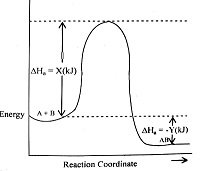
Question 22The energy for the dissociation of molecule AB in kJ in the diagram of energy against the reaction coordinate shown below is, A.146B.-540C.682D.398 Objective Show full explanation