Question 1A physical change is exemplified by the A.burning of bushB.rusting of a metalC.dissolution of calcium in waterD.heating of ammonium chloride Objective Show full explanation
Question 2The number of neutrons in the deuterium atom is/are A.0B.1C.2D.3 Objective Show full explanation
Question 3Which of these does not affect the rate of a particular chemical reaction? A.The order of the reactionB.The size of the particles of the reactantsC.The temperature of the reactionD.The concentration of the reactants Objective Show full explanation
Question 4The type of reaction an alkanoic acid cannot undergo is A.oxidationB.CombustionC.DecompositionD.Esterification Objective Show full explanation
Question 5Which of the followings will change the equilibrium constant of the reaction CO(g) + H2O(l) → CO2(g) + H2(g)? A.Increase of temperatureB.Increase of concentration ofC.removal of CO2 from the mixtureD.decrease of pressure Objective Show full explanation
Question 6In the electrolysis of acidified water using platinum electrodes, 1dm⊃3 of oxygen was collected at s.t.p. by passing 4.5 amperes into the electrolytic cell. Calculate the time required to set this amount of gas free. [molar volume of gas at s.t.p. = 22.4dm^3, 1 Faraday = 9650 coloumbs] A.40.4minB.63.8minC.55.5minD.5.68min Objective Show full explanation
Question 7Two plugs of glass wool soaked in concentrated ammonia and concentrated hydrochloric acid are placed at the opposite ends of a long tube such that the distance between them is 100cm^3. The ratio of the distance covered by ammonia to that covered by hydrochloric acid when a white smoke is first noticed is A.2.140B.1.465C.0.982D.0.476 Objective Show full explanation
Question 8The complete oxidation of propan - 1 - ol yields A.CH3CH2CHOB.CH3COCH3C.CH3COOCH3D.CH3CH2COOH Objective Show full explanation
Question 9Which of the following is responsible for the conduction of electricity in a gas enclosed in a glass tube containing two electrodes at a reduced pressure and to which a high voltage is applied? A.Cations and anionsB.CationsC.ElectronsD.Cations and electrons Objective Show full explanation
Question 10Which of these is correct about methyl orange? A.Yellow in excess aqueous hydrogen ionsB.Pink in excess aqueous hydrogen ionsC.Purple in excess aqueous hydrogen ions D.Colourless in excess aqueous hydrogen ions Objective Show full explanation
Question 11Which of the following ions will interact with water to give a solution of pH < 7? A.Na+B.NH4-C.CN-D.HCOO- Objective Show full explanation
Question 12M(s) + xH2SO4(aq) ⟶ M(SO4)x(aq) + xH2(g) Which of the following elements will not undergo the above reaction? A.ZnB.NaC.CuD.Ca Objective Show full explanation
Question 13An ideal gas changing volume as temperature rises can be represented by the diagram below: The point marked X on the graph is A.-273KB.273KC.273°CD.-100K Objective Show full explanation
Question 14150cm3 of nitrogen II oxide were sparked with 100cm3 of oxygen, what volume of nitrogen IV oxide will be produced at s.t.p.? A.100cm3B.75cm3C.50cm3D.150cm3 Objective Show full explanation
Question 15What is the pH of 2.5 x 10⁻³moldm-3 barium hydroxide solution? A.11.5B.11.6C.11.7D.11.8 Objective Show full explanation
Question 16When CuSO4 solution is treated with ammonia solution drop by drop till it is added in excess, a precipitate is first formed which then dissolves in excess to give a deep blue solution. The deep blue solution is A.Cu(OH)2B.[Cu(NH3)4](OH)2C.CuSO4D.[Cu(NH3)2]SO4 Objective Show full explanation
Question 17Which of these elements has the highest first ionization energy? A.RbB.LiC.NaD.K Objective Show full explanation
Question 18The name of CH3-O-COC2H5 is, A.methoxyethaneB.methyl propanoateC.ethyl ethanoateD.propyl methanoate Objective Show full explanation
Question 19How many isomeric dichlorobenzenes are obtainable? A.1B.2C.3D.4 Objective Show full explanation
Question 20By accurate description, ozone in the reaction, O3(g) + H2O2(l) -----> H2O(l) + 2O2(g) is A.displaced to form oxygenB.decomposed to form oxygenC.oxidized to oxygenD.reduced to oxygen Objective Show full explanation
Question 21If 7.0g of ethene at s.t.p. occupy 5.6dm3 what volume will 7.5g of ethane at the same condition occupy? [C = 12; H = 1; GMV at s.t.p. = 22.4dm3] A.6.0dm3B.5.6dm3C.5.2dm3D.9.4dm3 Objective Show full explanation
Question 22Which of the alcohols below is likely to be oxidized to give the acid, $\table CH_3, -, C, -, H, -, COOH; , , ∣, , , , , ; , , CH_3, , , , , ;$A.Butan - 1 - olB.2 - Methylpropan - 2 - olC.2 - Methylpropan - 1 olD.Propan - 2 - ol Objective Show full explanation
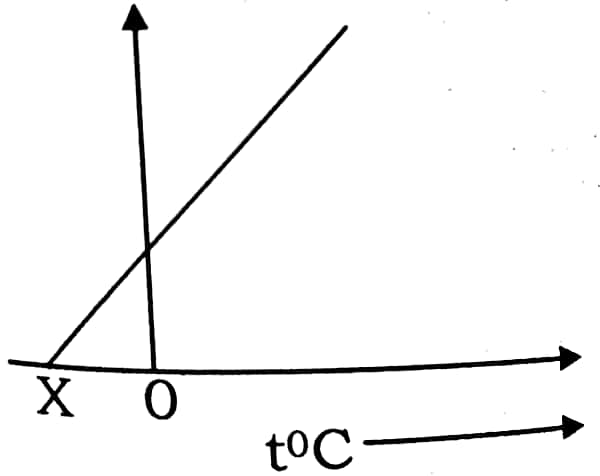 The point marked X on the graph is