Question 1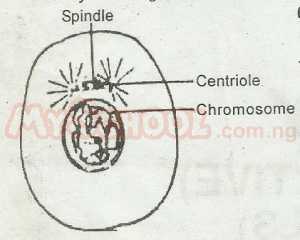
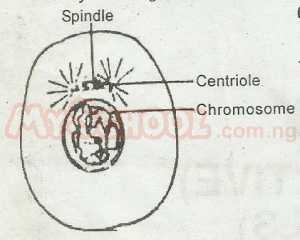
what stage mitotic division is represented in the diagram of the cell illustrated above
Objective
Practice each question, then open it to see the full details.
(i) Make a labelled drawing of a typical plant cell to show its essential features.
(ii) Give the functions of two labelled organelles
(b) Describe briefly two levels of cell organization in living organisms giving an example of each type.
(c) What role do the following processes play in the activities of a living cell (i) osmosis; (ii) diffusion.
(a) State four modes of nutrition in plants.
(b) Outline the process involved in the light and dark reactions of photosynthesis.
(c) Describe briefly the modifications and the mechanisms associated with the following feeding habits:
(i) filter feeding in mosquito larva; (ii) parasitic feeding in tapeworm.
(a) (i) Define the term population. (ii) List two biotic and abiotic factors each that affect population growth.
(b) What are the effects of food shortage on a population?
(c) Describe two methods each for:
(i) improving crop yield (ii) preserving and storing food. Explain the principle involved in each of the methods described.
(a) What is conservation of natural resources?
(b) List various natural resources that need to be conserved. State briefly the benefits of conservation in each case.
(c) List the problems often encountered in ensuring conservation of natural resources.
(d) What are the efforts being employed in your country to ensure conservation of natural resources?
Which of the following does not occur during photosynthesis?
During blood transfusion, agglutination may occur as a result of the reaction between