Question 1
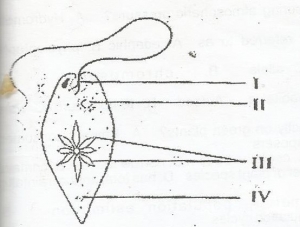
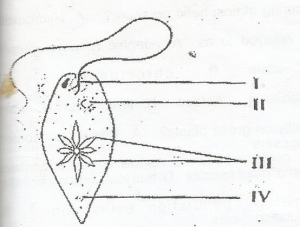
The excretory product in protozoans is
Objective
Practice each question, then open it to see the full details.
(a) (i) List three characteristics of living organisms.
(ii) Explain briefly the characteristics listed in (a)(i) above.
(b) In a tabular form, state four differences between plants and animals.
(c)(i) Name one organism that exhibits both plant and animal features.
(ii) State four animal features and two plant features possessed by the organism named in (c)(i) above.
(a) Define the following in
(i) elimination
(ii) excretion
(iii) secretion.
(b) Describe the digestion of boiled fish in the gut of humans
(c) Make a diagram 8cm - 10am long of a longitudinal section of a villus and label fully.
(a) Explain briefly the following ecological terms:
(i) biosphere
(ii) habitat
(b) Describe the mode of nutrition in a named carnivorous plant.
(c) State three reasons why the dispersal of fruits and seeds are important.
(d) State six methods of conserving soil.
(a)(i) Explain the term co-ordinance.
(ii) Calculate the number of individuals with co-dominant blood group.
(iii) What is the total number of individuals in the table that are able to donate blood to an accident victim with blood group B?
(b) A man whose blood group is heterozygous A is married to a
woman whose blood group is AB. With the aid of a genetic diagram, suggest the possible blood groups of their children.
A survey to determine blood groups was carried out on 250 people living in a community. The results are represented in the table below.
| Blood group | Percentage |
| A | 8.0 |
| B | 14.0 |
| AB | 32.8 |
| O | 45.2 |
(a) State five reasons why animals move from place to place.
(b) State one function each of the following structures found in plants:
(i) epidermis
(ii) phloem
(iii) sclerenchyma.
(c) Give two examples each of the following types of organisms:
(i) parasitic plants
(ii) saprophytes.
(d) State two adaptive features of plants which inhabit salt water swamp.
(e) State two factors each which result in
(i) increase
(ii) decrease, in population density.
(f) Mention four ways in which modern agricultural activities may threaten the survival of species.
(g) State three reasons why mitosis is important to living organisms
(h) State three causes of food spoilage.