Question 1
Which of the following organisms is not a protozoan?
Objective
Practice each question, then open it to see the full details.
(a) Explain briefly sexual reproduction in Rhizopus.
(b) A student suddenly stepped on a big snake, he cried for help and ran away.
(i) Name the hormone produced in the body for the reaction.
(ii) In which part of the human body is the hormone named in (b) (i) produced?
(iii) State five changes that must have taken place as a result of the hormone named in (a) (i).
(c) (i) In tabular form, state three differences between excretion in flowering plants and excretion in humans,
(ii) List two organelles found in plant cell that are responsible for the excretion of metabolic wastes.
(a) Explain how the leaf of a flowering plant is adapted for photosynthesis.
(b) Describe briefly the mode of feeding in tapeworm.
(c) Name one mineral element each needed for the proper functioning of :
(i) bones (ii) red blood cells
(iii) thyroid gland.
(d)(i) State three benefits of including roughages in the diet of humans.
(ii) State three reasons why proteins are important to humans.
(a)(i) What is sewage?
(ii) State five effects of releasing untreated sewage into a stagnant water body.
(b) Explain surface terracing as a soil conservation method.
(c) Explain the term adaptation.
(d) Explain two ways each by which the following organisms adapt to their habitats:
(i) hydrophytes
(ii) xerophytes.
(a) Explain the following terms:
(i) test cross
(ii) monohybrid cross.
(b) In a mango plant the, the allele for bean-shaped seed is r and is recessive to round-shaped seed R. With the aid of a genetic diagram, determine the genotypes of the offspring if:
(i) a homozygous bean-shaped parent with a homozygous round shaped parent;
(ii) a heterozygous bean-shaped parent is crossed with a heterozygous round shaped parent.
(a) Copy and complete the table below
| Disease | one effect | one remedy |
| kidney stones | ||
| Nephritis | ||
| Diuresis |
(b) Make a labelled diagram of the carbon cycle.
(c)(i) What is Estuarine habitat?
(ii) Construct a food chain typical of an Estuarine habitat.
(d)(i) Name two diseases that can attack plant crops.
(ii) State three ways of controlling plant diseases.
(e) State four functions of a public health authority
(f) State four ways of maintaining food hygiene in the community.
The colour change to be observed in step IV is

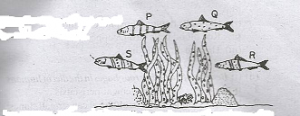
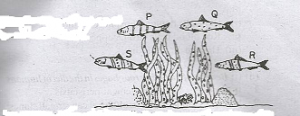
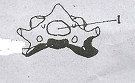
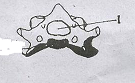
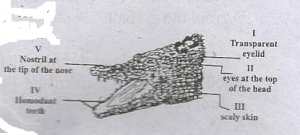
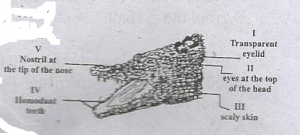
Study the diagram above and answer the question
The structure labelled I is