Question 1
Which of the following groups of animals do not possess a nervous system?
Objective
Practice each question, then open it to see the full details.
Which of the following groups of animals do not possess a nervous system?
(a) (i) What is classification of living things?
(ii) Name the scientist that developed the Binomial Sys-tern of Classification
(iii) State three reasons why it is necessary to classify living things
(iv) List seven major groups into which taxonomists classify living things in order of hierarchy
(b) state two features each which viruses have in common with: (i) living things
(ii) non-living things
(c) Name two viral disease each of:
(i) plants
(ii) humans
The structural similarities in Paramecium and Euglena are in the
(a) State four characteristics of enzymes
(b) (i) List two digestive enzymes produced in the duodenum of humans
(ii) Name the substrate that each enzyme listed in 2(b)(i) acts on.
(iii) State the products of each enzyme activity in 2(b)(ii)
(c) (i) State one way in which chlorophyll is important in plants
(ii) Name two macroelements that are required for the formation of chlorophyll in plants.
(iii) State one deficiency symptom of each macroelement named in 2 (c) (ii) above
(d) Outline the proce-dure used for testing for starch in a leaf
Which of the following organisms cannot exist freely on its own?
(a) Name one instrument used for collecting:
(i) soil organism from a soil sample
(ii) tiny insects from a leaf or a stem.
(b) make a diagram 6 cm - 8 cm long of the instrument named in (a)(ii) above and label fully.
(c) Explain briefly the relationship between three examples of symbiotic organisms.
Which of the following cell organelles is the site for the production of ATP?
(a) A child belongs to blood group 0 and the mother be-longs to group B. With the aid of genetic cross, state the possible blood groups of the father.
(b) (i) Name two forms of adaptive communication in animals
(ii) State two reasons why organisms communicate with one an-other.
An example of osmosis in plants is the
(a) Explain briefly the process of perceiving smell in humans.
(b) State the adaptive features of the egg of a domestic fowl
(c) (i) What are autotrophs?
(ii) Name two unicellular organisms that are autotrophs
(d) State five functions of the World Health Organisation
(e) Name two example each of plants and animals that live in a freshwater pond.
(f) In the table below, state five differences between the skin of a mammal and the epidermis of a leaf.
(g) A farmer has two plots of land; plots A and B. on Plot A the farmer planted several seeds of maize. On plot B, the farmer planted several seeds of maize and pepper in a small area. What type of competition would be observed on
(i) Plot A
(ii) Plot B
The organism that can carry out both autotropic and heterotrophic modes of nutritions is
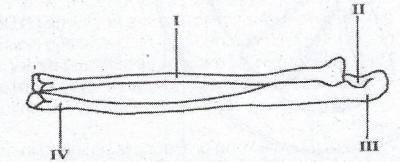
The diagram above illustrates a part of the human skeleton. It represents the bones of the
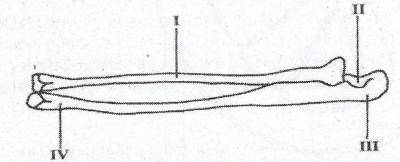
Which of the labelled parts of the diagram of the part of the human skeleton articulates with the head of the trochlea to form a hinge joint?
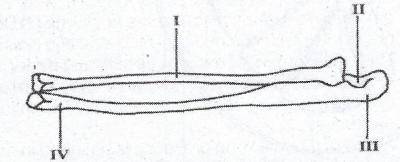
The diagram above illustrates a part of the human skeleton. The labelled part that provides surface for the attachment of the triceps is
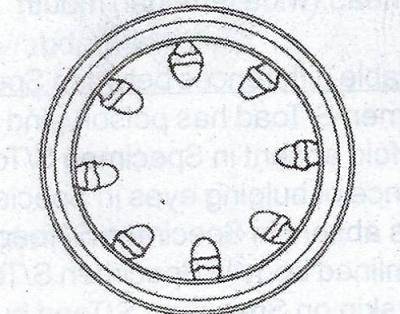
The diagram above illustrates the transverse section of a
Which of the following actions does not occur during exhalation in man?
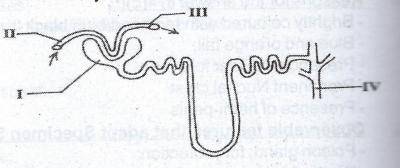
The diagram above is an illustration of the urinary tubule in a mammal. Which of the following substances is found in the part labelled II only?
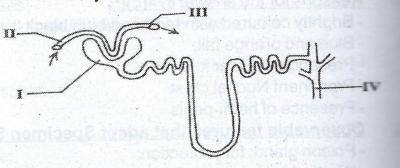
The diagram above is an illustration of the urinary tubule in a mammal. The part which contains lowest concentration of urea is labelled
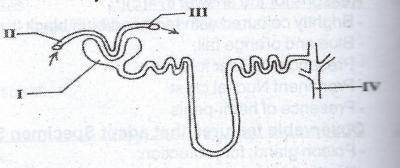
The diagram above is an illustration of the urinary tubule in a mammal. Which of the following substances is greater in concentration in the part labelled IV when compared to that part labelled I?
Deamination of amino acids in the liver produces
Which of the following glands also serves as an exocrine gland?
Which of the following sequences is the correct route of the transmission of impulses along a reflex arc?
When viewing an object that is close to the human eye, the
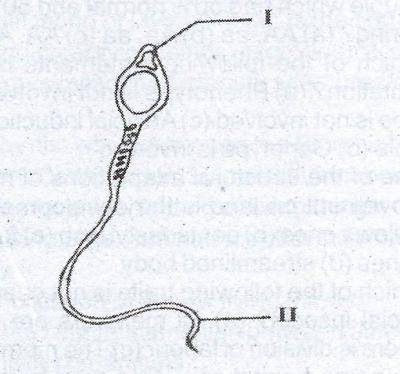
The diagram above is an illustration of the human sperm. The part labelled I is the
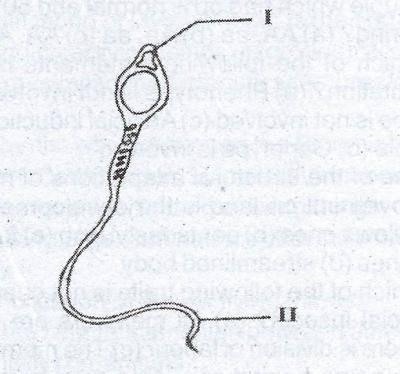
In the diagram of the human sperm above, the function of the part labelled II is to
Which of the following types of placentation is not common amongst syncarpous pistils?
The complex energy-rich organic matter which living organisms need for life is
Which of the following processes are associated with photosynthesis? I. Energy from sunlight is absorbed II. Carbon dioxide is evolved III. Oxygen is given off IV. Glucose is synthesized
Which of the following function is associated with calcium in plants? Formation of
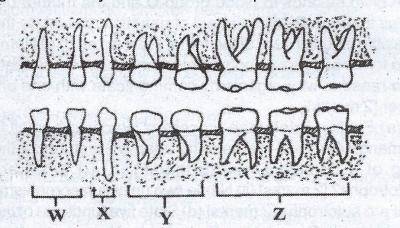
The diagram above shows the dentition of an organism. What organism is this?
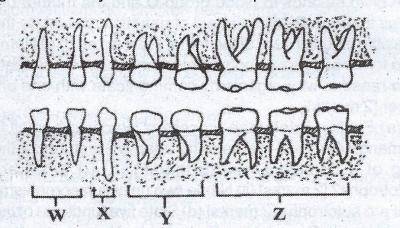
The diagrams below show the dentition of an organism. The function of the teeth labelled X is for
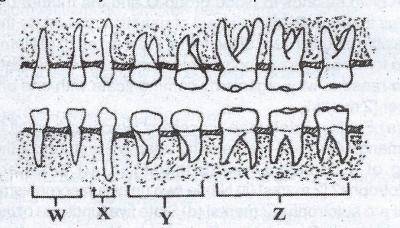
The teeth which are absent in the young of the organism whose dentition is shown above is labelled
The number of individuals that the environment can support over a long period of time is its
A good site for secondary succession would be
A population which exceeds its carrying capacity and then collapses is represented graphically by a
The natural dwelling place of an organism is called its
Which of the following ecological factors will result in food shortage?
Soil permeability refers to
Which of the following groups of organisms do not have members that can be called autotrophs?
Which of the following pyramids gives the most accurate picture of the relationships between at the various trophic levels in a food chain? A pyramid of
Which of the following statements is not associated with pyramids of energy?
Which of the following materials is not easily biodegradable?
Which of the following pairs of organisms is in a mutualistic relationship?
The establishment of game reserves and parks is a method of
Which of the following practices is not used in conserving water?
Which of the following resources cannot be renewed?
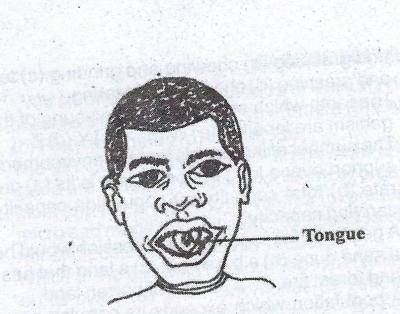
The type of variation illustrated above is
Which of the following characters is not a morphological variation?
An apple plant can produce sexually and asexually and it has 40 chromosomes in its leaf cells. How many chromosomes would be in each gamete and somatic cell?
Assuming that A is the gene for normal skin colour and is dominant, while a is the gene for albinism and its recessive, what is the likely genotype of the couple which had 50% normal and 50% albino offspring?