Question 1
The major raw material in a plastic industry is
Objective
Practice each question, then open it to see the full details.
(a) Write the chemical equation for the formation of named alkanoate.
(b)(i) What are the monomers of protein called?
(ii) Write the two functional groups present in the monomers named in (b)(i) above
(iii) State the type of reaction that leads to the formation of proteins from their monomers.
(a) When is a sample of water said to be hard?
(b) State one difference between temporary and permanent hardness of water
(c) Give one method of removing hardness completely from water
(d) Name two local is used for the production of soap.
(a) Give one physical property of
(i) diamond;
(ii) graphite
(b) Give two uses of diamond
(c) evidence that shows that both graphite and diamond are allotropes of carbon.
(a) Give two characteristic features of boiling
(b) What will be the effect of the following on the boiling point of water:
(i) addition of crystals of sodium chloride,
(ii) reduction of the atmospheric pressure?
(c) State two ways in which boiling differs from evaporation.
(a) Write the formula of the oxide of nitrogen in which nitrogen has oxidation number of (i) +1;
(ii) +2;
(iii) +3;
(iv) +4;
(b) State which of the oxides in (a) above is/are: (i) acidic (ii) neutral.
Name the type of chemical process involved in the production of
(a) polythene from ethene
(b) ethene from kerosene fraction of petroleum.
(c) soap from vegetable oils
(d) margarine from vegetable oils
(a) Name the gas evolved when dilute hydrochloric acid is added to each of the following solids and the mixture is warmed
(i) sodium trioxocarbonate (IV);
(ii) potassium trioxosulphate (IV);
(iii) iron (II) sulphide.
(b) Name the reagent(s) that you would use to identify the gas in (a)(ii) above.
The following are miscible with water except
(a) The half-life of 56/25 Mn is 9.3 x 10\(^3\)S. What does the statement mean?
(b) Give the three types of radiation that are usually emitted by radioactive substances.
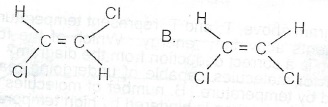
Consider the compounds represented as A and B below:
(a) What is the celationship between A and B? (
b) Name A and B.
(c) Will the chemical properties of A and B be the same? Give one reason for your answer.
(a) Name the components of
(i) producer gas; (ii) water gas;
(b) Give the reason why water is a better fuel than producer gas.
(a) State Le Chatelier's principle
(b) Use Le Chetelier's principle to deduce the conditions that favour a high yield of ammonia in the Haber process
(c) Give the chemical test for ammonia.
(d) State what would be observed when aqueous ammonia solution is added to:
(i) zinc chloride solution, (ii) copper (II) tetraoxosulohate (V) solution
(e) Explain why the H — N — H bond angle in ammonia is less than that of H — C — H in methane
(f) Give two uses of ammonia.
Given that for the reaction KOH (aq) + HCI(aq) → KCI(aq) + H2O(L) H = - 54 Kj mol-1. What is the quantity of heat involved in the reaction?2NaOH(aq) + H2SO 4(aq) → Na2SO4(aq) + 2H 2O(l)?
(a) List three characteristics of a homologous series
(b) Give one example of;
(i) alkanes; (ii) alkynes.
(c) A hydrocarbon contains 7.7% by mass of hydrogen and 92.3% by mass of carbon. The relative molar mass of the compound is 78.
(i) Derive the empirical formula of the compound and hence its molecular formula.
(ii) Name the hydrocarbon and write its structural formula. (H=1, C=12)
(d) Two hydrocarbons, X and Y were treated separated with acidified potassium tetraoxomanganate (VII) solution. X decolorized the solution and Y did not. Which of X and Y will undergo
(i) substitution reaction only,
(ii) both addition and substitution reactions.
(iii) polymerization?
(e) If ethanol is to be converted into ethanoic acid
(i) What are the conditions required?
(ii) name the type of reaction that will be involved and write the equation
(a) Distinguish between a conductor and an electrolyte
(b)(i) State Faraday's first law of electrolysis
(ii) Describe how you would investigate Faraday's law of electrolysis, using copper (II) tetraoxosulphate (VI) solution and copper electrodes.
(c) 0.222g of a divalent metal is deposited when a current of 0.45 ampere is passed through a solution of its salt for 25 minutes using appropriate electrodes. Calculate the relative atomic mass of the metal. 1F = 96500C mol\(^{-1}\)
`(d) State two applications of electrolysis.
(a) Explain the differences in the reactions of zinc with dilute trioxonitrate (V) acid and zinc with dilute hydrochloric acid.
(b) Write equations to illustrate how ammonia gas can be converted into trioxonitrate (V) acid.
(c) Calculate the mass of sodium trioxonitrate (V) produced when 30.0g of pure sodium hydroxide reacts with 100cm\(^3\) of 1.00 M trioxonitrate (V) acid. (H =1, N = 14, 0 = 16, Na = 23)
(d) Write the equations for the decomposition by heat of:
(i) sodium trioxonitrate(V);
(ii) copper (II) trioxonitrate (V);
(iii) mercury (II) trioxonitrate (V);
Given that for the reaction. N2(g) + 3H2(g) ⇌ 2NH3(g) ∆H = -92kJ. What is the enthalpy of formation of ammonia from its elements?
50cm 3 of a saturated solution of potassium trioxonitrate (V)at 40°C contains 5.05g of the salt. What is the solubility of potassium trioxonitrate (V) at 40°C? (KNO3 = 101)