Question 1
The metal extracted from cassiterite is
Objective
Practice each question, then open it to see the full details.
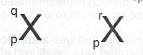
State the atoms represented as shown below:
(a) State the relationship between the two atoms.
(b) What is the difference between them?
(c) Give two examples of elements which exhibit the phenomenon illustrated above.
(a)State three characteristics of a catalyst.
(b) Mention one manufacturing process in which each of the following metals is used as a catalyst:
(i) iron;
(ii) nickel;
(iii) platinum
(c) Give one example of an organic catalyst.
A colourless and odourless gas X burns in oxygen with a pale blue flame.
(a) Suggest two gases which X could be.
(b) Give one chemical test that could be used to confirm which of the two gases X is.
Methane is obtained when a powdered mixture of anhydrous sodium ethanoate and soda-lime is heated in a hard glass test tube.
(a) Write an equation for the reaction.
b) Explain briefly why soda-lime is preferred to sodium hydroxide for the preparation.
(a) Give the products of electrolysis of dilute copper (II) tetraoxosulphate(VI) solution using the following materials as electrodes:
(i) carbon rod;
(ii) copper rods
(b) For each of the process in (a) above;
(i) write the anodic half reaction;
(ii) state how electrolysis affects the pH of electrolyte
(a) Give two reasons why fused alumina is mixed with cryolite in the electrolytic extraction of aluminium.
(b) Write an equation for the reaction of sodium hydroxide with bauxite.
(a) Name the industrial process by which ethene is obtained from petroleum fractions
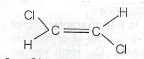
(b) Give the I. U. P.A.C name of the isomer whose structure is shown below.
(c) Illustrate with an equation, one reaction in which benzene behaves as:
(i) unsaturated hydrocarbon
(ii) a saturated hydrocarbon
Give one oxide in each case which;
(a) can act as a reducing agent
(b) can be used as a refrigerant
(c) is the anhydride of a strong acid;
(d) is yellow when hot and white then hot and white when cold;
(f) is usad as a pigment in paints.
Sketch a curve to show how the solubility of a gas varies with increasing temperature
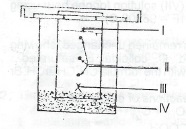
The set-up shown in the diagram below was used to separate a drop of universal indicator into the constituent dyes using ethyl ethanoate as the solvent.
(a) What name is given to the separate strated in the diagram?
(b) State: (i) how many components are resolved in the separation;
(ii) the material normally used in laborary as the adsorbent medium;
(iii) which of the labels the point of application of the indicator.
(a)(i) Give two uses of chlorine.
(ii) State the action of chlorine on moist blue litmus paper
(b) Draw a labelled diagram for the laboratory preparation of a dry sample of chlorine
(c) State the type of reaction involved between chlorine and (i) aqueous iron (II) chloride;
(ii) propane. Write an equation for each reaction and name the product formed in (c)(ii).
(d) Consider the reactions the following equations: Cl\(_{2(g)}\) + 2Br\(^-_{(aq)}\) \(\to\) 2Cl\(^-_{(aq)}\) + Br\(_{2(g)}\)
F\(_{2(g)}\) + 2Cl\(^-_{(aq)}\) ---> 2F\(^-_{(aq)}\) + Cl\(_{2(g)}\)
From the equations, arrange bromine, chlorine and fluorine in increasing order of oxidizing ability. Give the reason for your answer.
Which of the following modes of motion is exhibited by the particles of a solid?
(a) Name one gaseous hydrocarbon which is
(i) used for welding.
(ii) a major raw material for the plastic industry.
(b) Write the structural formula of the hydrocarbon in (a)(i) above. Name the process by which it can be converted to neoprene rubber.
(c) Potatoes contain a high proportion of carbohydrate.
(i) Give the main product formed when potatoes are dehydrated completely
(ii) Describe how you would convert potatoes to ethanol. State the reactions involved the process and write equation for the final stage of the conversion.
(iii) Draw a labelled diagram of the apparatus you would use to obtain a sample of fairly pure ethanol from the product formed in (c)(ii) above. What is the name given to the technique?
(a) Give three differences between electrovalent compounds and covalent compounds
(b) List two physical properties of metals which can be accounted for by their structure
(c) Thorium (Th) metal undergoes a reaction represented by the following equation:
\(^{234}_{90}Th \to X + ^{234}_{91}Pa\)
(i) State the type of process involved in the reaction
(ii) Balance the equation equation and hence identify X.
(iii) Name one equipment which can be used to detect X.
(iv) Sketch a curveto show the mass of given quantity of thorium will change over a long period of time.
(d) Y is a moderately reactive divalent found naturally in the combined state as the trioxocarbonate (IV) salt, YCO\(_3\) is decomposed by strong heat, state the steps you would use in extracting Y from the ore. Write equation to show the chemical processes involved.
(a) State two factors which can affect the rate of a chemical reaction.
(b) 0.72g of magnesium was added to different volumes of 2 mol. per dm\(^3\) hydrochloric acid. The volume of liberated was as measured at room temperature and pressure. The result of the experiment was as tabulated
| vol. of 2 mol. per dm\(^3\) HCl used (cm\(^3\) | Vol. of H\(_2\) evolved in cm\(^3\) (to the nearest 10cm\(^3\)) |
5 15 25 35 45 120 360 550 600 600 Use the data in the table to plot a graph of the volume of hydrogen liberated against the volume of acid used.
(c) From the graph in (b) above, determine the volume of: (i) hydrogen that would be produced if 50 cm\(^3\) of the acid were added to 0.72g of magnesium.
(ii) the acid which must be added to 0.72 g of magnesium to produce 480 cm\(^3\) of hydrogen;
(iii) the acid needed exactly to dissolve 0.72 g of magnesium completely.
(d) Explain your answer to (c)(iii).
(e) From your answers to (c) above, deduce the: (i) volume of the acid which will dissolve 1 mole of magnesium completely. (Mg = 24)
(ii) volume of hydrogen that would be liberated if 1 mole of magnesium dissolves completely in the acid;
(iii) equation for the reaction between magnesium and hydrochloric acid. Show clearly how you arrived at you answers