Question 1
The components of universal indicator solution can best be separated by
Objective
Practice each question, then open it to see the full details.
(a) State two differences in the chemical properties of metals and non-metals.
(b) List two general methods of extract metals from their ores.
(1)(a) State Avogadro's law
(b) Which of the state of matter contains particles that are: (i) readily used
(ii) held firmly together by some forces of cohesion;
(iii) involved in rapid random motion?
Catalytic hydrogenation of alkenes produces compounds with the general formula
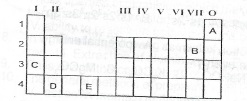
A shortened form of the Periodic Table is shown below. Use it to answer questions (a) and (b)
(a) Which of the elements represented as A to E in the table, above is:
(i) transition metal;
(ii) an alkaline earth meta
(iii) the least reactive;
(iv) the most electronegative?
(b)(i) What type of bond would exist in a compound formed when element D reacts with oxygen?
(ii) Write the formula of the compound formed in (b)(i) above.
(a) Give one example each of a naturally occurring substance that;
(i) conforms to the general formula C(_x\)(H\(_2\)O)\(_y\);
(ii) contains the carboxyl group as its functional group.
(b) Name the process for obtaining: (i) paraffin oil from crude oil; (ii) benzene from ethyne.
(a) Define oxidation in terms of electron transfer.
(b) Consider the following: Cu\(_{(s)}\) + 2Ag\(^{+}_{(Ag)}\) \(\to\) Cu\(^{2+}_{(aq)}\) + 2Ag\(_{(s)}\)
(i) State the species that is reduced
(ii) Write half-cell equation for each of the species.
(a) When MgSO\(_4\).XH\(_2\)O crystals were exposed to the atmosphere for several days, three was a loss in mass
(i) What name is given to this phenomenon?
(ii) Give another example of a compound that exhibits this phenomenon
(b) If 0.50 mole of MgSO\(_4\).XH\(_2\)O has a mass of 123g. calculate the value of X. (H = 1, O = 16, Mg = 24, S = 32)
(a) Write an equation to show the action of strong heat on:
(i) potassium trioxonitrate (V):
(ii) sucrose.
(b) State two observations in respect of the reaction between granulated zinc and dilute tetraoxosulphate (VI) acid.
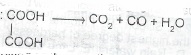
When ethane - 1,2-dioic acid is heated with concentrated tetraoxosulphate (VI) acid, a reaction represented by the following equation occurs:
(a) State the type of process involved in the reaction
(b) What is the basicity of ethane-1, s-dioic acid?
(c) List three differences in the chemical properties of the two oxides of carbon produced during the reaction
(a) State whether entropy increases or decreases during each of the following processes
(i) condensation of steam;
(ii) melting of wax;
(iii) dissolution of sugar in water;
(iv) abscas on charcoal.
(b) What deduction can be made in each case given that the value of the free energy change for a particular reaction is:
(i) zero;
ii) negative
Potassium trioxochlorate (V) undergoes thermal decomposition according to the fotpowing equation: 2KCIO\(_3\) \(\to\) 2KCI + 3O\(_2\)
(a) What substance could be used in the laboratory to in ease the rate of the reaction
(ii) absorb the oxygen produced
(b) Give the reason why an aqueous solution of silver trioxonitrate (V) gives a white precipitate with KCI but not with KClO\(_3\).
(a)(i) Draw a labelled diagram for the laboratory preparation of a dry sample of chlorine
(ii) Give one chemical test for chlorine.
(b) Write equations to represent the reaction of chlorine gas with: (i) iron (II) chloride solution;
(ii) potassium iodide solution;
(iii) hot concentrated sodium hydroxide solution.
(c) State what is observed on:
(i) bubbling hydrogen chloride gas into an solution of lead (II) trioxonitrate (V);
(ii) heating the mixture from (c)(i) above to boiling and aging it to cool.
(d) A solution of bismuth chloride was prepared by adding the oxychloride which is a white powder to concentrated hydrochloric acid. The following equilibrium was set up: BiOCI\(_{(s)}\) + 2HCI\(_{(aq)}\) \(\rightleftharpoons\) BiCl\(_{3(aq)}\) + H\(_2\)O\(_{(q)}\). State what would be observed if some water is added to the system. Explain your answer
(a)(i) What is meant by hydrocarbons?
(ii) A hydrocarbon consists of 92.3% carbon. If it's vapour density is 39, determine its molecular formula. (H = 1; C = 12)
(b)(i) Outline a suitable laboratory procedure for obtaining ethanol from cassava tubers
(ii) List two laboratory reagents used for oxidizing ethanol to ethanoic acid.
(c) What name is given to each of the following processes?:
(i) Conversion of alkanols to alkanoates;
(ii) Breakdown of proteins to amino acids;
(iii) Conversion of oils to fats
(iv) Alkaline hydrolysis of fats and oils.
(a)(i) Determine the maximum number of electrons that can occupy the principal energy level M of an atom.
(ii) Show the changes in the electronic structures of atoms of sodium and fluorine (\(^{23}_{11}\)Na: \(^{19}_{9}F\)) when they combine to form sodium fluoride.
(iii) State: three properties that sodium fluoride would have, based a-n the bond type present in the compound.
(b) Write equations to show when:
(i) sodium metal burns in limited supply of oxygen;
(ii) water is added to the product in (b)(i) above
(c) Describe a suitable laboratory procedure for comparing the conductance of 1 mol dm\(^{-3}\) aqueous solutions of sodium hydroxide and ethanoic acid.
(a) (i) Define heat of combustion.
(ii) What name is given to the container used for determining tne reaction?
(b) The heat of combustion of carbon in excess air is - 3935 kJ.
(i) Sketch an energy profile diagram for the reaction.
(ii) Calculate the heat change when 60 g of carbon undergoes complete combustion to produce carbon (IV) oxide. (C = 12)
(iii) Explain why the value of the heat of neutralization of strong acids by strong bases is constant.
(c) Give reason for the following:
(i) rusting of iron is regarded as a slow combustion process;
(ii) iron filings rust much more faster than iron nails when exposed to the same atmospheric condition;
(iii) iron is better protected from corrosion by plating it with.zinc than with tin