Question 1
The existance of two or more forms of the same element in the same physical state is known as
Objective
Practice each question, then open it to see the full details.
(a) List two gases which are monatomic
(b) Mention one gas which forms:
(i) dense white fumes with ammonia vapour
(ii) yellow precipitate with ammoniacal silver trioxonitrate (V) solution.
(a) State three postulates of the kinetic theory
(b) Name the process involved in the;
(i) spread of the smell of a perfume across a room
(ii) decrease in the yellow of a liquid after exposure in an open vessel.
(a) What is the anhydride of each of the following acids?:
(i) H\(_2\)SO\(_4\)
(ii) HNO\(_3\)
(b) Classify each of the: following as normal salt/acid salt/basic salt/double salt
(i) Sodium hydrogentrioxocarbonate (IV)
(ii) Iron (III) chloride
(iii) Sodium ethanoate.
(a)(i) State two physical properties of hydrogen sulphide
(ii) Name the laboratory equipment used for intermittent production of hydrogen sulphide
(b) What property of hydrogen sulphide is illustrated in the reaction represented by the following equation?
H\(_2\)S\(_{(g)}\) + 2NaOH\(_{(aq)}\) \(\to\) Na\(_2\)S\(_{(aq)}\) + H\(_2\)O\(_{(l)}\)
(a) The elements listed below to the same group in the Periodic Table \(_9F\) \(_{17}CI\) \(_{35}Br\) \(_{53}I\).
(i) Write the electronic structure of the first member
(ii) What is the family name of the elements.
(iii) Which of the elements has the strongest oxidizing ability?
(b) Use the information provided in the following table to answer Questions (i) to (ii) below
(b)(i) Which of the chlorides would exist as discrete molecules?
(ii) What type of bonding holds atoms of A and chlorine together in ACI?
(iii) Which of the chlorides would be a good conductor of electricity?
(a) (i)Name the class of oxides to which copper (II) oxide belongs.
(ii) Give the reason why copper (II) oxide increases in mass on exposure to the atmosphere
(iii) Write an equation to show the action of dilute hydrochloric acid on copper (II) oxide.
(b) List two methods of removing total hardness from water.
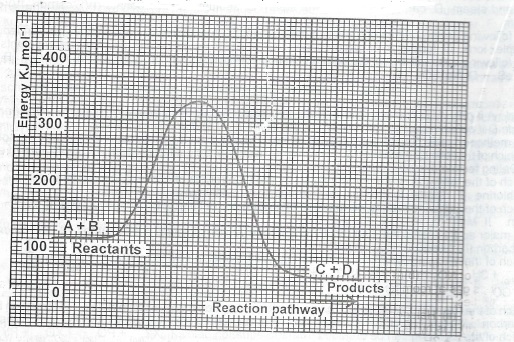
Use the following energy profile diagram to answer Questions (a) to (c) below.
(a) From the diagram, determine the value of the; (i) enthalpy of the reaction (ii) activation energy of the reaction.
(b) State whether the profile diagram is for an endothermic reaction or an exothermic reaction.
(c) What name is given to substances which can provide an alternative pathway for the reaction?
(a) Give the name of the:
(i) process for obtaining ethanol from sugars;
(ii) compound produced when ethanol undergoes bacterial oxidation.
(iii) enzyme in yeast which catalyses the conversion of maltose to glucose.
(b)(i) Write the structural formula of ethanol
(ii) Name the organic product formed when propanoic acid reacts with ethanol.
(a) State the monomer units of (i) polyethene; (ii) cellulose
(b) Name the two fuels obtained when steam and air are passed over red-hot coke.
(a) Determine the oxidation number of manganese in MnO\(_4\)
(b)(i) List two metals that are extracted from their ores by electrolysis
(ii) Give one difference between a conductor and an electrolyte.
(a)(i) Explain what is meant by an effective collision
(ii) What does each term represent in the following expression? \(\Delta G\) = \(\Delta H\) — T\(\Delta\)S
(iii) What deduction can be made about a system given that the value of its \(\Delta\)G is zero?
(b)(i) State Le Chatelier's principle.
(ii) Suggest three conditions necessary for maximum yield of A\(_2\)B in the reaction represented by the following equation 2A\(_{2(g)}\) + B\(_{2(g)}\) \(\rightleftharpoons\) 2A\(_2\)B\(_{(g)}\) \(\Delta\)H = xkj.
(iii) Write an expression for the equilibrium constant of the reaction in (b)(ii) above.
(c)(i) Give the reason why a log of wood of a given mass does not burn out as quickly as sawdust of the same mass, under the same conditions.
(iii) List two examples of chemical reactions that are catalyzed by light
(a)(i) Give one major use of alkenes.
(ii) Name the simplest alkane that exhibits structural isomerism
(iii) Determine the molar mass of an alkane that is represented as C\(_x\)F\(_{22}\). [H = 1, C = 12]
(iv) List two types of chemical reactions which the alkenes and alkynes undergo.
(b)(i) State the type of reaction involved in the conversion of palm oil to margarine.
(ii) Give the reason why the palm oil for manufacturing margarine is first treated activated charcoal
(iii) What is commonly used to catalyse the conversion of vegetable oils to margarine?
(c)(i) Name the class of organic compounds to which oils belong.
(ii) Describe briefly procedure for the manufacture of soap from vegetable oils
(iii) Explain why the presence of calcium ions in domestic water supply wastes soap.
(a)(i) What is an acid?
(ii) List three chemical properties of tetraoxosulphate (VI) acid
(iii) Give two uses of tetraoxosulphate (VI) acid.
(b)(i) Describe a suitable laboratory procedure for preparing a sample of zinc tetraoxosulphate (VI) crystals, starting from zinc oxide.
(ii) Write two equations to show why zinc oxide is classified as an amphoteric oxide.
(c) Zinc reacts with copper (II) tetraoxosulphate (VI) according to the following equation: Zn + CuSO\(_4\) -> ZnSO\(_4\) + Cu
(i) State the type of reaction involved
(ii) Determine the mass of zinc that would react completely with 8.0g of copper (II) tetraoxosulphate (VI). [CuSO\(_4\) = 160; Zn = 65]
(a)(i) List three factors which affect the discharge of ions during electrolysis
(ii) Describe in outline, the purification of copper by electrolysis.
(b) the following data were collected in an experiment on electrolysis:
| Current flowing(amps) | Time of current flow (secs) | Quantity of electricity (coulombs) | Mass of metal M deposited (gram) |
|
0.20 0.20 0.20 0.20 |
900 1800 2700 3600 0.06 0.12 0.18 0.24 |
(i) Copy and complete the table above calculating the quantity of electricity passed in each case
(ii) Plot a graph of the mass of M deposited against the quantity of electricity passed.
(iii) From the graph, determine the mass of M that was deposited by the same current passing for 20 minutes.
(iv) From the shape of the graph, which of the laws of electrolysis does the experiment verify?