Question 1
The phenomenon observed when dust particles collide randomly in a beam of sunlight is known as
Objective
Practice each question, then open it to see the full details.
(a) List two properties of alpha particles.
(b) X is an element which exists as an isotopic mixture containing 90% of \(^{39}_{19} X\) and 10% of \(^{41}_{19}X\).
(i) How many neutrons are present in the isotope \(^{41}_{19}X\)?
(ii) Calculate the mean relative atomic mass of X.
(a)(i) State the two main processes involved in the manufacture of oxygen from air
(ii) Name the type of chemical bonding which exists between oxygen atoms in a molecule of oxygen
(b) What term is used to describe the relationship between oxygen and ozone (O\(_3\))?
(a) List two industrial uses of concentrated tetraoxosulphate (VI) acid
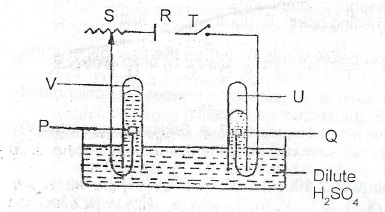
(b) The diagram below represents the set-up for the electrolysis of dilute tetraoxosulphate (VI) acid. Use it to answer Questions (i) to (iii).
(i) Which letter on the diagram represents the battery?
(ii) Write an equation for the reaction occurring at the cathode
(iii) What product does V represent?
(a) State two properties of alkalis
(b)(i) Why is tetraoxosulphate (VI) acid able to produce two types of salt?
(ii) Write an equation for the reactior involved on heating sodium trioxosulphate (IV) with hydrochloric acid.
Consider the reaction represented by the following Q equation: N\(_2\)O\(_{4(g)}\) \(\rightleftharpoons\) 2NO\(_{2(g)}\) \(\Delta\)H = +57.2KJmol\(^{-1}\)
(a) When is the reaction said to be at equilibrium?
(b) Mention two conditions that can favour the forward reaction
(c) Name the principle involved in (b) above.
(a) List two products obtained when crude oil is refined
(b)(i) What is the general formula for alkanols?
(ii) State the type of reaction involved in the conversion of ethanol to ethanoic acid
(iii) Write an equation to show how ethanoic acid reacts with sodium trioxocarbonate (IV).
(a) State Gay Lussac's law of combining volumes
(b) Hydrogen reacts with oxygen according to the following equation;
2H\(_{2(g)}\) + O\(_{2(g)}\) ---> 2H\(_2\)O\(_{(g)}\). If 50cm\(^3\) of hydrogen were sparked with 30cm\(^{3}\) of oxygen, calculate the volume of unused oxygen after cooling to the initial temperature and pressure.
(a) Mention three chemical properties of chlorine
(b) What type of reaction is represented by each of the following equations?
(i) Mg\(_{(s)}\) + 2HCI\(_{(aq)}\) --> Mg\(_2\)Cl\(_{2(aq)}\) + H\(_{2(g)}\)
(ii) Ag\(^+_{aq}\) + Cl\(^-\)\(_{(aq)}\) ----> AgCl\(_{(s)}\)
(a) Give one example of a metal which:
(i) can displace hydrogen from cold water
(ii) at red-heat, reacts reversibly with steam
(iii) does not react with dilute hydrochloric acid
(b) When dry hydrogen was passed over lead (II) oxide, a greyish solid J was obtained.
(i) Identify J
(ii) What type of reaction was involved in the formation of J from lead (II) oxide?
A given volume of methane diffuses in 20 seconds. How long will it take the same volume of sulphur (IV) oxide to diffuse under the same conditions? [CH4 = 16; SO2 = 64]
(a)(i) Define entropy
(ii) What term is used to describe a reaction in which heat is absorbed from the surrounding?
(b) State two conditions that can lead to ineffective collisions during a chemical reaction.
(a)(i) List two reactants for the laboratory preparation of ammonia
(ii) State three physical properties of ammonia
(iii) Describe in outline, the manufacture of ammonia by the Haber process.
(b) Write an equation in each case to show the:
(i) reaction between ammonia gas and heated copper (II) oxide
(ii) action of heat on ammonium trioxocarbonate (IV)
(c)(i) Which industrial process is used for convey ammonia to trioxonitrate (V) acid?
(ii) Give the reason why electropositive metals do not generally are off hydrogen with dilute trioxonitrate (V) acid
(d) Give one example in each case, to show how trioxonitrate (V) acid reacts generally with: (i) bases (ii) non-metals.
(a)(i) State two general methods of preparing soluble salts.
(ii) Mention three pieces of apparatus required for determining the solubility of a salt at a given temperature.
(b) The solubilities of two salts represented as K and L were determined at various temperatures. The results are shown in the table below:
| Temperature (\(^o\)C) | 0 | 20 | 40 | 60 | 80 | 90 |
| Solubility of K (mol. dm\(^{-3}\)) | 0.38 | 0.46 | 0.54 | 0.62 | 0.69 | 0.73 |
| Solubility of L (mol. dm\(^{-3}\)) | 0.12 | 0.34 | 0.64 | 1.08 | 1.64 | 2.00 |
(i) Plot the solubility curves of K and L on the same graph. Use the curves to answer questions (ii) - (iv) below.
(ii) What is the solubility of K at 50°C?
(iii) At what temperature is the solubility of L equal to 1.0mol. dm\(^{-3}\)?
(iv) Over what temperature range is K more soluble that L?
(v) Given that the molar mass of L is 101g, determine whether a solution containing 3.4g of L per 250cm\(^3\) at 20°C is saturated or unsaturated.
(a)(i) What is meant by cracking of petroleum fractions?
(ii) Write an equation for the laboratory preparation of ethene from ethanol.
(iii) Give one chemical test to distinguish between ethane and ethene.
(b)(i) Name the class of carbohydrates to which starch and cellulose belong.
(ii) What process is used for isolating ethanol from the other products of fermentation of sugar?
(iii) Name the organic product of the reaction between ethanol and sodium
(iv). Write the structural formula of 2-chloroethanol.
(c) State the reason why:
(i) benzene produces more soot than ethene on burning in excess air;
(ii) ethanoic acid has a higher boiling point than methanoic acid;
(iii) sodium chloride is used during the manufacture of soap.
(d) Give one use of: (i) ethyne (ii) coal (iii) carbon black
(a)(i) List three characteristic properties of transition metals
(ii) 0.45g of a metal M was deposited when a current of 1.8 amperes was passed for 12.5 minutes through a solution containing M\(^{2+}\). Calculate the relative atomic mass of M. [1 Faraday = 96500 C]
(iii) Give the reason why copper-plated iron corrodes easily when the surface is scratched.
(b)(i) State the law of definite proportions (constant composition).
(ii) Describe in outline, an experimental procedure for determining the proportion of oxygen in a given sample of copper(II) oxide.
(iii) Write an equation to show how copper (II) oxide can be obtained directly from copper (II) trioxonitrate (V)
Which of the following is the relative molecular mass of a compound which has empirical formula CH\(_2\)O? (H = 1; C = 12; O = 16)