Question 1
The mass spectrometer can be used to measure mass of
Objective
Practice each question, then open it to see the full details.
(a) State (i) Pauli's Excusion principle;
(ii) Hund's rule of maximum multiplicity.
(b)(i) Write the electronic configuration of each of the following ions of copper: I. Cu\(_+\) II. Cu\(_{(2+)}\) [\(_{29}Cu\)]
(ii) Give the number of unpaired-electrons in each of the ions in (b)(i) above.
(iii) State the type of reaction represented by the following equation:
2Cu\(^+_{(aq)}\) \(\to\) Cu\(^{2+}_{(aq)}\) + Cu\(_{(s)}\)
(iv) Write the formula of one compound of Cu+.
(c)(i) Name the type of radiation that will I. penetrate lead block; II. be stopped by thin paper
(ii) Give the charge on each of the radiations mentioned in I(c)(i) above.
(iii) What term is used to describe each of the following nuclear processes?
I. Combination of two lighter nuclei to form a heavy nucleus II. Splitting of a heavy nucleus into two or more lighter nuclei
III. Time required for one-half of the atoms of a radioactive substance to decay.
(d) Arrange the following ions in order of increasing size. Give a reason for your answer in each case. I. Li\(^{+}\), K\(^{+}\), Na\(^{+}\); II. O\(^{2-}\), F\(^{-}\), N\(^{3-}\)
(e) Determine the percentage composition of phosphorus and oxygen in phosphorus (V) oxide [ P = 31, O = 16 ]
(a)(i) Define in terms of electron transfer I. oxidizing agent; II. reducing agent.
(ii) Write a balanced equation to show that carbon in a reducing agent.
(iii) State the change in oxidation number of the specie that reacted with carbon in (a)((ii).
(b) A gas X has a vapour density of 32. It reacts with sodium hydroxide solution to form salt and water only. It decolourizes acidified potassium tetraoxomanganate (VII) solution and reacts with H\(_2\)S to form sulphur. Using the information provided:
(i) identify gas X; (ii) state two properties exhibited by X;
(iii) give two uses of X.
(c) Consider the following substances: sodium; lead (II) iodide; hydrogen; magnesium; oxygen. Which of the substances
(i) conducts electricity?
(ii) is produced at the cathode during electrolysis of H\(_2\)SO\(_{4(aq)}\)?
(iii) corresponds to the molecular formula A\(_2\)?
(iv) is an alkaline earth metal?
d)(i) Define the term salt.
(ii) Mention two types of salt
(iii) Give an example of each of the salts mentioned in (d)(ii) above.
(e) In a neutralization reaction, dilute tetraoxosulphate (VI) acid completely reacted with sodium hydroxide solution.
(i) Write a balanced equation for the reaction
(ii) How many moles of sodium hydroxide would be required for the complete neutralization of 0.50 moles of tetraoxosulphate (VI) acid?
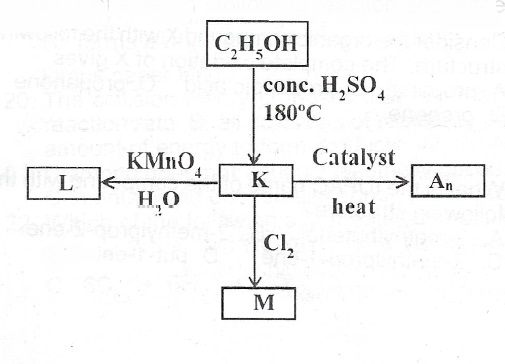
(a) Consider the following reaction sequence.
(i) What process leads/tathe formation of K?
(ii) Write the formula of K.
(iii) Write the structural formula of L and name L.
(iv) Name A\(_n\)
(v) Write the structure of M and name M.
(b)(i) What are carbohydrates?
(ii) Give one example each of a I. monosaccharide; II. disaccharide; III. polysaccharide.
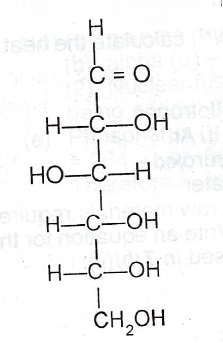
(c) Consider the following structure of a simple sugar :
(i) Which functional group makes the compound a reducing agent?
(ii) State what would C = O be observed when I. the compound is mixed with Fehling's solution and boiled;
I. few drops of concentrated H\(_2\)SO\(_4\) is added to the sample of the compound. H—C—OH
(iii) Write an equation for the reaction in (c)(ii)(II).
(d) A hydrocarbon Z with molecular mass 78 on combustion gave 3.385 g of CO\(_2\) and and 0.692 g of H\(_2\)O. Determine the molecular formula of Z. [ H = 1, C = 12, O = 16]
(a)(1) Define covalent bond.
(ii) Give two properties of covalent compounds
(ii) With the aid of a diagram, show how ammonia molecule is formed
(iv) Illustrate with a diagram the formation of ammonium ion?
(v) What type of bond(s) exist(s) in I. ammonia, H. ammonium ion? (\(_1\)H\(_7\)N)
(b)(i) Write three subatomic particles with their corresponding relative masses. CH\(_2\)OH
(ii) Name the possible states in which water can exist.
(c) (i) State Graham's law of diffusion
(ii) Arrange the following gases, He, CH\(_4\) and N\(_2\) in order of increasing rates of diffusion. Give a reason for the order. [ H = 1, He = 4, C = 12, N = 14 ]
(d) Draw the structures of the following compounds:
(i) 2,3-dimethylbutane;
(ii) 1,4-dibromocyclohexane.
Atom \(^{234} _{88} Q\) decay by alpha emission to give an atom R. The atomic number and mass number of atom R are respectively
(a)(i) What are acidic oxides?
(ii) Give one example of each of the following oxides: I. acidic oxide; II. basic oxide; III. amphoteric oxide; IV. neutral oxide
(b)(i) Define each of the following terms; I. Heat II. Heat of neutralization
(ii) Weite the above an equation to illustrate each of the terms in (b)(i) above
(ii) Given that the standard heat of combustion of butane (C\(_4\)H\(_{(10)}\) is + 5877 kJmol\(^{-1}\), calculate the heat of 14.5 g butane. [ H = 1, = 12 ]
(c) (i) Name two allotropes of sulphur
(ii) State one difference between the two allotropes.
(d)(i) Give two characteristics of noble eases
(ii) State one use each of I. He; II. Ar.
(e) State what is observed on warming ammonium trioxonitrate (V) with sodium hydroxide.
(a)(i) Define hard water
(ii) Name two substances responsible for hardness in water
(iii) Give two methods for the removal of hardness in water.
(b)(i) What are the raw materials require for the manufacture of tetraoxosulphate (VI) acid by the contact process?
(ii) Write an equation for tr reaction that requires a catalyst in the contact process (iii) State the catalyst used in (b)(ii).
(c)(i) Give two uses of sodium tetraoxosulphate (VI) Consider the reaction represented by the following equation:
Na\(_2\)SO\(_4\).10H\(_2\)O\(_{(s)}\) \(\to\) Na\(_2\)SO\(_4\).H\(_2\)O + 9H\(_2\)O\(_{(g)}\)
(ii) What name is given to this type of reaction?
(iii) Calculate the solubility of Na\(_2\)CO\(_3\) at 25°C. if 30.0 cm\(^3\) of its saturated solution at that temperature gave 1.80 g of the anhydrous salt. [C = 12, 0 = 16, Na = 23]
(d)(i) Define the term activated complex
(ii) State one reason why a collision may not produce a chemical reaction
(iii) The formation of water gas is represented by the following equation:
C\(_{(s)}\) + H\(_2\)O\(_{(g)}\) \(\to\) CO\(_{(g)}\) + H\(_{2(0)}\) \(\Delta\)H= + 131 kJmol\(^{-1}\)
Draw an energy profile diagram for the reaction showing the I. activated complex, II. enthalpy of reactants.
Arrange the following compounds in order of increasing boiling point
l.CH 3CH2CH2OH
II.CH 3CH 2OH
III.CH3CH2CH2CH2OH
IV. CH3CH 2CH2CH 2CH 3