Question 1
Simplify \(\frac{\sqrt{3} + \sqrt{48}}{\sqrt{6}}\)
Objective
Practice each question, then open it to see the full details.
Simplify \(\frac{\sqrt{3} + \sqrt{48}}{\sqrt{6}}\)
A function F is defined on the set R, of real numbers by \(f : x \to px^{2} + qx + 2\), where p and q are constants. If \(f(-2) = 0\) and \(f(1) = 3\), find \(f(-4)\).
Find the range of values of x for which \(2x^{2} + 7x - 15 > 0\).
If \(\sin A = \frac{3}{5}\) and \(\cos B = \frac{15}{17}\), where A is an obtuse angle and B is acute, find the value of \(\cos (A + B)\).
A function f is defined on R, the set of real numbers, by: \(f : x \to \frac{x + 3}{x - 2}, x \neq 2\), find \(f^{-1}\).
Differentiate, with respect to x, \(x^{3} + 2x\) from the first principle.
The sum of the first n terms of a linear sequence is \(S_{n} = n^{2} + 2n\). Find the common difference of the sequence.
A straight line passes through the point P(-1, 3). Another line which passes through Q(-4, 4) intersects the first line at the point R(k, 5), where k is a constant. If \(<PRQ = 90°\), find the values of k.
The sum of the first n terms of a linear sequence is \(S_{n} = n^{2} + 2n\). Determine the general term of the sequence.
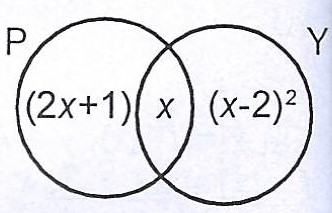
In a hotel, the breakfast is a choice between yam (Y) or plantain (P) or both. The Venn diagram shows the choices made by 25 guests of the hotel.
(a) Find the value of x;
(b) What is the probability that a guest chosen at random chose only one of the two?
If \(f(x) = 2x^{2} - 3x - 1\), find the value of x for which f(x) is minimum.
The table shows the distribution of marks obtained by some candidates in a test.
| Marks | 10-14 | 15-24 | 25-29 | 30-39 | 40-44 | 45-49 |
| No of candidates | 14 | 30 | 22 | 18 | 12 | 4 |
Draw a histogram for the distribution.
The polynomial \(2x^{3} + x^{2} - 3x + p\) has a remainder of 20 when divided by (x - 2). Find the value of constant p.
A car travelling at a velocity of 50kmh\(^{-1}\), covers a distance of 20km. If it was accelerating at 6kmh\(^{-1}\), calculate, correct to one decimal place, the time the car took to cover the distance.
If \(2\log_{4} 2 = x + 1\), find the value of x.
The magnitude of a force \(xi + 15j\) is 17N. Find the :
(a) possible values of x ;
(b) directions of the forces, correct to the nearest degree.
Which of the following quadratic curves will not intersect with the x- axis?
(a) The sum of the first n terms of a sequence is given by \(S_{n} = \frac{5n^{2}}{2} + \frac{5n}{2}\). Write down the first four terms of the sequence and an expression for the nth term.
(b) The equation of a circle is given by \(x^{2} + y^{2} - 10x - 8y + 25 = 0\).
(i) Show that the circle touches the x- axis ; (ii) Find the coordinates of the point of contact.
What is the coordinate of the centre of the circle \(5x^{2} + 5y^{2} - 15x + 25y - 3 = 0\)?
(a) If \(\alpha\) and \(\beta\) are the roots of the equation \(2x^{2} + 5x - 6 = 0\), find the equation whose roots are \((\alpha - 2)\) and \((\beta - 2)\).
(b) Given that \(\int_{0} ^{k} (x^{2} - 2x) \mathrm {d} x = 4\), find the values of k.
Evaluate \(\int_{1}^{2} (2 + 2x - 3x^{2}) \mathrm {d} x\).
(a) Express \(\frac{2x^{2} - 5x + 1}{x^{3} - 4x^{2} + 3x}\) in partial fractions.
(b) If \(\begin{vmatrix} x - 3 & -4 & 3 \\ 5 & 2 & 2 \\ 2 & -4 & 6 - x \end{vmatrix} = -24\), find the value of x.
A rectangle has a perimeter of 24m. If its area is to be maximum, find its dimension.
(a) The point P(3, -5) is rotated through an angle 60° anticlockwise about the origin. (i) Obtain the matrix for the rotation ; (ii) Find the image P' of the point P under the rotation.
(b) A linear transformation is given by \(N : (x, y) \to (2x + 3y, 3x - y)\).
(i) Write down the matrix N of the transformation ; (ii) If \(N^{2} + aN + bI = 0\), where a, b \(\in\) R, \(I\) is the \(2 \times 2\) matrix and \(0\) is the \(2 \times 2\) null matrix, find the values of a and b.
Express \(\frac{7\pi}{6}\) radians in degrees.
A survey indicated that 65% of the families in an area have cars. Find, correct to three decimal places, the probability that among 7 families selected at random in the area
(a) exactly 5 ;
(b) 3 or 4 ;
(c) at most 2 of them have cars.
If \(P = \begin{pmatrix} 1 & -2 \\ 3 & 4 \end{pmatrix}\) and \(Q = \begin{pmatrix} -2 & 3 \\ 1 & 0 \end{pmatrix}\), find PQ.
The following table shows the distribution of marks obtained by some students in an examination.
| Marks | 0-9 | 10-19 | 20-29 | 30-39 | 40-49 | 50-59 | 60-69 | 70-79 | 80-89 | 90-99 |
| Frequency | 50 | 50 | 40 | 60 | 100 | 100 | 50 | 25 | 15 | 10 |
(a) Construct a cumulative frequency table for the distribution
(b) Draw an ogive for the distribution
(c) Use your graph in (b) to determine : (i) semi- interquartile range ; (ii) number of students who failed, if the pass mark for the examination is 37 ; (iii) probability that a student selected at random scored between 20% and 60%.
Two statements are represented by p and q as follows:
p : He is brilliant; q : He is regular in class
Which of the following symbols represent "He is regular in class but dull"?
(a) Five female and seven male teachers applied for 4 vacancies in a Junior High School. The teachers are equally qualified. Find the number of ways of employing the 4 teachers, if : (i) there is no restriction ; (ii) at least 2 of them are females.
(b) The table shows the positions awarded to 7 contestants by Judges X and Y in a competition.
| Contestant | P | Q | R | S | T | U | V |
| Judge X | 2 | 7 | 1 | 3 | 6 | 5 | 4 |
| Judge Y | 4 | 6 | 2 | 3 | 1 | 1 | 5 |
(i) Calculate, correct to one decimal place, the Spearman's rank correlation coefficient.
(ii) Interpret your answer in b(i) above.
Find the locus of points which is equidistant from P(4, 5) and Q(-6, -1).
The position vectors of points P, Q and R with respect to the origin are \((4i - 5j), (i + 3j)\) and \((-5i + 2j)\) respectively. If PQRM is a parallelogram, find:
(a) the position vector of M ;
(b) \(|\overrightarrow{PM}|\) and \(|\overrightarrow{PQ}|\) ;
(c) the acute angle between \(\overrightarrow{PM}\) and \(\overrightarrow{PQ}\), correct to 1 decimal place ;
(d) the area of PQRM.
A binary operation ,*, is defined on the set R, of real numbers by \(a * b = a^{2} + b + ab\). Find the value of x for which \(5 * x = 37\).
(a) Forces \(F_{1} = \begin{pmatrix} -5 & 4 \end{pmatrix} N; F_{2} = \begin{pmatrix} 2 \\ 5 \end{pmatrix} N; F_{3} = \begin{pmatrix} 2 & -1 \end{pmatrix} N\) and \(F_{4} = \begin{pmatrix} 3 & -5 \end{pmatrix} N\) act on a body. Find the :
(i) resultant of these forces ; (ii) fifth force that will keep the body in equilibrium.
(b) A body moving at 20 ms\(^{-1}\) accelerates uniformly at 2.5 ms\(^{-2}\) for 4 seconds. It continues the journey at the speed for 8 seconds, before coming to rest in t seconds with a uniform retardation. If the ratio of the acceleration to the retardation is 3 : 4,
(i) sketch the velocity- time graph of the journey ; (ii) find t ; (iii) find the total distance of the journey.
Find the derivative of \(3x^{2} + \frac{1}{x^{2}}\)
(a) An object is thrown up a smooth plane inclined at an angle of 30° to the horizontal. If the plane is 15m long and the object comes to rest at the top, find the :
(i) initial speed of the object ; (ii) time taken to reach the top.
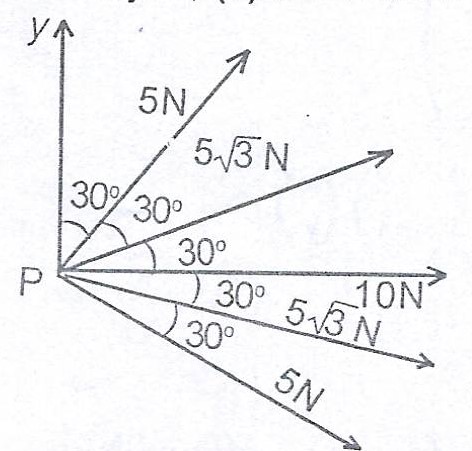
(b) Force of magnitudes \(5 N, 5\sqrt{3} N, 10 N, 5\sqrt{3} N\) and \(5 N\) act on a body P, of mass 5 kg as shown in the diagram. Find the :
(i) magnitude of the resultant force ; (ii) acceleration of the body.
The coefficient of the 5th term in the binomial expansion of \((1 + kx)^{8}\), in ascending powers of x is \(\frac{35}{8}\). Find the value of the constant k.
Given that \(f '(x) = 3x^{2} - 6x + 1\) and f(3) = 5, find f(x).
Express \(\frac{1}{1 - \sin 45°}\) in surd form.
If \(\begin{vmatrix} 4 & x \\ 5 & 3 \end{vmatrix} = 32\), find the value of x.
If events A and B are independent and \(P(A) = \frac{7}{12}\) and \(P(A \cap B) = \frac{1}{4}\), find P(B).
Given that \(\overrightarrow{AB} = 5i + 3j\) and \(\overrightarrow{AC} = 2i + 5j\), find \(\overrightarrow{BC}\).
The probability of Jide, Atu and Obu solving a given problem are \(\frac{1}{12}\), \(\frac{1}{6}\) and \(\frac{1}{8}\) respectively. Calculate the probability that only one solves the problem.
Two forces \(F_{1} = (10N, 020°)\) and \(F_{2} = (7N, 200°)\) act on a particle. Find the resultant force.
| Marks | 2 | 3 | 4 | 5 | 6 | 7 | 8 |
| No of students | 5 | 7 | 9 | 6 | 3 | 6 | 4 |
The table above shows the distribution of marks by some candidates in a test. What is the median score?
| Marks | 2 | 3 | 4 | 5 | 6 | 7 | 8 |
| No of students | 5 | 7 | 9 | 6 | 3 | 6 | 4 |
The table above shows the distribution of marks by some candidates in a test. Find, correct to one decimal place, the mean of the distribution.
| Marks | 2 | 3 | 4 | 5 | 6 | 7 | 8 |
| No of students | 5 | 7 | 9 | 6 | 3 | 6 | 4 |
The table above shows the distribution of marks by some candidates in a test. If a student is selected at random, what is the probability that she scored at least 6 marks?
Express \(r = (12, 210°)\) in the form \(a i + b j\).
A test consists of 12 questions out of which candidates are to answer 10. If the first 6 are compulsory, in how many ways can each candidate select her questions?
A body starts from rest and moves in a straight line with uniform acceleration of \(5 ms^{-2}\). How far, in metres, does it go in 10 seconds?