Question 1
Which of the following sets is equivalent to \((P \cup Q) \cap (P \cup Q')\)?
Objective
Practice each question, then open it to see the full details.
Which of the following sets is equivalent to \((P \cup Q) \cap (P \cup Q')\)?
Two functions g and h are defined on the set R of real numbers by \(g : x \to x^{2} - 2\) and \(h : x \to \frac{1}{x + 2}\). Find :
(a) \(h^{-1}\), the inverse of h ;
(b) \(g \circ h\), when \(x = -\frac{1}{2}\).
Simplify: \(\frac{\cos 2\theta - 1}{\sin 2\theta}\)
Express \(3x^{2} - 6x + 10\) in the form \(a(x - b)^{2} + c\), where a, b and c are integers. Hence state the minimum value of \(3x^{2} - 6x + 10\) and the value of x for which it occurs.
Solve the inequality \(x^{2} - 2x \geq 3\)
The twenty-first term of an Arithmetic Progression is \(5\frac{1}{2}\) and the sum of the first twenty-one terms is \(94\frac{1}{2}\). Find the :
(a) first term ; (b) common difference ; (c) sum of the first thirty terms.
Given that \(\sqrt{6}, 3\sqrt{2}, 3\sqrt{6}, 9\sqrt{2},...\) are the first four terms of an exponential sequence (G.P), find in its simplest form the 8th term.
Write down the first three terms of the binomial expansion \((1 + ax)^{n}\) in ascending powers of x. If the coefficients of x and x\(^{2}\) are 2 and \(\frac{3}{2}\) respectively, find the values of a and n.
Given that \(\sin x = \frac{-\sqrt{3}}{2}\) and \(\cos x > 0\), find x.
The gradient function of \(y = ax^{2} + bx + c\) is \(8x + 4\). If the function has a minimum value of 1, find the values of a, b and c.
Evaluate \(\log_{10}(\frac{1}{3} + \frac{1}{4}) + 2\log_{10} 2 + \log_{10} (\frac{3}{7})\)
Three forces \(-63j , 32.14i + 38.3j\) and \(14i - 24.25j\) act on a body of mass 5kg. Find, correct to one decimal place, the :
(a) magnitude of the resultant force ;
(b) acceleration of the body.
QRS is a triangle such that \(\overrightarrow{QR} = (3i + 2j)\) and \(\overrightarrow{SR} = (-5i + 3j)\), find \(\overrightarrow{SQ}\).
Simplify \(^{n + 1}C_{4} - ^{n - 1}C_{4}\)
= \(\frac{(n + 1)!}{4! (n - 3)!} - \frac{(n - 1)!}{4! (n - 5)!}\)
= \(\frac{(n + 1)(n)(n - 1)(n - 2)(n - 3)!}{4! (n - 3)!} - \frac{(n - 1)(n - 2)(n - 3)(n - 4)(n - 5)!}{4! (n - 5)!}\)
= \(\frac{(n + 1)(n)(n - 1)(n - 2)}{4!} - \frac{(n - 1)(n - 2)(n - 3)(n - 4)}{4!}\)
= \(\frac{(n - 1)(n - 2) [n(n + 1) - (n - 3)(n - 4)]}{4!}\)
= \(\frac{(n - 1)(n - 2) [n^{2} + n - n^{2} + 7n - 12]}{24}\)
= \(\frac{(n - 1)(n - 2)[8n - 12]}{24}\)
= \(\frac{(n - 1)(n - 2)(2n - 3)}{6}\)
If (x + 1) is a factor of the polynomial \(x^{3} + px^{2} + x + 6\). Find the value of p.
The marks scored by 35 students in a test are given in the table below.
| Marks | 1-5 | 6-10 | 11-15 | 16-20 | 21-25 | 26-30 |
| Frequency | 2 | 7 | 12 | 8 | 5 | 1 |
Draw a histogram for the distribution.
A polynomial is defined by \(f(x + 1) = x^{3} + px^{2} - 4x + 2\), find f(2).
(a) The polynomial \(f(x) = x^{3} + px^{2} - 10x + q\) is exactly divisible by \(x^{2} + x - 6\). Find the :
(i) values of p and q ; (ii) third factor.
(b) The volume of a cube is increasing at the rate of \(2\frac{1}{2} cm^{3} s^{-1}\). Find the rate of change of the side of the base when its length is 2cm.
The equation of a circle is \(3x^{2} + 3y^{2} + 24x - 12y = 15\). Find its radius.
(a) Write down the matrix A of the linear transformation \(A(x, y) \to (2x -y, -5x + 3y)\).
(b) If \(B = \begin{pmatrix} 3 & 1 \\ 5 & 2 \end{pmatrix}\), find :
(i) \(A^{2} - B^{2}\) ; (ii) matrix \(C = B^{2} A\) ; (iii) the point \(M(x, y)\) whose image under the linear transformation \(C\) is \(M' (10, 18)\).
(c) What is the relationship between matrix A and matrix C?
If the midpoint of the line joining (1 - k, -4) and (2, k + 1) is (-k, k), find the value of k.
(a) Evaluate : \(\int_{1} ^{4} \frac{x(3x - 2)}{2\sqrt{x}} \mathrm {d} x\)
(b) The equation of a circle is given by \(2x^{2} + 2y^{2} - 8x + 5y - 10 = 0\). Find the :
(i) coordinates of the centre ; (ii) radius of the circle .
Evaluate \(\int_{-2}^{3} (3x^{2} - 2x - 12) \mathrm {d} x\)
(a)(i) Find the sum of the series \(A(1 + r) + A(1 + r)^{2} + ... + A(1 + r)^{n}\).
(ii) Given that r = 8% and A = GH 40.00, find the sum of the 6th to 10th terms of the series in (i).
(b) Find the equation of the tangent to the curve \(y = \frac{1}{x}\) at the point on the curve when x = 2.
If \(y = x^{3} - x^{2} - x + 6\), find the values of x at the turning point.
(a) A fair die with six faces is thrown six times. Calculate, correct to three decimal places, the probability of obtaining :
(i) exactly three sixes ; (ii) at most three sixes.
(b) Eight percent of screws produced by a machine are defective. From a random sample of 10 screws produced by the machine, find the probability that :
(i) exactly two will be defective ; (ii) not more than two will be defective.
Given that \(P = \begin{pmatrix} 2 & 1 \\ 5 & -3 \end{pmatrix}\) and \(Q = \begin{pmatrix} 4 & -8 \\ 1 & -2 \end{pmatrix}\), Find (2P - Q).
The table gives the distribution of heights in metres of 100 students.
| Height | 1.40-1.42 | 1.43-1.45 | 1.46-1.48 | 1.49-1.51 | 1.52-1.54 | 1.55-1.57 | 1.58-1.60 | 1.61-1.63 |
| Freq | 2 | 4 | 19 | 30 | 24 | 14 | 6 | 1 |
(a) Calculate the : (i) mean height ; (ii) mean deviation of the distribution.
(b) What is the probability that the height of a student selected at random is greater than the mean height of the distribution?
A binary operation, \(\Delta\), is defined on the set of real numbers by \(a \Delta b = a + b + 4\). Find the identity element.
(a) Two items are selected at random from four items labelled (p, q, r, s).
(i) List the sample space if sampling is done (1) with replacement ; (2) without replacement.
(ii) Find the probability that r is at least one of the two objects selected : (1) in a(i)1 ; (2) in a(i)2.
(b) How many whole numbers from 100 to 999 are divisible by (i) 4 ; (ii) both 3 and 4?
The marks obtained by 10 students in a test are as follows: 3, 7, 6, 2, 8, 5, 9, 1, 4 and 10. Find the mean mark.
(a) A body P of mass 5kg is suspended by two light inextensible strings AP and BP attached to a ceiling. If the strings are inclined at angles 40° and 30° respectively to the downward vertical, find the tension in each of the strings. [Take \(g = 10 ms^{-2}\)].
(b) A constant force F acts on a toy car of mass 5 kg and increases its velocity from 5 ms\(^{-1}\) to 9 ms\(^{-1}\) in 2 seconds. Calculate :
(i) the magnitude of the force ; (ii) velocity of the toy car 3 seconds after attaining a velocity of 9 ms\(^{-1}\).
The marks obtained by 10 students in a test are as follows: 3, 7, 6, 2, 8, 5, 9, 1, 4 and 10. Find the variance.
(a) Given that \(p = (4i - 3j)\) and \(q = (-i + 5j)\), find r such that \(|r| = 15\) and is in the direction \((2p + 3q)\).
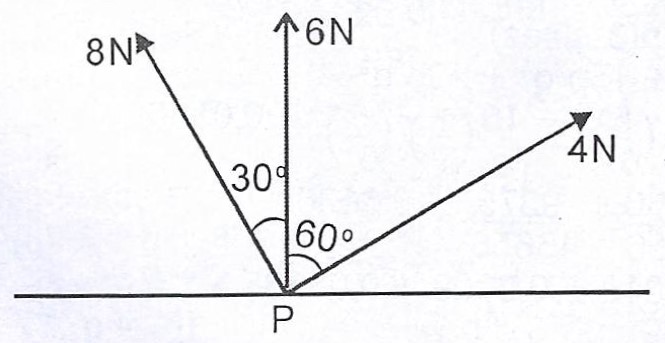
(b) Forces of magnitude 8N, 6N and 4N act at the point P, as shown in the above diagram. Find the : (i) magnitude ; (ii) direction of the resultant force.
If r denotes the correlation coefficient between two variables, which of the following is always true?
(a) Find the angle between the vectors \(a = \begin{pmatrix} -3 \\ 4 \end{pmatrix}\) and \(b = \begin{pmatrix} -8 \\ -15 \end{pmatrix}\).
(b) Given that \(a = (4N, 060°)\) and \(b = (3N, 120°)\), find, in component form, the unit vector along \(a - b\).
A stone is dropped from a height of 45m. Find the time it takes to hit the ground. \([g = 10 ms^{-2}]\)
Differentiate \(\frac{x}{x + 1}\) with respect to x.
Two forces 10N and 6N act in the directions 060° and 330° respectively. Find the x- component of their resultant.
Find the unit vector in the direction of the vector \(-12i + 5j\).
In computing the mean of 8 numbers, a boy mistakenly used 17 instead of 25 as one of the numbers and obtained 20 as the mean. Find the correct mean
Given that \(^{n}P_{r} = 90\) and \(^{n}C_{r} = 15\), find the value of r.
Which of the following is nor a measure of central tendency?
A fair die is tossed twice. Find the probability of obtaining a 3 and a 5.
If P(x - 3) + Q(x + 1) = 2x + 3, find the value of (P + Q).
Find the values of x at the point of intersection of the curve \(y = x^{2} + 2x - 3\) and the lines \(y + x = 1\).
Find the constant term in the binomial expansion of \((2x - \frac{3}{x})^{8}\).
A straight line makes intercepts of -3 and 2 on the x- and y- axes respectively. Find the equation of the line.
Find the number of different arrangements of the word IKOTITINA.
Find the acute angle between the lines 2x + y = 4 and -3x + y + 7 = 0.