Question 1
If 3loga + 5loga - 6loga = log64, what is a?
Objective
Practice each question, then open it to see the full details.
(a) Without using Mathematical tables, find x, given that \(6 \log (x + 4) = \log 64\)
(b) If \(U = {1, 2, 3,4, 5, 6, 7, 8, 9, 10}, X = {1, 2, 4, 6, 7, 8, 9}, Y = {1, 2, 3, 4, 7, 9}\) and \(Z = {2, 3, 4, 7, 9}\). What is \(X \cap Y \cap Z' \)?
The table shows the weights, to the nearest kilogram, of twelve students in a Further Mathematics class
| Weight in kg | 55 | 57 | 59 | 61 | 63 |
| No of students | 2 | 1 | 2 | 4 | 3 |
(a) Draw a bar chart to illustrate the above information;
(b) What is (i) the mode; (ii) the median of the distribution?
(c) Calculate the mean weight correct to the nearest kilogram.

In the diagram above, TPS is a straight line, PQRS is a parallelogram with base QR and height 8cm. |QR| = 6cm and the area of triangle QST is 52cm2. Find the area of ΔQPT
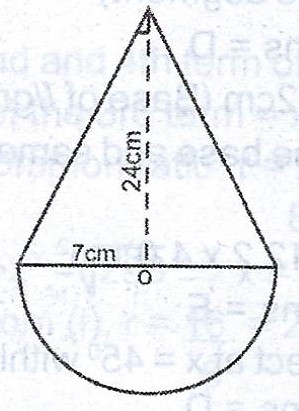
The diagram shows a wooden structure in the form of a cone, mounted on a hemispherical base. The vertical height of the cone is 24cm and the base height 7cm. Calculate, correct to three significant figures, the surface area of the structure. [Take \(\pi = \frac{22}{7}\)].

In the diagram O is the center of the circle, if ∠QRS = 62o, find the value of ∠SQR.
Using a ruler and a pair of compasses only, construct a triangle ABC, given that |AB| = 8.4cm, |BC| = 6.5cm and < ABC = 30°. Construct the locus:
(a) \(l_{1}\) of points equidistant from AB and BC, and within the angle ABC;
(b) \(l_{2}\) of points equidistant from B and C. Locate the point of intersection P of \(l_{1}\) and \(l_{2}\). Measure |AP|.
Evaluate, using logarithm tables \(\frac{5.34 \times 67.4}{2.7}\)
(a) If \(\cos \alpha = 0.6717\), use mathematical tables to find (i) \(\alpha\) ; (ii) \(\sin \alpha\)
(b) The angle of depression of a point P on the ground, from the top T of a building is 23.6°. If the distance of P from the foot of the building is 50m, calculate the height of the building, correct to the nearest metre.
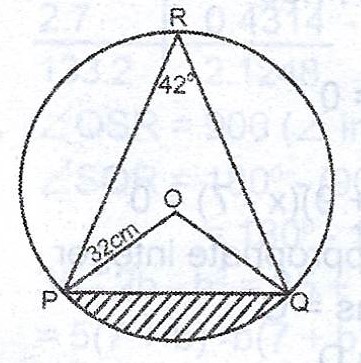
(a) In the diagram, O is the centre of the circle radius 3.2cm. If < PRQ = 42°, calculate, correct to two decimal places, the area of the:
(i) minor sector POQ ; (ii) shaded part.
(b) If the sector POQ in (a) is used to form the curved surface of a cone with vertex O, calculate the base radius of the cone, correct to one decimal place.
Evaluate \(\frac{0.009}{0.012}\), leaving your answer in standard form.
When a stone is thrown vertically upwards, its distance d metres after t seconds is given by the formula \(d = 60t - 10t^{2}\). Draw the graph of \(d = 60t - 10t^{2}\) for values of t from 1 to 5 seconds using 2cm to 1 unit on the t- axis and 2cm to 20 units on the d- axis.
(a) Using your graph, (i) how long does it take to reach a height of 70 metres? (ii) determine the height of the stone after 5 seconds. (iii) after how many seconds does it reach its maximum height.
(b) Determine the slope of the graph when t = 4 seconds.

(a) (i) Prove that the angle which an arc of a circle subtends at the centre is twice that which it subtends at any point on the remaining part of the circumference.
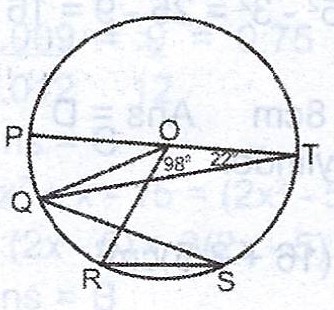
(ii) In the diagram above, O is the centre of the circle and PT is a diameter. If < PTQ = 22° and < TOR = 98°, calculate < QRS.
(b) ABCD is a cyclic quadrilateral and the diagonals AC and BD intersect at H. If < DAC = 41° and < AHB = 70°, calculate < ABC.
(a) In an A.P, the difference between the 8th and 4th terms is 20 and the 8th term is \(1\frac{1}{2}\) times the 4th term. What is the:
(i) common difference ; (ii) first term of the sequence?
(b) The value of a machine depreciates each year by 5% of its value at the beginning of that year. If its value when new on 1st January 1980 was N10,250.00, what was its value in January 1989 when it was 9 years old? Give your answer correct to three significant figures.
(a) A pair of fair dice each numbered 1 to 6 is tossed. Find the probability of getting a sum of at least 9.
(b) If the probability that a civil servant owns a car is \(\frac{1}{6}\), find the probability that:
(i) two civil servants, A and B, selected at random each owns a car ; (ii) of two civil servants, C and D selected at random, only one owns a car ; (iii) of three civil servants, X, Y and Z, selected at random, only one owns a car.
(a) Triangle PQR is right-angled at Q. PQ = 3a cm and QR = 4a cm. Determine PR in terms of a.
(b) Ayo travels a distance of 24km from X on a bearing of 060° to Y. He then travels a distance of 18km to a point Z and Z is 30km from X.
(i) Draw the diagram to show the positions of X, Y and Z ; (ii) What is the bearing of Z from Y ; (iii) Calculate the bearing of X from Z.

(a) Derive the smallest equation whose coefficients are integers and which has roots of \(\frac{1}{2}\) and -7.
(b) Three years ago, a father was four times as old as his daughter is now. The product of their present ages is 430. Calculate the ages of the father and daughter.


An arc of a circle radius 7cm is 14cm long. What angle does the arc subtend at the center of circle?
[Take π = 22/7]
If twice a certain integer is subtracted from 5 times the integer, the result is 63. Find the integer.
If 3\(^y\) = 243, find the value of y.
Points X and Y are respectively 20km North and 9km East of a point O. What is the bearing of Y from X? Correct to the nearest degree

In the diagram above, O is the center of the circle. Calculate the length of the chord AB if |OA| = 5cm, |OD| = 3cm and ∠AOD = ∠BOD
Solve the following equation: 6x\(^2\) - 7x - 5 = 0

What angle represents grown up girls ? Correct to one decimal place

If A = {a,b,c}, B = {a,b,c,d,e} and C = {a,b,c,d,e,f}. Find (A∪B)∩(A∪C)

In the diagram above O is the center of the circle, if ∠PAQ = 75o, what is the value of ∠PBQ?
Simplify \(\frac{9^{-\frac{1}{2}}}{27^{\frac{2}{3}}}\)

In the diagram above, what is the size of angle ACB?


The table above gives the scores of a group of students in an English Language test


A sector is cut off from a circle radius 8.2cm to form a cone, if the radius of the resulting cone is 3.5cm, calculate the curved surface area of the cone. [take π = 22/7]