Question 1
If 23x + 101x = 130x, find the value of x
Objective
Practice each question, then open it to see the full details.
(a) Without using Mathematical tables or calculators, evaluate \(\frac{0.09 \times 1.21}{3.3 \times 0.00025}\), leaving the answer in standard form (Scientific Notation).
(b) A principal of GH¢5,600 was deposited for 3 years at compound interest. If the interest earned was GH¢1,200, find, correct to 3 significant figures, the interest rate per annum.
(a) Solve : \(7(x + 4) - \frac{2}{3}(x - 6) \leq 2[x - 3(x + 5)]\)
(b) A transport company has a total of 20 vehicles made up of tricycle and taxicabs. Each tricycle carries 2 passengers while each taxicab carries four passengers. If the 20 vehicles carry a total of 66 passengers at a time, how many tricycles does the company have?
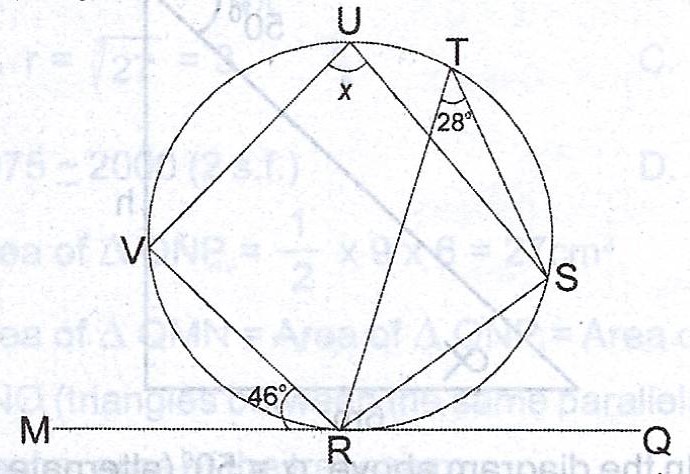
(a) In the diagram, < RTS = 28°, < VRM = 46°, MQ is a tangent to the circle VRSTU at the point R. Find < VUS.
(b) A cylinder tin, 7cm high, is closed at one end. If its total surface area is 462\(cm^{2}\), calculate its radius. [Take \(\pi = \frac{22}{7}\)].
| Scores | 1 | 2 | 3 | 4 | 5 | 6 |
| Frequency | 25 | 30 | x | 28 | 40 | 32 |
The table shows the outcome when a die is thrown a number of times. If the probability of obtaining a 3 is 0.225;
(a) How many times was the die thrown?
(b) Calculate the probability that a trial chosen at random gives a score of an even number or a prime number.
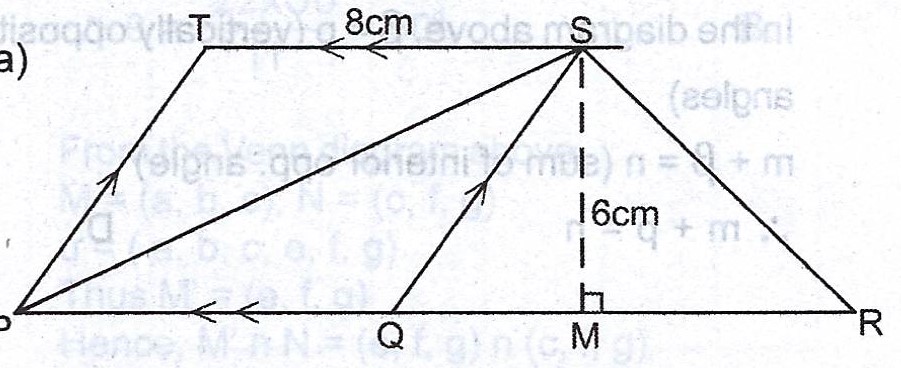
(a) In the diagram, PQST is a parallelogram, PR is a straight line, |TS| = 8cm, |SM| = 6cm and area of triangle PSR = \(36 cm^{2}\). Find the value of |QR|.
(b) A tree and a flagpole are on the same horizontal ground. A bird on top of the tree observes the top and bottom of the flagpole below it at angle of 45° and 60° respectively. If the tree is 10.65m high, calculate, correct to 3 significant figures, the height of the flagpole.
(a) Find the sum of the Arithmetic Progression (AP) 1, 3, 5,..., 101.
(b) Out of the 95 travellers interviewed, 7 travelled by bus and train only, 3 by train and car only and 8 travelled by all 3 means of transport. The number, x, of travellerswho travelled by bus only was equal to the number who travelled by bus and car only. If 47 people travelled by bus and 30 by train :
(i) represent this information in a Venn diagram;
(ii) calculate the
(1) value of x ; (2) number who travelled by at least two means.
(a) Using the method of completing the square, solve, correct to 2 decimal places, \(\frac{x - 2}{4} = \frac{x + 2}{2x}\).
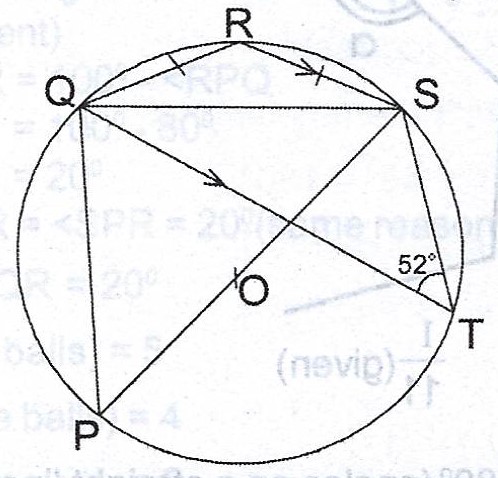
(b) In the diagram, PQRST is a circle with centre O. If PS is a diameter, RS//QT, and < QTS = 52°, find :
(i) < SQT ; (ii) < PQT.
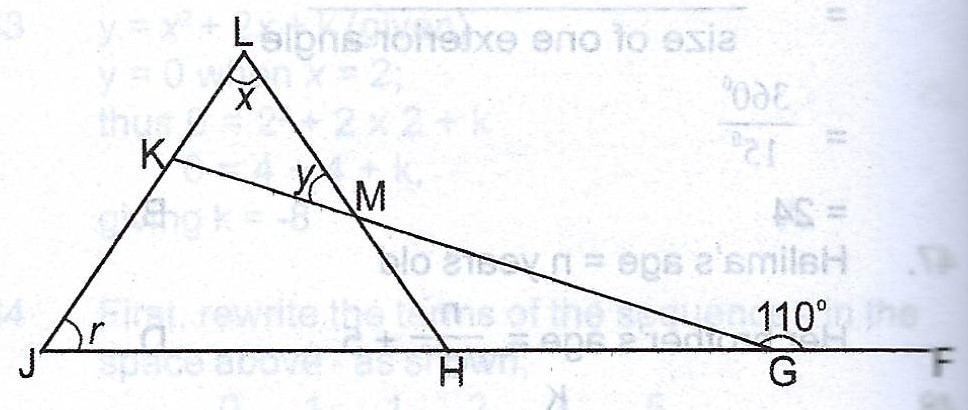
(a) In the diagram, < KLM = x, < LMK = y, < KJH = r and < KGF = 110°. If 2x = r = y, find the value of x.
(b) Ten boys and twelve girls collected donations for a project. The total amount collected by the boys was N600.00 gretaer than that collected by the girls. If the average collection of the boys was N100.00 greater than the average collection of the girls, how much was collected by the two groups?
The weight (in kg) of 50 contestants at a competition is as follows:
65 66 67 66 64 66 65 63 65 68 64 62 66 64 67 65 64 66 65 67 65 67 66 64 65 64 66 65 64 65 66 65 64 65 63 63 67 65 63 64 66 64 68 65 63 65 64 67 66 64.
(a) Construct a frequenct table for the discrete data.
(b) Calculate, correct to 2 decimal places, the;
(i) mean ; (ii) standard deviation of the data.
Using ruler and a pair of compasses only,
(a) construct :
(i) \(\Delta\)XYZ such that |XY| = 10cm, < XYZ = 30° and < YXZ = 45°.
(ii) locus, \(l_{1}\), of points equidistant from Y and Z.
(iii) locus, \(l_{2}\), of points parallel to XY through Z.
(b) Locate M, the point of intersection of \(l_{1}\) and \(l_{2}\).
(c) Measure < ZMY.
(a) If \(\frac{3p + 4q}{3p - 4q} = 2\), find \(p : q\).
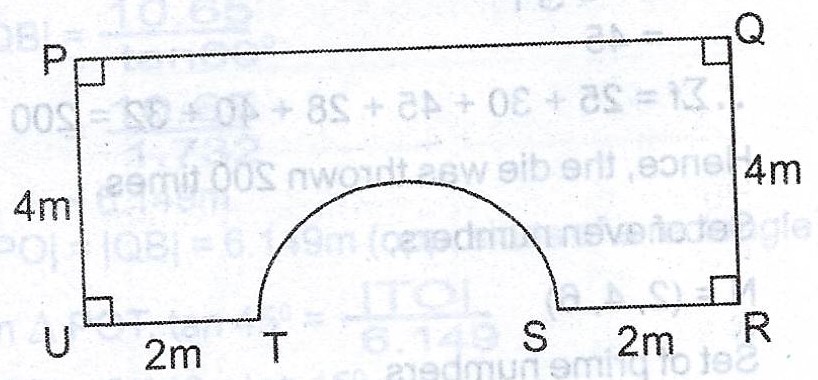
(b) The diagram shows the cross section of a bridge with a semi-circular hollow in the middle. If the perimeter of the cross section is 34 cm, calculate the :
(i) length PQ; (ii) area of the cross section.
[Take \(\pi = \frac{22}{7}\)].
(a) Copy and complete the table of values, correct to one decimal place, for the relation \(y = 3\sin x + 2\cos x\) for \(0° \leq x \leq 360°\).
| x | 0° | 30° | 60° | 90° | 120° | 150° | 180° | 210° | 240° | 270° | 300° | 330° | 360° |
| y | 3.0 | 1.6 | -2.0 | -3.6 | -3.0 | 2.0 |
(b) Using scales of 2cm to 30°mon the x- axis and 2cm to 1 unit on the y- axis, draw the graph of the relation \(y = 3\sin x + 2\cos x\) for \(0°\leq x \leq 360°\).
(c) Use the graph to solve :
(i) \(3\sin x + 2\cos x = 0\)
(ii) \(2 + 2\cos x + 3\sin x = 0\).
(a) Find the equation of a straight line which passes through the point (2, -3) and is parallel to the line \(2x + y = 6\).
(b) The operation \(\Delta\) is defined on the set T = {2, 3, 5, 7} by \(x \Delta y = (x + y + xy) mod 8\).
(i) Construct modulo 8 table for the operation \(\Delta\) on the set T.
(ii) Use the the table to find: (a) \(2 \Delta (5 \Delta 7)\) ; (b) \(2 \Delta n = 5 \Delta 7\).
A straight line passes through the points P(1,2) and Q(5,8). Calculate the gradient of the line PQ


