Question 1
Which of the units of the following physical quantities are derived? I. Area II. Thrust III. Pressure IV. Mass
Objective
Practice each question, then open it to see the full details.
(a) Explain with the aid of a diagram what is meant by the moment of a force about a point.
(b) State the conditions of equilibrium for a number of coplanar parallel forces.
A metre rule is found to balance at the 48cm mark. When a body of mass 60g is suspended at the 6cm mark, the balance point is found to be at the 30cm mark. Calculate:
(i) the mass of the metre rule; (ii) the distance of the balance point from the zero end, if the body were moved to the 13cm mark.
(c) Show that the efficiency E, the force ratio M.A and the velocity ratio V.R of a machine are related by the equation \(E = \frac{M.A}{V.R} \times 100%\)
The efficiency of a machine is 80%. Determine the work done by a person using this machine to raise a load of 200kg through a vertical distance of 3.0m.
[Take g = 10ms\(^{-2}\)]
(a) Draw a labelled diagram of a vacuum flask. Explain how its construction minimizes heat exchange with the surroundings.
(b) State Boyle's law. A thread of mercury of length 15cm is used to trap some air in a capillary tube with uniform cross- sectional area and closed at one end with the tube vertical and the open end uppermost, the length of the trapped air column is 20cm. Calculate the length of the air column when the tube is held:
(i) Horizontally ; (ii) vertically with the open end underneath. [Atmospheric pressure = 76cm Hg]
(c) Explain why it is not advisable to sterilize a clinical thermometer in boiling water at normal atmospheric pressure.
(a) Explain with the aid of a diagram how a converging lens could be used to : (i) ignite a piece of carbon paper ; (ii) produce an enlarged picture on a screen ; (iii) correct an eye defect.
(b) What is a mechanical wave? Describe with the aid of a diagram, an experiment to show that sound needs a material medium for transmission.
State 3 characteristics of sound and mention the factor on which each depends.
(a) Explain what is meant by: (i) electric field intensity ; (ii) electric lines of force.
(b) Two similar but opposite point charges -q and +q each of magnitude \(5 \times 10^{-8} C\) are seperated by a distance of 8.0cm in vacuum as shown in the diagram below.
Calculate the magnitude and direction of the resultant electric field intensity E at the point P. Draw the lines of force due to this system of charges. [Take \(\frac{1}{4 \pi \varepsilon _{0}}\)]
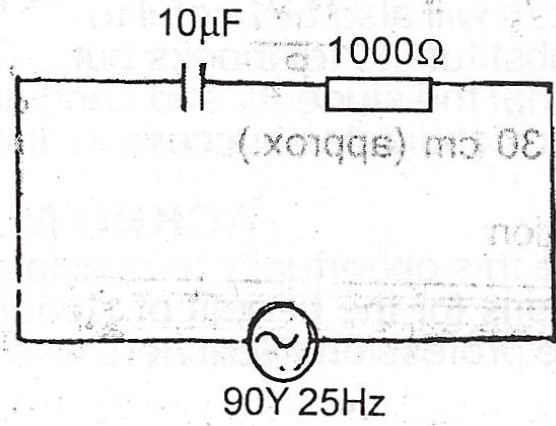
(c) Calculate the following in the series circuit shown above: (i) reactance of the capacitor ; (ii) impedance of the circuit ; (iii) current through the circuit ; (iv) voltage across the capacitor ; (v) average power used in the circuit.

Which of the following statements about the gaseous state of matter is not correct? The molecules of a substance is in gaseous state
Which of the following cannot be used to measure the temperature of a substance?
Which of the following statements about radiant heat is/are not correct?
I. radiant heat cannot travel through a vacuum
II. rough surfaces emit radiant heat more than polished surfaces
III. Dark surfaces absorb radiant heat more than bright surfaces