Question 1
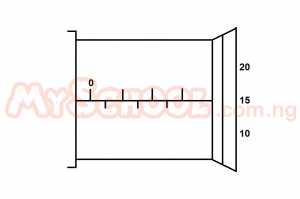
Which of the following instruments is suitable for making the most accurate measurement of the internal diameter of a test tube?
Objective
Practice each question, then open it to see the full details.
(a) Using a suitable diagram, explain how the following can be obtained from a velocity-time graph (i) acceleration; (ii) retardation; (iii) total distance covered.
(b) Show that the displacement of a body moving with uniform acceleration a is given by \(s = ut + \frac{1}{2} at^{2}\) where u is the velocity of the body at time t = 0.
(c) A particle moving in a straight line with uniform deceleration has a velocity of 40ms\(^{-1}\) at a point P, 20ms\(^{-1}\) at a point Q and comes to rest at a point R where QR = 50m. Calculate the: (i) distance PQ; (ii) time taken to cover PQ; (iii) time taken to cover PR.
(a) Define the boiling point of a liquid.
(b) Describe an experiment to determine the boiling point of small quantity of a liquid.
(c) A piece of copper of mass 300 g at a temperature of 950°C is quickly transferred to a vessel of negligible thermal capacity containing 250 g of water at 25°C. If the final steady temperature of the mixture is 100°C, calculate the mass of the water that will boil away.
[Specific heat capacity of copper = \(4.0 \times 10^{2} Jkg^{-1} K^{-1}\); Specific heat capacity of water = \(4.2 \times 10^{3} Jkg^{-1} K^{-1}\); Specific latent heat of vaporization of steam = \(2.26 \times 10^{6} Jkg^{-1}\)
(d) State four other effects of heat on a substance other than expansion.
(a) Define the capacitance of a capacitor.
(b) State three factors on which the capacitance of a parallel plate capacitor depends.
(c) Derive a formula for the energy W stored in a charged capacitor of capacitance C carrying a charge Q on either plate.
(d) Two capacitors of capacitance 4\(\mu F\) and 6\(\mu F\) are connected in series to a 100V d.c supply. Draw the circuit diagram and calculate the (i) charge on either plate of each capacitor (ii) p.d. across each capacitor; (iii) energy of the combined capacitors.
(a) Explain the terms nuclear fission and nuclear fusion.
(b) State two advantages of fusion over fission and explain briefly why, in spite of these advantages, fusion is not normally used for the generation of power.
(c) \(^{238} _{92} U\) is a long half- life alpha emitter and decays to thorium Th which, in turn decays by beta emission with a small decay constant to an isotope of protactinium Pa. The protactinium decay scheme of \(^{238} _{92} U \) as stated above.
(d) State three uses of radioisotopes.
Which of the following is/are necessary for the production of interference with two wave trains? I. The sources must be close to each other. II The waves must have the same frequency. III. The waves must have the same amplitude. IV. The waves must travel with the speed of light.