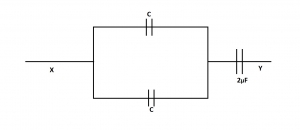
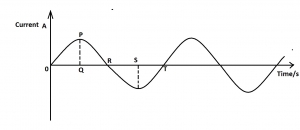
Question 1
Which of the following is a fundamental quantity?
Objective
Practice each question, then open it to see the full details.
(a) Explain what is meant by acceleration of free fall due to gravity, g.
(b) State two reasons why g varies on the surface of the earth
(c) A stone is projected upwards at an angle of 30° to the horizontal from the top of a tower of height 100 m and it hits the ground at a point Q. If the initial velocity of projection is 100ms\(^{-1}\), calculate the
(i) maximum height of the stone above the ground;
(ii) time it takes to reach this height;
(iii) time of flight
(iv) horizontal distance from the foot of the tower to the point Q. (Neglect air resistance and take g as 10m\(^{-2}\))
(a) State Faraday's law of electromagnetic induction.
(b) Draw a labelled diagram of an induction coil and explain how it works.
(c) How is the effect of eddy currents minimized in the coil?
(d) State two reasons why a capacitor should be included in the primary circuit of the coil.
(e) State three uses of an induction coil.
(a) What is surface tension? Explain the phenomenon in terms of intermolecular forces
(b) Describe a simple experiment to demonstrate the surface tension of a liquid
(c) State three examples to illustrate the effects of surface tension
(d) Why does water wet a clean glass surface whereas mercury does not?
(e) State two methods by which the surface tension of a liquid may reduced.
(a) Define the boiling it of a liquid.
(b) Describe with the a d. labelled diagram, an experiment to determire the boiling point of a small quantity of a liquid.
(c) factors that may affect the boiling point of a liquid
(d) Using the kinetic theory of matter, explain why pure water changes to steam at S.T.P. without any change in temperature, although heat is being supplied to the water.
Hot water at a temperature of t is added to twice that amount of water at a temperature of 30°C. If the resulting temperature of the mixture is 50°C. Calculate t.
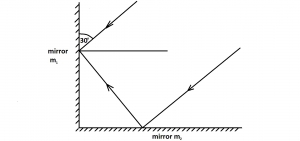
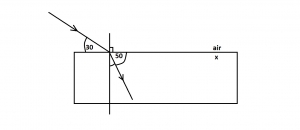
The image of any real object formed by a diverging lens is always
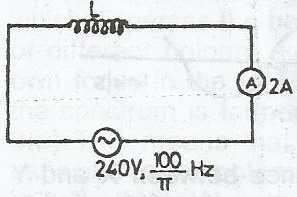
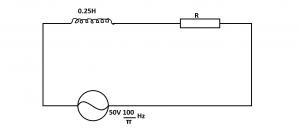
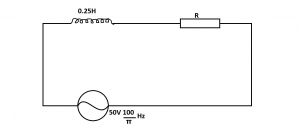
The energy stored in a capacitor of capacitance 5μF is 40J. Calculate the voltage applied across its terminals?