Question 1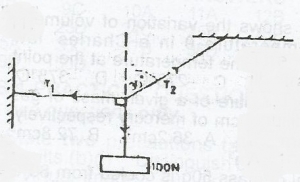
The diagram above illustrates three forces T1, T2 and 100N in equilibrium. Determine the magnitude of T1
Objective
Practice each question, then open it to see the full details.
A body of mass 0.6kg is thrown vertically upward from the ground with a speed of 20ms\(^{-2}\). Calculate its;
(i) potential energy at the maximum height reached.
(ii) kinetic energy just before it hits the ground.
What is a projectile? Give four examples of projectiles in everyday life
a) Define the term surface tension
(b) Calculate the force required to lift a needle 4cm long off the surface of water if the surface tension of water is 7.3 x 10\(^{-4}\) NM\(^{-1}\)
State any three properties of matter which are common to all substances.
Define (i) Elasticity; (ii) Young's modulus; (iii) Force constant.
A force of 40 N is applied at the end of a wire 4m long and produces an extension of 0.24mm. If the diameter of the wire is 2.00mm, calculate the;
(i) stress on the wire; (ii) strain in the wire.
(a) Differentiate between interference and polarisation as applied to waves.
(b) Mention two uses of polaroids
(a) Define angle of contact
(b) Draw sketches to show angles of contact for a capillary tube dipped vertically in (i) water; (ii) mercury.
During the electrolysis of copper (II) tetraoxosulphate (VI) solution, a steady current of 4.0 x 10\(^2\) A flowing for one hour liberated 0.48 g of copper. Calculate the mass of copper liberated by one coulomb of charge.
An electron of mass 9. 1 x 10\(^{-31}\) kg moves with a velocity of 4.2 x 10 ms\(^{-1}\) between the cathode and anode of an x-ray tube. Calculate the wavelength. (Take Planck's constant h = 6.6 x 10\(^{-34}\) J S)
(a)(i) Define the term linear momentum.
(ii) State the law of conservation of linear momentum.
(b) A ball P of mass 0.25 kg, loses one-third of its velocity when it makes a head on collision with an identical ball Q at rest. After the collision, Q moves off with a speed of 2ms\(^{-1}\) in the original direction of P. Calculate the initial velocity of R
(c)(i) State Newton's second law of motion.
(ii) Show that F = ma where F is the magnitude of the force acting on a body of mass m to give it an acceleration of magnitude a.
(iii) The engine of a vehicle moves it forward with a force of 9600 N against a resistive force of 2200 N. If the mass of the vehicle is 3400 kg, calculate the acceleration produced.
(a)(i) Mention two modes of heat transfer other than convection.
(ii) Explain land and sea breezes.
(b) An iron rod of length 30cm is heated through 50 kelvin. Calculate its increase in length. (linear expansivity of iron = 1.2 x 10\(^{-5}\)K\(^{-1}\)
(c) An electric heater immersed in some water raises the temperature of the water from 40°C to 100°C in 6 minutes. After another 25 minutes, it is noticed that half the water has boiled away. Neglecting heat losses to the surrounding, calculate the specific latent heat of vaporisation of water.
(a)(i) State the laws of refraction of light.
(ii) Describe an experiment to determine the refractive index, n, of the material of an equilaleral triangular glass prism using the minimum deviation method.
(b) A rectangular glass prism of thickness 12cm is placed on a mark on a piece of paper resting on a horizontal bench:
(i) Draw a ray diagram to show the apparent position of the mark in the glass prism.
(ii) If the refractive-index of the material of the prism is 1.5, calculate the apparent displacement of the mark.
(a) Define the following terms:
(i) Electric field intensity
(ii) Electric potential
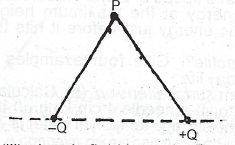
(b) The diagram below illustrates two collinear electric charges of magnitudes + Q and -Q. The charges are equidistant from a point P at which a rest charge is placed.
Copy the diagram and use arrows to indicate, from the point P, the direction of the;
(i) electric force F\(_1\) due to + Q.
(ii) electric force F\(_2\) due to -Q.
(iii) electric field intensity E.
(c) What is meant by dielectric substance?
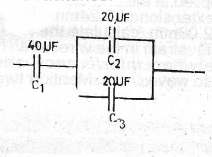
(ii) List the factors which determine the capacitance of a parallel plate capacitor and state the effect each of them has on the capacitance.The diagram above represents a section of a circuit. Calculate the effective capacitance in the section.
(iii)
The diagram above represents a section of a circuit. Calculate the effective capacitance in the section.
(a)(1) State the energy transformations which take place during the operation of a modern x-ray tube.
(ii) Distinguish between hard and soft x-rays.
(iii) State three uses of x-rays.
(iv) Mention one hazard of over-exposure to x-rays in a radiological laboratory, and indicate any two safety precautions.
(b) A possible fusion reaction is \(^2_1 H + ^2_1 H \to ^3_1H + ^1_1H + Q\)
where Q is the energy released as a result of the reaction. If Q = 4.03 MeV, calculate the atomic mass of \(^3_1H\) in atomic mass units. (\(^2_1 H = 2.01410 U; ^1_1H = 1.00783 U; 1U = 931 MeV\))
A turning fork of frequency 600Hz is sounded over a closed resonance tube. If the first and second resonant positions are 0.130m and 0.413m respectively, calculate the speed of sound in air