Question 1
Which of the following phenomena causes capillary of liquids in tubes of narrow bore?
Objective
Practice each question, then open it to see the full details.
(a) Explain the statement the acceleration of free fall cohesion.
(b) State two factors that can affect the value of the narrow glass tube has a concave meniscus while acceleration of free fall at a place.
A particle is projected horizontally at 10 ms\(^{-1}\) from a height of 45m. Calculate the horizontal distance covered by the particle before hitting the ground. [g = 10ms\(^{-1}\)]
A particle dropped from a vertical height and falls freely for a time interval t. Sketch and explain a graph to show how h varies with (a) t (b) t\(^{2}\).
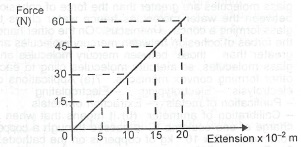
The diagram below represents the graph of the force applied in stretching a spiral spring against the corresponding extension produced within its elastic limit.
Using the notations on the graph, determine the:
(a) force constant of the spring;
(b) work done in stretching the spring from 10 x 10\(^{-2}\)m to 20 x 10\(^{-2}\)m.
(a) Distinguish between the forces of adhesion and cohension
(b) Give one example each of the forces of adhesion and cohesion.
Explain why water in a narrow glass tube has a concave meniscus while mecury in the same tube, has a convex meniscus
(a) State two applications of electrolysis.
(b) Explain what is meant by the electrochemical equivalent of copper is 3.3 x 10\(^{-7}\) kgC\(^{-1}\)
The uncertinty in determining the duration during which an electron remains in a particular energy level before returning to the ground state is 2.0 x 10\(^{-9}\)s. Calculate the uncertainty in determining its energy at that level [Take \(\frac{h}{2\pi} = h = 1.054 \times 10^{-34}\) Js]
A paralIel beam of unpolarized light is incident on a plane glass of refractive index 1.60 at an angle to the normal. If the reflected beam is completely polarized, calculate the angle of incidence of the beam.
List three observations in support of the de-Broglie's assumptions that moving particles behave like waves.
(a) State two;
(i) laws of solid friction;
(ii) advantages of friction;
(iii) methods of reducing friction.
(b) Draw and label a diagram of a pulley system with velocity ratio of 5.
(c)(i) Show that the efficiency L, force ratio M.A. and the velocity ratio V.R. of a machine are related by the equation \(E = \frac{M.A.}{V.R}\) x 100%.
(ii) The efficiency of a machine is 80%. Calcuate the work done by a person using the machine to raise a load of 300 kg through a height of 4 m.[ g = 10 ms\(^{-2}\) ]
(a) With the aid of ray diagrams, explain total internal reflection.
(b) Describe, with the aid of a labelled diagram, the essential features of an astronomical telescope in normal adjustment.
(c) A converging lens forms a real image of a real object. If the magnification is 2 and the distance between the image and the object is 90.0 cm, determine the
(i) focal length of the lens;
(ii) object distance for which the image would be the same size as the object.
(a)(i) Name and explain the common defects of a primary cell.
(ii) State two advantages of a secondary cell over a primary cell.
(b) Draw a labelled diagram to show the essential parts of a dry leclanche cell.
(c)(i) Explain why six accumulators each of e.m.f 2V connected in series can be used to start the engine of a car whereas eight dry cells each of e.m.f 1.5 V connected in series cannot be used.
(ii) Name the materials used for the positive terminal, the negative terminal and the electrolyte in a
I. leclanche cell;
II. charged lead acid accumulator.
(a) Define
(i) proton number;
(ii) nucleon number;
(iii) isotopes.
(b) A nuclide \(^A_ZX\) emits \(\beta\)-particle to form a daughter nuclide Y. Write a nuclear equation to illustrate the charge conservation.
(c) The radioactive nuclei \(^{210}_{84}P_o\) emits an \(\alpha\) - particle to produce \(^{206}_{82}P_b\). Calculate the energy, in MeV, released in each disintegration.
Take the masses of \(^{210}_{84}P_o\) = 209.936730 u;
\(^{206}_{82}P_b\) = 205.929421 u;
\(^{4}_{2}He\) = 4.001504 u;
and that 1u = 931 MeV
(a) State the conditions for the equilibrium of a rigid body acted upon by parallel forces.
(b)(i) Describe an experiment to determine the mass of a metre rule using the principle of moments.
(ii) State two precautions necessary to obtain accurate results in the experiment described in (b)(i) above.
(c) A bullet of mass 120 g is fired horizontally into a fixed wooden block with a speed of 20 ms\(^{-1}\). If the bullet is brought to rest in the block in 0.1s by a constant resistance, calculate the (i) magnitude of the resistance; (ii) distance moved by the bullet in the wood.