Question 1
If the air inside a rigid box is heated, the i, average speed of the molecules increases ii. pressure of the air increases iii. average separation of the molecule increases. Which of the statements above are correct?
Objective
Practice each question, then open it to see the full details.
A wire gradually stretched by loading it until it snaps.
(a) Sketch a load-extension graph for the wire
(b) Indicate on the graph the
(i) elastic limit (E);
(ii) yield point (Y);
(iii) breaking point (B).
In an electrolysis experiment, the ammeter records a steady current of 1 A. The mass of copper deposited in 30 minutes is 0.66 g. Calculate the error in the ammeter reading. [ Electrochemical equivalent of copper = 0.00033 g C\(^{-1}\)]
The horizontal component of the initial speed of a particle projected at 30° to the horizontal is 50 m\(^{-1}\). If the acceleration of free fall due to gravity is 10 ms\(^{-2}\), determine its;
(a) initial speed;
(b) speed at the maximum height reached.
Explain plane polarized light
A ball bearing falls through a viscous liquid
(a) Using a labelled diagram of a tall vessel, show all the forces acting on it
(b) When will it attain terminal velocity?
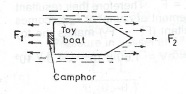
Use the diagram to answer question;
Camphor is a chemical that sub-limes and interacts with water reducing the surface tension where it is put. Explain why the toy boat illustrated above would move forward with the camphor placed at the back of it but would be stationary before the placement of the camphor.
An electron of charge 1.60 x 10\(^{-19}\)C is accelerated under a potential difference of 1.0 x 10\(^{5}\) V. Calculate the energy of the electron in joules.
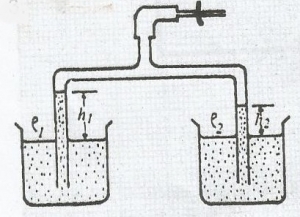
a) On what principle does lighting in a fluorescent tube operate?
(b) State two factors which determine the colour of light produced in a fluorescent tube.
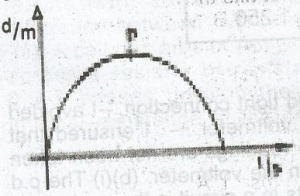
(a) Define electrolysis.
(b) Classify each of the following substances as an electrolyte or a non-electrolyte
(i) sugar solution;
(ii) kerosene;
(iii) alkaline solution
(iv) lemon fruit juice.
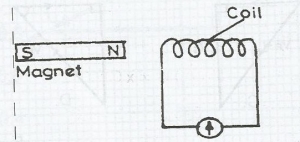
(a) State Heisenberg's Uncertainty Principle.
(b) State one phenomenon that can only be explained in terms of the wave nature of light.
(a) A particle moves on a straight path with an initial speed u and final speed v in time t. Show that the total distance X covered by the particle is given by
\(x = ut + \frac{1}{2}at^2\)
where a is the magnitude of acceleration
(b) State;
(i) Newton's second law of motion
(ii) the principle of conservation of energy
(iii) the law of floatation.
(c) Consider a balloon of mass 0.030 kg being inflated with a gas of density 0.54 kg m\(^{-3}\). What will be the volume of the balloon when it just begins to rise in air of density 1.29 kg m\(^{-3}\)? [ g = 10 ms\(^{-2}\)]
(a) State two differences between boiling and evaporation.
(b) A closed inexpansibie vessel contains air saturated with water vapour at 77°C. The total pressure in the vessel is 1007 mmHg. Calculate the new pressure in the vessel if the temperature is reduced 1.2 27°C. [ The s.v.p. of water at 77°C and 27°C respectively are 314 mmHg and 27 mmHg. Treat the air in the vessel as an ideal gas]
(c) The lengtn of a zinc rod at 23°C is 200 m. Calculate the increase in length of the rod when its temperature rises to 33°C. [ expansivity of zinc = 2.6 x 10\(^{-5}\) K\(^{-1}\)]
(d) Explain with there is no temperature change when a solid being heated changes into liquid at its melting point.
A ball is dropped and it hits the floor at a point A. It rebounds upward to a point B. While moving from A to B its
(a) The equation y = \(\alpha\) sin (wt - kx) represents a plane wave travelling in a medium along the x-direction, being the displacement at the point x at time t.
(i) Given that x is in metres and t is in seconds, state the units of k and w
(ii) What physical quantity does \(\frac{W}{k}\) represent? Justify your answer
(iii) State whether the wave is travelling in the positive or negative x-direction.
(b)(i) What are beats?
(ii) A sonometer wire has a frequency of 259 Hz. It is sounded alongside a tuning fork of frequency 256 Hz. Calculate the beat frequency
(iii) The sonometer wire in (b)(ii) above is under a tension of 1200 N. If a metre of the wire has a mass of 0.03 kg, calculate the length l of the wire when it is vibrating in the fundamental mode.
(c) List two similarities between the human eye and the photographic camera.
(a) What is a magnetic field?
(b) With the aid of a labelled diagram describe an experiment to show that a magnetic field exists around a straight wire carrying current.
(c) A 40 \(\mu\)F capacitor in series with a 40 Q resistor is connected to a 100 V, 50 Hz a.c. supply.
(i) Draw a circuit diagram of the arrangement
(ii) Calculate the: I. impedance in the circuit; II. current in the circuit III. potential difference across the capacitor.
(a)(i) State Einstein's equation of photoelectric effect
(ii) What conservation principle does the equation represent?
(b) List three applications of photocells
(c) A photo emissive surface has a threshold frequency of 4.02 x 10\(^{14}\)Hz. If the surface is illuminated by light of frequency 5.0 x 10\(^{15}\)Hz, calculate the:
(i) threshold wavelength;
(ii) work function;
(iii) kinetic energy of the emitted photoelectrons. [ c = 3.0 x 10\(^{8}\) ms\(^{-1}\), h = 6.63 x 10\(^{-34}\) Js]