Question 1
The S.I unit for sound energy is
Objective
Practice each question, then open it to see the full details.
The S.I unit for sound energy is
(a) Define strain.
(b) A rubber band is stretched to twice its original length. Calculate the strain on the rubber band.
The general definition of elastic modulus is
State three materials used for making optical fibres.
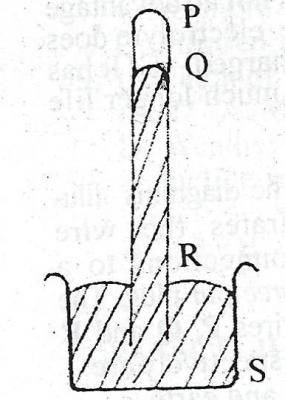
The diagram above illustrates a simple barometer. Which distance measures the atmospheric pressure?
Name three classes of magnetic materials.
The property of a body to remain at rest or to continue in uniform motion in a straight line is called
(a) What is an intrinsic semiconductor?
(b) Distinguish between the p-type and n-type semi-conductors.
During a training session, two footballers pass a ball repeatedly between each other. The 'to and fro' motion of the ball is not simple harmonic because the
I. Acceleration of the ball is not directed towards a fixed point
II. Restoring force is not directed towards the centre
III. Acceleration of the ball is not directly proportional to the displacement from a fixed point
Which of the statements above are correct?
A missile is projected so as to attain its maximum range. Calculate the maximum height attained if the initial velocity of projection is 200 ms\(^{-1}\). [g = 10ms\(^{-2}\)]
A dam is able to hold a large quantity of water because its wall is
A black body radiates maximum energy when its surface temperature T and the corresponding wavelength \(\lambda\)max are related by the equation \(\lambda\)max T = constant. Given the values of the constant and surface temperature as 2.9 x 10\(^{-3}\) mK and 57°C respectively; Calculate the frequency of the energy radiated.
A body of mass m moving around a circle of radius r with a uniform speed v experiences a centripetal force F. The work done by the centripetal force on it is
a) What does the acronym LASER stand for?
b) What is a laser?
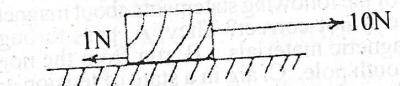
A block is acted upon by TWO horizontal forces as illustrated in the diagram above. The block accelerates at 1.5\(ms^{-2}\). Calculate the mass of the block.
(a) Define uniform acceleration.
(b) Forces act on a car in motion. List the
(i) horizontal forces and their directions;
(ii) vertical forces and their directions
(c) A car starts from rest and accelerate uniformly for 20s to attain a speed of 25 ms\(^{-1}\). It maintains this speed for 30s before decelerating uniformly to rest. The total time for the journey is 60s.
(i) Sketch a velocity-tune graph for the motion.
(ii) Use the graph to determine the (\(\alpha\)) total distance travelled by the car (\(\beta\)) deceleration of the car.
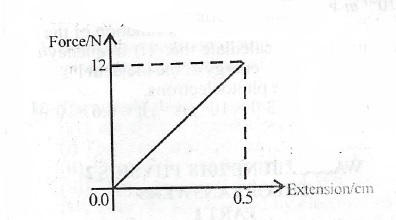
The figure here illustrates force-extension graph for a stretched spiral spring. Determine the work done on the spring.
Which of the following quantities are dimensionally independent?
I. Dielectric constant II. Momentum III. Efficiency IV. Refractive index
(a) List two factors each that affect heat loss by:
(i) radiation;
(ii) convection.
(b) State two factors that determine the quantity of heat in a body.
(c) Explain the statement: The vecilic latent heat of vaporization of mercury is 2.72 x 10\(^5\) Jkg\(^{-1}\).
(d)A jug of heat capacity 250 Jkg\(^{-1}\) contains water at 28°C. An electric heater of resistance 35\(\Omega\) connected to a 220 V source is used to raise the temperature of the water until it boils at 100°C in 4 minutes. After. another 5 minutes, 300 g of water has evaporated. Assuming no heat is lost to the surroundings, calculate the:
(i) mass of water in the jug before heating;
(ii) specific latent heat of vaporization of steam. [Specific heat capacity of water = 4200 kg\(^{-1}\)K\(^{-1}\)]
A body is projected with an initial velocity u at angle \(\theta\) to the horizontal. If \(R_{max}\) is the maximum range of the projectile, what does the relation \(\frac{u^{2}}{R_{max}}\) represent?
(a) Define dffraction.
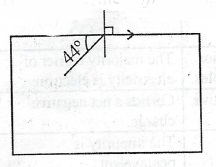
(b)(i) Explain critical angle. The diagram here illustrates a ray of light passing through a rectangular transparent plastic block \(\alpha\) Determine the value of the critical angle. \(\beta\) Calculate the refractive index of the block.
(c) A pipe closed at one end has fundamental frequency of 200Hz. The frequency of the first overtone of the closed pipe is equal to the frequency of the first overtone of an open pipe. Calculate the:
(i) fundamental frequency of the open pipe;
(ii) length of the closed pipe;
(iii) length of the open pipe. [Speed of sound in air = 330 ms\(^{-1}\)]
An object at rest is said to possess
(a) Define:
(i) reactance;
(ii) impedance in an a.c.
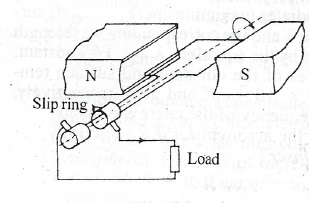
The diagram here illustrates an a.c. generator. When the coil is rotated, an e.m.f is induced in the coil.
(i) Explain why an e.m.f. is induced.
(ii) State the purpose of the slip-rings.
(iii) Name and state the law used to determine the direction of the induced current.
(iv) State two ways to increase the induced e.m.f.
(c) A lamp is rated 12 V. 6 W. Calculate the amount of energy transformed by the lamp in 5 minutes.
According to Newton's law of cooling, the heat energy lost per unit area of a body depends on the
I. Surface area
II. Nature of the surface
III. Temperature of the surface
IV. Excess temperature over the surroundings
(a) Define binding energy in an atom.
(b) List three evidence to support the claim that X-rays are electromagnetic waves.
(c) List three peaceful uses of nuclear energy.
(d) Light of wavelength 4.5 x 10\(^{-7}\) in is incident on a metal resulting in the emission of photo electrons. If the work function of the metal is 3.0 x 10\(^{-9}\) J, calculate the:
(i) frequency of the incident light;
(ii) energy of the incident light;
(iii) energy of the photoelectrons. [Speed of light = 3.0 x 10\(^8\) ms\(^{-1}\), h = 6.6 x 10\(^{-34}\) Js]
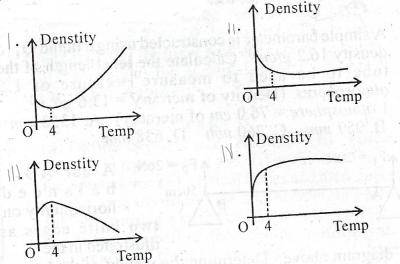
The graph of density against temperature for water is correctly illustrated by
A football is kicked at an angle of 45° to the horizontal over a defense line up with a velocity of 15\(ms^{-1}\). Calculate the magnitudeof horizontal velocity of the ball at its highest point [Neglect friction, g = 10\(ms^{-2}\)].
The ice point on the absolute scale of temperature is
Which of the following factors does not increase the rate of evaporation of water in a lake?
The bob of a simple pendulum takes 8.0s to complete 10 oscillations. Determine the frequency of oscillation of the bob.
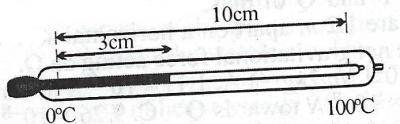
The diagram above illustrates the mercury-in-glass thermometer used for determining the temperature of a room. Use the data on it to determine the room temperature.
Frequency is measured in
Which of the following electromagnetic waves is most energetic?
Rainbow formation is a natural phenomenon illustrating that white light
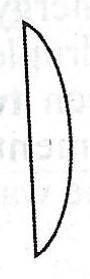
The lens illustrated above can best be described as a
Two plane mirrors are inclined to each other such that an object placed between them has 11 images. Determine the angle of inclination
The pitch of a note is not affected by
When two flat plate conductors are arranged in such a way that they possess equal and opposite charges seperated by a dielectric, they form a/an
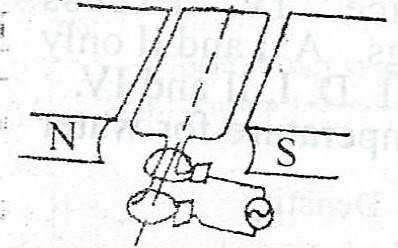
Which electrical device is illustrated above?
A simple barometer is constructed using a liquid \(Q_{1}\) of density 16.2\(g/cm^{3}\). Calculate the least lenth of the tube to be used to measure pressure of 1.5atm. [Density of mercury = 13.6\(g/cm^{3}\), 1atm = 76.0 cm of Mercury]
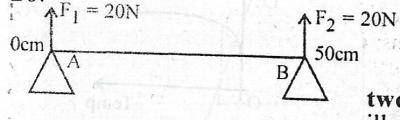
A bar AB is balanced horizontally on two knife edges as illustrated as in the diagram above. Determine the weight of the bar.
To obtain a virtual, erect and magnified image from a thin converging lens, an object must be placed
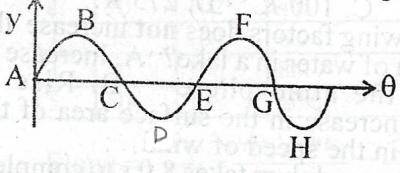
The diagram above represents a transverse travelling wave. Which two points are 180° out of phase?
Two objects P and Q of masses 100kg and 20kg respectively are 1.2m apart on a horizontal surface. Calculate the net gravitational force acting on Q. \([G= 6.67 \times 10^{-11} Nm^{2}kg^{-2}]\)
The primary of a transformer has 100 turns and its secondary has 200 turns. If the voltage at the primary is 100V, determine the voltage at the secondary.
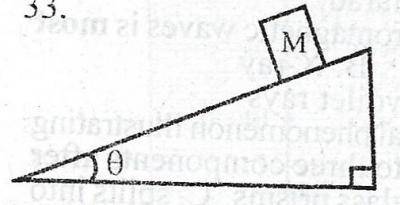
In the diagram illustrated a block of mass M is at rest on a plane inclined at an angle \(\theta\) to the horizontal. As \(\theta\) increases, the velocity ratio of the plane
When the speed of a car is halved, its kinetic energy is
A wire of length 400cm is stretched between two fixed points. When plucked, its fundamental frequency is 150Hz. Calculate the speed of the wave produced.
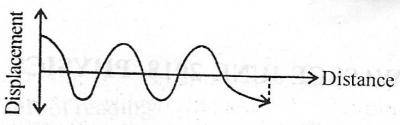
The diagram above illustrates a waveform. Determine the number of wavelengths in it
A resistor with fixed resistance value is called a
Which of the following statements is not an advantage of an alkaline accumulator?