Question 1
A stone of mass 20g is released from a catapult whose rubber is stretched through 5cm. If the force constant of the rubber is 200Nm\(^{-1}\), calculate the speed with which the stone leaves the catapult.
Theory
Practice each question, then open it to see the full details.
A stone of mass 20g is released from a catapult whose rubber is stretched through 5cm. If the force constant of the rubber is 200Nm\(^{-1}\), calculate the speed with which the stone leaves the catapult.
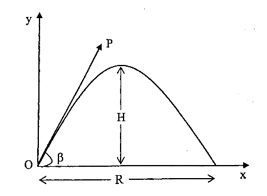
(a) The diagram above illustrates a projectile motion. Identify each of the physical quantities labeled P, β, H and R.
(b) Write an equation to show the relationship between P, g and Rmax’ where g is the acceleration due to gravity and Rmax is maximum R.
State three observable phenomena in which waves behave like a particle.
List three magnetic elements that determine the earth’s magnetic field at a point.
Explain each of the following terms as used in Electronics.
(a) free electrons;
(b) holes.
(a) State the principle of operation of fibre optics.
(b) State two applications of fibre optics in medicine.
(a) Define diffusion
(b) State two factors that affect the rate of diffusion
(a) (i) State Newton’s Law of Universal Gravitation.
(ii) Define gravitational field.
(b) (i) Derive the equation relating the universal gravitational constant, G, and the acceleration of free fall, g, at the surface of the earth from Newton’s law of universal gravitation.
(ii) State two assumptions for which the relationship in 8(b)(i) holds.
(c) Calculate the force of attraction between a star of mass 2.00 x 1030 kg and the earth assuming the star is located 1.50 x 10⁸ km from the earth. [Mass of the earth = 5.98 x 1024kg; G = 6.67 x 10⁻¹¹N m\(^{2}\) kg-2; g = 10 m s\(^{-2}\)
(d) (i) Define escape velocity.
(ii) State two differences between the acceleration of free fall (g) and the universal gravitational constant (G).
(a) (i) Explain latent heat.
(ii) State two factors that affect the rate of evaporation of a liquid
(b) Explain each of the following observations:
(i) On a dry day, water in a clay pot is cooler than water in a closed plastic container;
(ii) Food gets cooked faster in a pressure cooker than in an ordinary cooking pot.
(c) State two effects of heat on a substance.
(d) A 40 V electric heater is used to supply a current of 12 A for 1400 s to a body of mass 1.5 kg at the melting point of the body. The body melts and its temperature rises through 60\(^o\)C in an extra 72 s. Determine the:
(i) latent heat of fusion of the body;
(ii)specific heat capacity of the body.
(a) (i) Define atomic spectra.
(ii) Differentiate between emission spectra and absorption spectra.
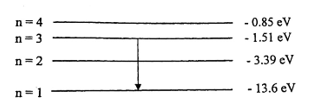
The diagram above illustrates an electron transition from energy level n = 3 to n = 1. Calculate the:
(i) energy of the photon;
(ii) frequency of the photon;
(iii) wavelength of the photon.
(c) (i) Differentiate between soft x-rays and hard x-rays.
(ii) Draw the circuit symbol for a p-n junction diode.
(iii) Give the reason for doping a semiconductor material.
(a) (i) Define force and state its S.I unit.
(ii) List the two types of solid friction.
(b) A car travelling at a constant speed of 30 ms-1 for 20 s was suddenly decelerated when the driver sighted a pot-hole. It took the driver 6 s to get to the pot-hole with a reduced speed of 18 ms-1. He maintained the steady speed for another 10 s to cross the pot-hole. The brakes were then applied and the car came to rest 5 s later.
(i) Draw the velocity-time graph for the journey.
(ii) Calculate the deceleration during the last 5 s of the journey.
(iii) Calculate the total distance covered.
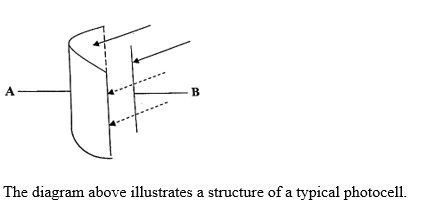
The diagram above illustrates a structure of a typical photocell.
(i) Identify each of the parts labelled A and B.
(ii) State one function each of A and B
(iii) Einstein’s photoelectric equation can be written as E = hf – Wo. State what each of the terms E, hf and Wo represent.
(b) A photon is incident on a metal whose work function is 1.32 eV. An electron is emitted from the surface with a maximum kinetic energy of 1.97 eV. Calculate the frequency of the photon. [1 eV = 1.6 x 10⁻¹⁹ J]
(c)(i) Define half-life of a radioactive element.
(ii) Sketch a graph of the relation N = Noe-λt and indicate the half-life.