Question 0Convert 726 to a number in base threeA.2211B.2121C.1212D.1122E.Objective Show full explanation
Question 0Simply \(\frac{2\frac{2}{3} \times 1\frac{1}{2}}{4\frac{4}{5}}\)A.\(1\frac{1}{4}\)B.\(1\frac{1}{6}\)C.\(\frac{5}{6}\)D.\(\frac{4}{5}\)E.Objective Show full explanation
Question 0Evaluate \(\frac{21}{9}\) to 3 significant figuresA.2.30B.2.31C.2.32D.2.33E.Objective Show full explanation
Question 0A man earns N3,500 per month out of which he spends 15% on his children's education. If he spends additional N1,950 on food, how much does he have left?A.N525B.N1,025C.N1,950D.N2,975E.Objective Show full explanation
Question 0If log3x2 = -8, what is x?A.\(\frac{1}{3}\)B.\(\frac{1}{9}\)C.\(\frac{1}{27}\)D.\(\frac{1}{81}\)E.Objective Show full explanation
Question 0Simplify \((\sqrt{6} + 2)^2 - (\sqrt{6} - 2)^2\)A.\(2\sqrt{6}\)B.\(4\sqrt{6}\)C.\(8\sqrt{6}\)D.\(16\sqrt{6}\)E.Objective Show full explanation
Question 0If P is a set of all prime factors of 30 and Q is a set of all factors of 18 less than 10, find P \(\cap\) QA.{3}B.{2,3}C.{2,3,5}D.{1,2}E.Objective Show full explanation
Question 0In a class of 46 students, 22 play football and 26 play volleyball. If 3 students play both games, how many play neither?A.1B.2C.3D.4E.Objective Show full explanation
Question 0Make 'n' the subject of the formula if w = \(\frac{v(2 + cn)}{1 - cn}\)A.\(\frac{1}{c}(\frac{w - 2v}{v + w})\)B.\(\frac{1}{c}(\frac{w - 2v}{v - w})\)C.\(\frac{1}{c}(\frac{w + 2v}{v - w})\)D.\(\frac{1}{c}(\frac{w + 2v}{v + w})\)E.Objective Show full explanation
Question 0Find the remainder when 2x3 - 11x2 + 8x - 1 is divided by x + 3A.-871B.-781C.-187D.-178E.Objective Show full explanation
Question 0Solve for x and y in the equations below x2 - y2 = 4 x + y = 2A.x = 0, y = -2B.x = 0, y = 2C.x = 2, y = 0D.x = -2, y = 0E.Objective Show full explanation
Question 0If y varies directly as \(\sqrt{n}\) and y = 4 when n = 4, find y when n = 1\(\frac{7}{9}\)A.\(\sqrt{17}\)B.\(\frac{4}{3}\)C.\(\frac{8}{3}\)D.\(\frac{2}{3}\)E.Objective Show full explanation
Question 0U is inversely proportional to the cube of V and U = 81 when V = 2. Find U when V = 3A.24B.27C.32D.36E.Objective Show full explanation
Question 0The value of y for which \(\frac{1}{5}y + \frac{1}{5} < \frac{1}{2}y + \frac{2}{5}\) isA.\(y > \frac{2}{3}\)B.\(y < \frac{2}{3}\)C.\(y > -\frac{2}{3}\)D.\(y < -\frac{2}{3}\)E.Objective Show full explanation
Question 0Find the range of values of m which satisfy (m - 3)(m - 4) < 0A.2 < m < 5B.-3 < m < 4C.3 < m < 4D.-4 < m < 3E.Objective Show full explanation
Question 0The nth term of a sequence is n2 - 6n - 4. Find the sum of the 3rd and 4th terms.A.24B.23C.-24D.-25E.Objective Show full explanation
Question 0The sum to infinity of a geometric progression is \(-\frac{1}{10}\) and the first term is \(-\frac{1}{8}\). Find the common ratio of the progression.A.\(-\frac{1}{5}\)B.\(-\frac{1}{4}\)C.\(-\frac{1}{3}\)D.\(-\frac{1}{2}\)E.Objective Show full explanation
Question 0The binary operation * is defined on the set of integers such that p * q = pq + p - q. Find 2 * (3 * 4)A.11B.13C.15D.22E.Objective Show full explanation
Question 0The binary operation on the set of real numbers is defined by m*n = \(\frac{mn}{2}\) for all m, n \(\in\) R. If the identity element is 2, find the inverse of -5A.\(-\frac{4}{5}\)B.\(-\frac{2}{5}\)C.4D.5E.Objective Show full explanation
Question 0If \(\begin{vmatrix} 5 & 3 \\ x & 2 \end{vmatrix}\) = \(\begin{vmatrix} 3 & 5 \\ 4 & 5 \end{vmatrix}\), find the value of xA.3B.4C.5D.7E.Objective Show full explanation
Question 0Given that I3 is a unit matrix of order 3, find |I3|A.-1B.OC.1D.2E.Objective Show full explanation
Question 0The angles of a polygon are given by x, 2x, 3x, 4x and 5x respectively. Find the value of x.A.24oB.30oC.33oD.36oE.Objective Show full explanation
Question 0Calculate the volume of a cuboid of length 0.76cm, breadth 2.6cm and height 0.82cm.A.3.92cm3B.2.13cm3C.1.97cm3D.1.62cm3E.Objective Show full explanation
Question 0The locus of a point equidistant from the intersection of lines 3x - 7y + 7 = 0 and 4x - 6y + 1 = 0 is aA.line parallel to 7x + 13y + 8 = 0B.circleC.semicircleD.bisector of the line 7x + 13y + 8 = 0E.Objective Show full explanation
Question 0The gradient of the straight line joining the points P(5, -7) and Q(-2, -3) isA.\(\frac{1}{2}\)B.\(\frac{2}{5}\)C.\(-\frac{4}{7}\)D.\(-\frac{2}{3}\)E.Objective Show full explanation
Question 0The distance between the point (4, 3) and the intersection of y = 2x + 4 and y = 7 - x isA.\(\sqrt{13}\)B.\(3\sqrt{2}\)C.\(\sqrt{26}\)D.\(10\sqrt{5}\)E.Objective Show full explanation
Question 0Find the equation of the line through the points (-2, 1) and (-\(\frac{1}{2}\), 4)A.y = 2x - 3B.y = 2x + 5C.y = 3x - 2D.y = 2x + 1E.Objective Show full explanation
Question 0If angle \(\theta\) is 135o, evaluate cos\(\theta\)A.\(\frac{1}{2}\)B.\(\frac{\sqrt{2}}{2}\)C.\(-\frac{\sqrt{2}}{2}\)D.\(-\frac{1}{2}\)E.Objective Show full explanation
Question 0If y = x2 - \(\frac{1}{x}\), find \(\frac{\delta y}{\delta x}\)A.2x - \(\frac{1}{x^2}\)B.2x + x2C.2x - x2D.2x + \(\frac{1}{x^2}\)E.Objective Show full explanation
Question 0Evaluate \(\int^2_1(x^2 - 4x)dx\)A.\(\frac{11}{3}\)B.\(\frac{3}{11}\)C.\(-\frac{3}{11}\)D.\(-\frac{11}{3}\)E.Objective Show full explanation
Question 0Evaluate \(\int^{\frac{\pi}{4}}_0sec^2 \theta d \theta\)A.1B.2C.3D.4E.Objective Show full explanation
Question 0The mean of seven numbers is 96. If an eighth number is added, the mean becomes 112. Find the eighth number.A.126B.180C.216D.224E.Objective Show full explanation
Question 0Find the median of 2,3,7,3,4,5,8,9,9,4,5,3,4,2,4 and 5A.9B.8C.7D.4E.Objective Show full explanation
Question 0Find the standard deviation of 2,3,8,10 and 12A.3.9B.4.9C.5.9D.6.9E.Objective Show full explanation
Question 0In how many ways can the letters of the word TOTALITY be arranged?A.6720B.6270C.6207D.6027E.Objective Show full explanation
Question 0The probability that a student passes a physics test is \(\frac{2}{3}\). If he takes three physics tests, what is the probability that he passes two of the tests?A.\(\frac{2}{27}\)B.\(\frac{3}{27}\)C.\(\frac{4}{27}\)D.\(\frac{5}{3}\)E.Objective Show full explanation
Question 0The probabilities that a man and his wife live for 80 years are \(\frac{2}{3}\) and \(\frac{3}{5}\) respectively. Find the probability that at least one of them will live up to 80 yearsA.\(\frac{2}{15}\)B.\(\frac{3}{15}\)C.\(\frac{7}{15}\)D.\(\frac{13}{15}\)E.Objective Show full explanation
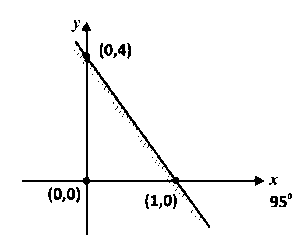
Question 0The shaded region above is represented by the equationA.y ≤ 4x + 2B.y ≥ 4x + 2C.y ≤ -4x + 4D.y ≤ 4x + 4E.Objective Show full explanation
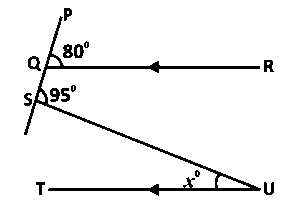
Question 0In diagram above, QR//TU, < PQR = 80o and < PSU = 95o. Calculate < SUT.A.15oB.25oC.30oD.80oE.Objective Show full explanation
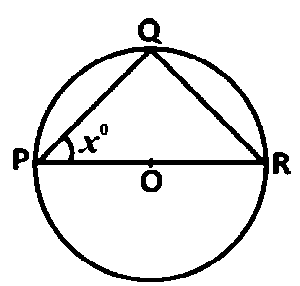
Question 0In the diagram above, PQR is a circle centre O. If < QPR is XO, find < QRP.A.XOB.(90 – x)oC.(90 + x)oD.(180 – x)oE.Objective Show full explanation
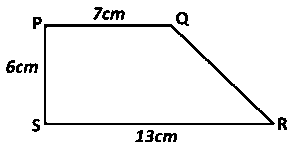
Question 0Find the area of the trapezium above.A.91 cm2B.78 cm2C.60 cm2D.19 cm2E.Objective Show full explanation
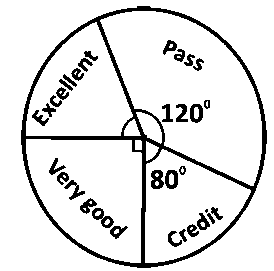
Question 0The grades of 36 students in a class test are as shown in the pie chart above. How many students have excellent?A.12B.9C.8D.7E.Objective Show full explanation
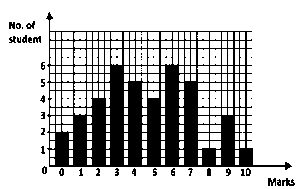
Question 0The bar chart above shows the distribution of marks in a class test. If the pass mark is 5, what percentage of students failed the test?A.10%B.20%C.50%D.60%E.Objective Show full explanation