Question 1
Scarcity implies that
Objective
Practice each question, then open it to see the full details.
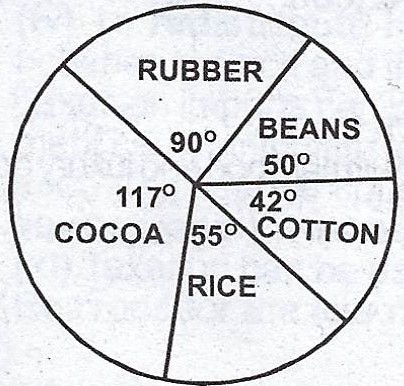
The pie chart here represents the hypothetical output of farmers in a country in a particular year. The total output of the crops was 72,000 tonnes.
(a) Calculate the quantity of each product.
(b) (i) By what quantity is the export crops greater than the food crops?
(ii) Which crop contributed the least and by what quantity?
(iii) Which crop has the highest output?
(a) What is income elasticity of demand? The table below shows the various incomes and demand for different commodities.
| Income (N) | Quantity Demanded (kg) |
| A 20,000 | 120 |
| B 36,000 | 96 |
| C 40,000 | 160 |
| D 44,000 | 200 |
| E 45,000 | 240 |
| F 47,000 | 252 |
(b) Calculate the income elasticity between
(i) A and B
(ii) C and D
(iii) E and F
(c) What kind of good is between
(i) A and B?
(ii) C and D?
(a) State the laws of demand and supply.
(b) With the aid of a diagram, explain the implications of a change in the quantity demanded of a commodity.
What form of business enterprise would you recommend for a tailor? Give reasons for your answer.
(a) What is mobility of labour?
(b) What factors serve as obstacles to occupational mobility of labour?
Highlight any five objectives of price control.
The quantity supplied of a book per week is represented by the function: Qs + 70 + 1/2 P, At a price of N8.00, the quantity supplied is
Why should a country measure her national income?
Explain each of the following:
(a) Indigenisation policy
(b) Localization of industry
(c) Economies of scale
(d) National budget.
(a) What is unemployment?
(b) Explain any three types of unemployment
Why do governments impose taxes?
Give five reasons for the low rate of industrial growth in your country.
How can the International Bank for Reconstruction and Development (World Bank) contribute to the economic development of your country?