Question 1
If \(\frac{1}{5^{-y}} = 25(5^{4-2y})\), find the value of y.
Objective
Practice each question, then open it to see the full details.
If \(\frac{1}{5^{-y}} = 25(5^{4-2y})\), find the value of y.
Solve \((\log_{2} m)^{2} - \log_{2} m^{3} = 10\).
Simplify: \((1 - \sin \theta)(1 + \sin \theta)\).
A binary operation \(\ast\) is defined on the set of rational numbers by \(m \ast n = \frac{m^{2} - n^{2}}{2mn}, m \neq 0 ; n \neq 0\).
(a) Find \(-3 \ast 2\).
(b) Show whether or not \(\ast\) is associative.
Given that \(3x + 4y + 6 = 0\) and \(4x - by + 3 = 0\) are perpendicular, find the value of b.
If \(\alpha\) and \(\beta\) are the roots of \(3x^{2} + 5x + 1 = 0\), evaluate \(27(\alpha^{3} + \beta^{3})\).
Given that \(x * y = \frac{x + y}{2}, x \circ y = \frac{x^{2}}{y}\) and \((3 * b) \circ 48 = \frac{1}{3}\), find b, where b > 0.
Find the gradient of \(xy^{2} + x^{2} y = 4xy\) at the point (1, 3).
If \(f(x) = 3x^{3} + 8x^{2} + 6x + k\) and \(f(2) = 1\), find the value of k.
The position vectors of P, Q and R are \(11i + j, 5i + \frac{13}{3}j\) and \(2i + 6j\) respectively.
(a) Show that P, Q and R lie on a straight line.
(b) Find the ratio of \(|\overrightarrow{PQ}| : |\overrightarrow{QR}|\)
If \(8^{x} ÷ (\frac{1}{4})^{y} = 1\) and \(\log_{2}(x - 2y) = 1\), find the value of (x - y).
A committee of 3 is formed from a panel of 5 men and 3 women. Find the :
(a) number of ways of forming the committee ;
(b) probability that at least one woman is on the committee.
Simplify \(\frac{1 + \sqrt{8}}{3 - \sqrt{2}}\).
The table shows the distribution of the lengths of 20 iron rods measured in metres :
| Length (m) | 1.0 - 1.1 | 1.2 - 1.3 | 1.4 - 1.5 | 1.6 - 1.7 | 1.8 - 1.9 |
| Frequency | 2 | 3 | 8 | 5 | 2 |
Using an assumed mean of 1.45, calculate the mean of the distribution.
Using the binomial expansion \((1+x)^{6} = 1 + 6x + 15x^{2} + 20x^{3} + 15x^{4} + 6x^{5} + x^{6}\), find, correct to 3 dp, the value of \((1.98)^{6}\).
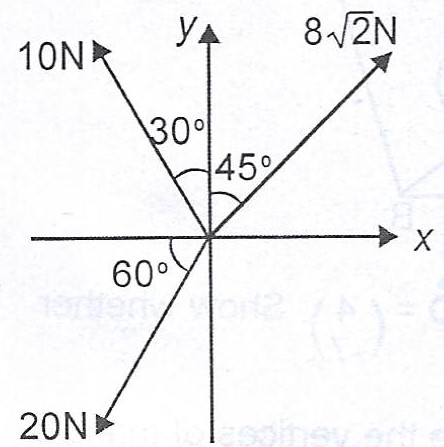
Find the direction of the resultant of the forces in the diagram.
If \((x + 2)\) and \((3x - 1)\) are factors of \(6x^{3} + x^{2} - 19x + 6\), find the third factor.
(a) Differentiate \((x - 3)(x^{2} + 5)\) with respect to x.
(b) If \((x + 1)^{2}\) is a factor of \(f(x) = x^{3} + ax^{2} + bx + 3\), where a and b are constants, find the :
(i) values of a and b ; (ii) zeros of f(x).
If \(2, (k+1), 8,...\) form an exponential sequence (GP), find the values of k.
(a) Express \(\frac{5 + \sqrt{2}}{3 - \sqrt{2}} - \frac{5 - \sqrt{2}}{3 + \sqrt{2}}\) in the form \(a + b\sqrt{2}\).
(b) Solve the following equations simultaneously using the determinant method.
\(3x - y - z = -2\)
\(x + 5y + 2z = 5 \)
\(2x + 3y + z = 0\)
A box contains 5 red and k blue balls. A ball is selected at random from the box. If the probability of selecting a blue ball is \(\frac{2}{3}\), find the value of k.
(a) If \(f(x) = \frac{x - 3}{2x - 1} , x \neq \frac{1}{2}\) and \(g(x) = \frac{x - 1}{x + 1}, x \neq -1\), fing \(g \circ f\).
(b)(i) Sketch the curve \(y = 9x - x^{3}\) ; (ii) Calculate the total area bounded by the x- axis and the curve \(y = 9x - x^{3}\).
If \(\frac{x + P}{(x - 1)(x - 3)} = \frac{Q}{x - 1} + \frac{2}{x - 3}\), find the value of (P + Q).
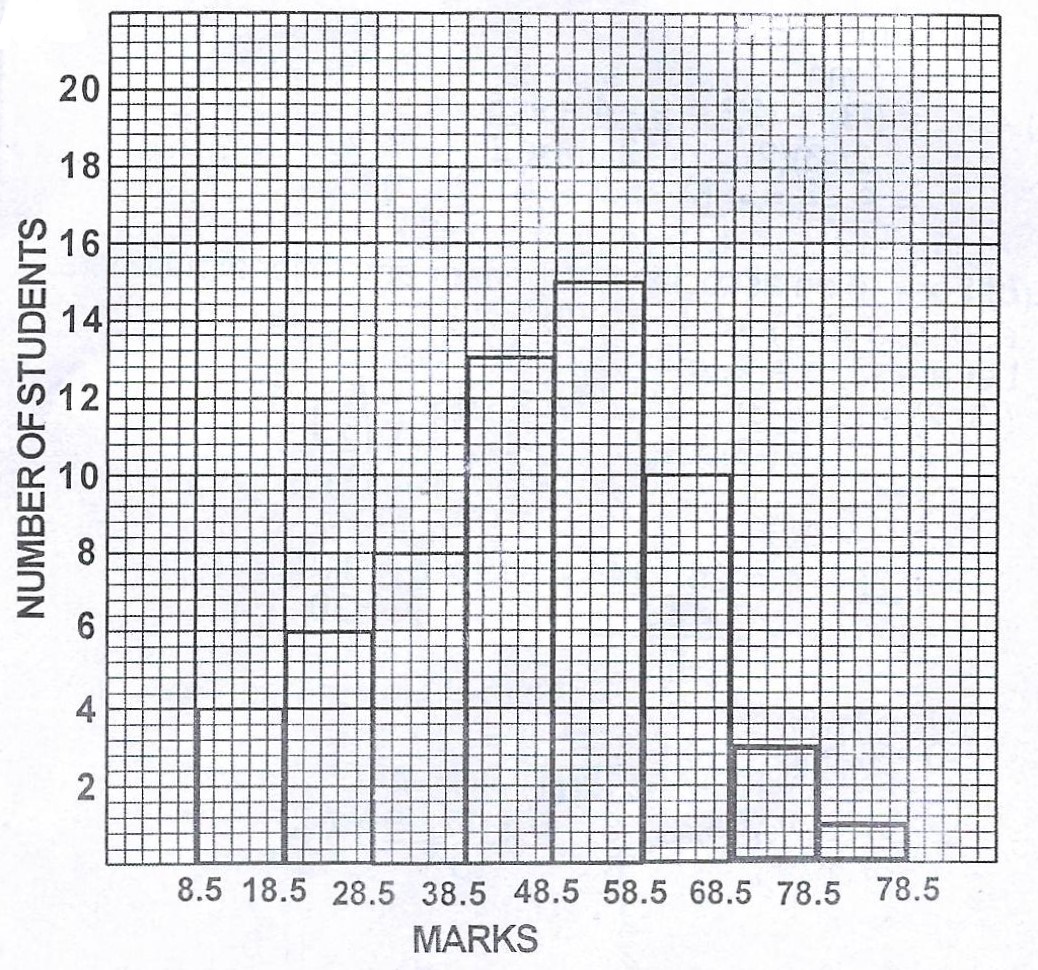
The histogram above represents the scores of some candidates in an examination.
(a) Using the histogram, construct a frequency distribution table indicating clearly the class intervals ;
(b) Draw a cumulative frequency curve of the distribution and use it to estimate the :
(i) median ; (ii) quartile deviation.
Find the derivative of \(\sqrt[3]{(3x^{3} + 1}\) with respect to x.
The probabilities that Kofi, Kwasi and Ama will pass a certain examination are \(\frac{9}{10}, \frac{4}{5}\) and x respectively. If the probability that only one of them will pass the examination is \(\frac{9}{50}\), find the :
(a) value of x ;
(b) probability that at least one of them will pass the examination.
If \(T = \begin{pmatrix} -2 & -5 \\ 3 & 8 \end{pmatrix}\), find \(T^{-1}\), the inverse of T.
(a) Given that \(x = 3i - j, y = 2i + kj\) and the cosine of the angle between x and y is \(\frac{\sqrt{5}}{5}\), find the values of the constant k.
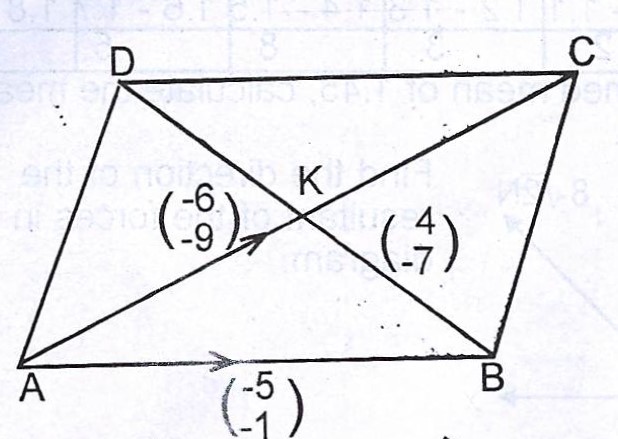
(b) In the quadrilateral ABCD,
\(\overrightarrow{AB} = \begin{pmatrix} -5 \\ -1 \end{pmatrix}, \overrightarrow{AC} = \begin{pmatrix} -6 \\ -9 \end{pmatrix}\)
and \(\overrightarrow{BD} = \begin{pmatrix} 4 \\ -7 \end{pmatrix}\). Show whether or not ABCD is a parallelogram.
A function is defined by \(h : x \to 2 - \frac{1}{2x - 3}, x \neq \frac{3}{2}\). Find \(h^-1\), the inverse of h.
(a) A(-1, 2), B(3, 5) and C(4, 8) are the vertices of triangle ABC. Forces whose magnitudes are 5N and \(3\sqrt{10}\)N act along \(\overrightarrow{AB}\) and \(\overrightarrow{CB}\) respectively. Find the direction of the resultant of the forces.
(b) A particle starts from rest and moves in a straight line. It attains a velocity of 20 m/s after covering a distance of 8 metres. Calculate :
(i) its acceleration ; (ii) the time it will take to cover a distance of 40 metres.
A function is defined by \(h : x \to 2 - \frac{1}{2x - 3}, x \neq \frac{3}{2}\). Find \(h^{-1}(\frac{1}{2})\).
The radius of a sphere is increasing at a rate \(3cm s^{-1}\). Find the rate of increase in the surface area, when the radius is 2cm.
| Age in years | 10 - 14 | 15 - 19 | 20 - 24 | 25 - 29 | 30 - 34 |
| Frequency | 6 | 8 | 14 | 10 | 12 |
What is the class mark of the median class?
| Age in years | 10 - 14 | 15 - 19 | 20 - 24 | 25 - 29 | 30 - 34 |
| Frequency | 6 | 8 | 14 | 10 | 12 |
In which group is the upper quartile?
| Age in years | 10 - 14 | 15 - 19 | 20 - 24 | 25 - 29 | 30 - 34 |
| Frequency | 6 | 8 | 14 | 10 | 12 |
Find the mean of the distribution.
If \(Px^{2} + (P+1)x + P = 0\) has equal roots, find the values of P.
Integrate \((x - \frac{1}{x})^{2}\) with respect to x.
Given that \(AB = \begin{pmatrix} 4 \\ 3 \end{pmatrix}\) and \(AC = \begin{pmatrix} 2 \\ -3 \end{pmatrix}\), find |BC|.
Find the angle between \((5i + 3j)\) and \((3i - 5j)\).
Find the coefficient of \(x^3\) in the binomial expansion of \((3x + 4)^4\) in ascending powers of x.
If a fair coin is tossed four times, what is the probability of obtaining at least one head?
Forces 90N and 120N act in the directions 120° and 240° respectively. Find the resultant of these forces.
The deviations from the mean of a set of numbers are \((k+3)^{2}, (k+7), -2, \text{k and (} k+2)^{2}\), where k is a constant. Find the value of k.
Find the equation of a circle with centre (2, -3) and radius 2 units.
The first term of a linear sequence is 9 and the common difference is 7. If the nth term is 380, find the value of n.
For what values of m is \(9y^{2} + my + 4\) a perfect square?
A particle accelerates at 12\(ms^{-2}\) and travels a distance of 250m in 6 seconds. Find the initial velocity of the particle.
In how many ways can 9 people be seated on a bench if only 3 places are available?
Find the variance of 1, 2, 0, -3, 5, -2, 4.
If the points (-1, t -1), (t, t - 3) and (t - 6, 3) lie on the same straight line, find the values of t.