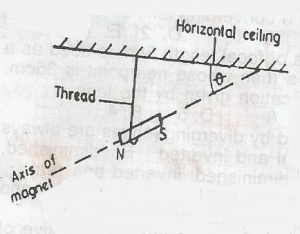
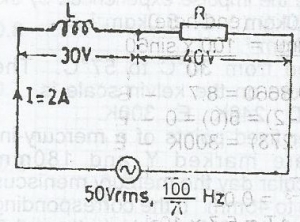
Question 1
which of the following pairs of physical quantities comprises vectors?
Objective
Practice each question, then open it to see the full details.
(a) Explain the term uniform acceleration
(b)(i) Sketch and describe the velocity-time graph for the motion of a ball from the time it is projected vertically upwards until it returns to the point of projection.
(ii) Neglecting air resistance and using ycur sketch, explain how the acceleration of free fall due to gravity g, and the maximum height attained when the ball is projected vertically upwards can be determined.
(c) A stone is projected vertically upwards with a velocity of 20ms\(^{-1}\). Two seconds later, a second stone is similarly projected with the same velocity. When the two stones meet, the second one is rising at a velocity of 10ms\(^{-1}\). Neglecting air resistance, calculate the:
(i) length of time the second stone is in motion before they meet,
(ii) velocity of the first stone when they meet (Take g as 10ms\(^{-2}\))
(a) Distinguish between heat and temperature.
(b) State two physical properties of substances which may be used to measure temperature.
(c) State two reasons why mercury is preferred to alcohol as a thermometric liquid.
(d)(i) Describe how a mercury-in-glass thermometer is calibrated.
(ii) State two precautions necessary to ensure an accurate result.
(e) Explain how land and sea breezes occur.
(a)(i) Describe, with the aid of a circuit diagram, an experiment to measure the resistance of a wire given an ammeter of low resistance, a battery, a key, a rheostat, va high-resistance voltmeter and some connecting wires.
(ii) State two precautions necessary to obtain an accurate result.
(b) Using the experimental result and any necessary measurements, explain how the resistivity of the wire may be determined.
(c) Two cells, each of e.m.f. 2V and internal resistance 0.552, are connected in series. They are made to supply current to a combination of three resistors, one of resistance 20 connected in series to a parallel combination of two other resistors each of resistance 3Q. Draw the circuit diagram and calculate the:
(i) current in the circuit
(ii) potential difference across the parallel combination of the resistors
(iii) lost volts of the battery.
(a) Explain the term photoelectric effect.
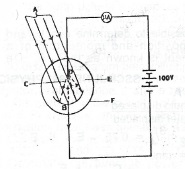
(b)
The diagram above represents a photocell with its associated electric circuit. Identify each of the physical quantities
represented by the letters A, B, C, D, E and F
(c) What factor determines the: (i) current produced by the photocell
(ii) maximum kinetic energy of the photoelectrons?
(d) State one similarity and one difference between photoemission and evaporation
(e) Name two methods by which a beam of free electrons may be produced other than photoemission
(f) State two applications of photoelectric effect.
(g) A light wavelength 5.0 x 10\(^{-7}\) m is incident on metal resulting in photoemission of electrons. If the work function of the metal is 3.04 x 10\(^{-19}\)J, calculate the:
(i) frequency of the light
(ii) energy of the incident photon,
(iii) maximum kinetic energy of the photoelectrons (Speed of light = 3.00 x 10⁸ms\(^{-1}\); Planck's constant = 6.6 x 10\(^{-34}\)Js).
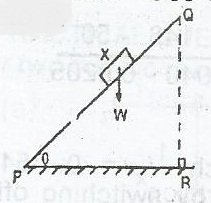
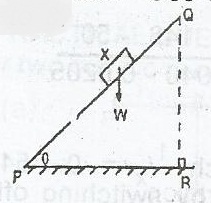
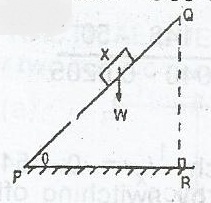
a pilot records the atmospheric pressure outside his plane as 63cm of Hg while a ground observer records a reading of 75cm of Hg with his barometer. Assuming that the density of air is constant, calculate the height of the plane above the ground. (take the relative densities of air and mecury as 0.00136 and 13.6 respectively)