WAEC Physics 2015 Past Questions

Practice each question, then open it to see the full details.

Question 8

(a) (i) Define uniform acceleration.

(ii) Write an equation that relates linear velocity, angular velocity and radius
of path in circular motion.

(b) Two forces 30 N and 40 N act at right angles to each other. Determine by scale drawing, the magnitude and direction of the resultant force,.using a scale of 1 cm to 5 N.

(c) Explain why ships are usually refilled with sand and water after they have been emptied of their cargo.

(d) A crate of drinks of mass 20 kg is placed on a plane inclined at 30° to the horizontal. If the crate slides down with a constant speed, calculate the:

(i) co-efficient of kinetic friction;

(ii) magnitude of the frictional force acting on the crate. [ g = 10 ms\(^{-2}\)]

Theory
Question 9

(a) Define specific latent heat of vaporization.

(b) (i) What are renewable energy sources?

(ii) List four renewable energy sources.

(c) Explain why tomatoes keep longer when kept in a moist jute bag in a clay pot.

(d) A box has a volume of 0.28 m\(^3\) and is 70% filled with iron fillings at 25°C. Calculate the:

(i) total mass of the iron fillings;

(ii) energy required to melt 10% of the iron fillings. [Density of iron = 8.00 x 10\(^3\) kgm\(^{-3}\); specific latent heat of fusion of iron = 1.38 x 10\(^5\) Jkg\(^{-1}\), specific heat capacity of iron = 460 Jkg\(^{-1}\) k\(^{-1}\), melting point of iron = 1500°C] 10.


Theory
Question 10

(a)(i) what is resonance?

(ii) State two eXwilples of resonance.

(iii) Differentiate between loudness and intensity of sound.


(b) When a ray is refracted through a rectangular glass prism, which of the following properties of the ray will change? Wavelength, frequency and speed.

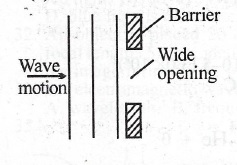
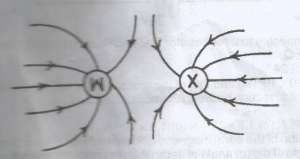
(c) 

(i) Copy the diagram above in your answer booklet.

(iii) On the copied diagram, sketch the pattern of the waves immediately after passing through the opening.

(d) A diverging lens of focal length 18.0 in is used to view a shark that is 90.0 in away from the lens. If the image formed is 1.0 m long, calculate the:

(i) image distance;

(ii) length of the shark.  


Sub-part image
Theory
Question 11

(a) Define:(i) the coulomb; (ii) resistance.

(b) State the three effects of an electric current.

(c) State the standard international colour convention for the insulating material covering the following electrical wires in a three-pin plug: (i) live; (ii) neutral; (iii) earth.

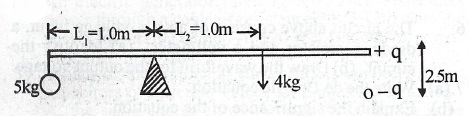
(d) 
A water melon of mass 5.0 kg is suspended on a uniform rod of mass 4.0 kg and 4.0 in long as illustrated in the diagram above. If the rod is in equilibrium by the action of the force between the charges +q and -q, calculate the:

(i) anti-clockwise moment;
(ii) value of q. [ g = 10 ms\(^{-2}\)]

Sub-part image
Theory
Question 12

 (a) Define nucleon number

(b) A radioactive isotope of Americium (Am —241) decays into a nucleus of Neptunium (Np — 237) and an alpha (\(\alpha\)) particle as shown in the nuclear equation below. \(^{241}_{95}Am\) \(\to\) \(^{237}_{c} + ^b_a \alpha\)

(i) State the number of neutrons in the nucleus of Americium — 241.

(ii) Determine the values of a,b and c.

(c)(i) Why are y-rays not deflected by electromagnetic field?

(ii) State two properties of gamma rays that make them suitable for sterilizing medical equipment.

(d) A sample of radioactive substance was found to be left with h of its initial count rate after 110 years. Calculate its decay constant.

Theory