Question 1
If a solid has a low melting point and dissolves readily in benzene, it would probably
Objective
Practice each question, then open it to see the full details.
(a) State three reasons why air is classified as a mixture.
(b) List two methods that can be used to separate a mixture of iodine crystals and iron filings.
What name is given to each of the following? The
(a) irregular random movement of smoke particles in air.
(b) existence of an element in various forms in the same physical-state
(c) disintegration of atomic nuclei, accompanied with radiation emission.
(d) conversion of a solid difitrunto vapour without melting.
(a)(i) Explain the term pH
(ii) If sodium hydroxide solution were added to a solution of a strong acid, what would happen to the pH of the solution?
(b) Give one example of each of the following:
(i) acidic oxide
(ii) acid salt.
(a)(i) Sketch a graph to illustrate Charles' law.
(ii) A gas occupies 500 cm\(^{ 3}\) at 2TC. calculate its volume at 40°C constant pressure.
(b) List two gases that are used as refrigerant
(a) State the type of reaction involved in the conversion of:
(i) proteins.to amino acids:
(ii) ethanol to ethene;
(iii) benzene to bromobenzene
(b) Write an equation to show that ethene reasts with hydrogen in the presence of finely divided nickel.
(a) Name the device used for producing an electric current from a chemical
(b) Copy and complete the table below.
|
Electrolyte |
Product at the anode (carbon) |
Product at the cathode (carbon) |
|
Dilute NaCl\(_{(aq)}\) Concentrated NaCI\(_{(aq)}\) |
(a) Mention the chemical substance manufactured starting from each of the foirownc sets of materials:
(i) sugar and yeast;
(ii) ammonia, air and water;
(iii) vegetable oil and caustic alkali.
(b) State one air pollutant generated during the manufacture of fertilizers.
(a) What is the change in oxidation state of chromium in the reaction represented by the following equation?
3SO\(_2\) + Cr\(_2\)O\(^2_{-7}\) + 2H\(^+\) -> 3SO\(_4^{2-}\) + 2Cr\(^{3+}\) + H\(_2\)O
(b) Use the half equations given below to deduce the equation for the reaction between iron(II) ions and heptaoxodichromate (VI) ions in acidic solution.
Fe\(^{2+}\) --> Fe\(^{3+}\) + e\(^-\)
Cr\(_2\)O\(^{2-}_7\) + 14H\(^+\) + 6e\(^-\) ----> 2Cr\(^{3+}\) + 7H\(_2\)O.
(a) Mention one process apart from respiration, which increases the amount of carbon (IV) oxide in the atmosphere.
(b)(i) State one use of sodium hydrogentrioxocarbonate (IV).
(ii) Write an equation to show the action of heat on sodium hydrogentrioxocarbonate(IV).
(a) List two differences between solids and liquids.
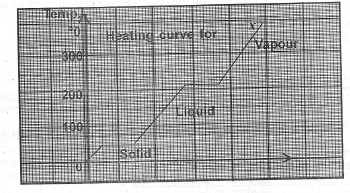
(b) The graph below is the heating curve for a solid X. Use the graph to answer Questions (i) — (iii) below.
(i) What is the melting point of X?
(ii) If the vapour of X is cooled, at what temperature will it start to condense?
(iii) (I) As X is heated, state what happens to the: I. frequency of collision of molecules of X;
(II) value of the entropy of the system.
(a)(i) List the three types of particles present in atoms.
(ii) name the element which does not contain all the three particles in its atom. Mention the particle that is not present.
(b) Give the reason why:
(i) the relative atomic masses of some elements are not whole number;
(ii) relative atomic masses are used instead of the actual masses of atoms in grams;
(iii) metals are good conductors of electricity.
(c)(i) Name the type of bond present in the oxonium ion,
(ii) State one effect of the existence of intermolecular hydrogen bonding on the physical properties of ethanol.
(d)(i) Explain what is meant by water of crystallization.
(ii) When 5.0g of a compound Y was heated to constant mass, 1.8g of water vapour was given off. Determine the number of molecules of water of crystallization in one molecule of Y, given that the molar mass of its anhydrous form is 160g. [H = 1, 0 = 16]
(a)(i) What is isomerism?
(ii) Name the alkanol that is isomeric with methoxymethane (CH\(_3\)OCH\(_3\)).
(b)(i) Outline the laboratory:preparation of ethylethanoate. (Diagrams not required)
(ii) Write the structural formula of ethylethancqte
(iii) State two physical properties of ethylethanoate.
(c) When gas oil which consists of larger hydrocarbons was subjected to high temperature and pressure, the following reaction occurred.
C\(_{17}\)H\(_{36(l)}\) \(\to\) 3C\(_2\)H\(_{4(g)}\) + C\(_3\)H\(_{6(g)}\) + Q\(_{(l)}\)
(i) What name is given to the process indicated above?
(ii) State the importance of the process to the petroleum industry.
(iii) Find the formula of the product which Q represents in the equation above.
(iv) Mention one type of chemical industry that utilizes ethene as raw material.
(d) Consider the following compounds: CH\(_3\) — (CH\(_2\))\(_2\) —CH\(_3\); C\(_6\)H\(_5\) —CH = CH\(_2\); CH=C — CH\(_3\). State which of them:
(i) is used as a domestic fuel;
(ii) is an aromatic compound,
(iii) participates in such situation but not addition reactions;
(iv) would react with two moles of hydrogen per mole.
(a) List three properties of a system that is in a state of chemical equilibrium.
(b) Consider reaction represented by the following equation: 3H\(_{2(g)}\) + N\(_{2(g)}\) \(\rightleftharpoons\) 2NH\(_{3(g)}\); H = 92KJ
(i) Explain the effect of increasing the temperature of the reaction on the yield of ammonia
(ii) Uses of energy profile diagram to illustrate the effect of a positive catalyst on the rate of either the forward reaction or the reverse reaction.
(c) In the extraction of aluminium from bauxite:
(i) outline the procedure used for purifying the ore;
(ii) write equation for the reaction at each electrode, during the electrolysis of the pure alumina;
(iii) state the function of molten cryolite in the electrolytic cell for the extraction.
(a)(i) Explain what is meant by saturated solution
(ii) Describe in outline, a suitable procedure for preparing a saturated solution of sodium trioxonitrate(V) at 30°C.
(ii) State two techniques that can be used to recover crystals of sodium trioxonitrate(V) from its saturated solution.
(b) 1.0dm\(^3\) of an aqueous solution at 90°C contains 404g of potassium trioxonitrate(V) and 245g of potassium trioxochlorate (V).
(i) Determine which of the two salts will separate out when the solution is cooled to 60°C. N = 14. O = 16, CI = 35.5, K = 39; Solubility of KNO\(_3\) in water at 60\(^o\)C = 5.14 mol.dm\(^{-3}\), Solubility of KCIO\(_3\) in water at 60°C = 1.61 mol.dm\(^{-3}\)
(ii) Calculate the mass of salt that will separate out at 60°C
(c)(i) List two salts which cause hardness of water.
(ii) Explain why temporary hardness of water result in the furring of kettle.